
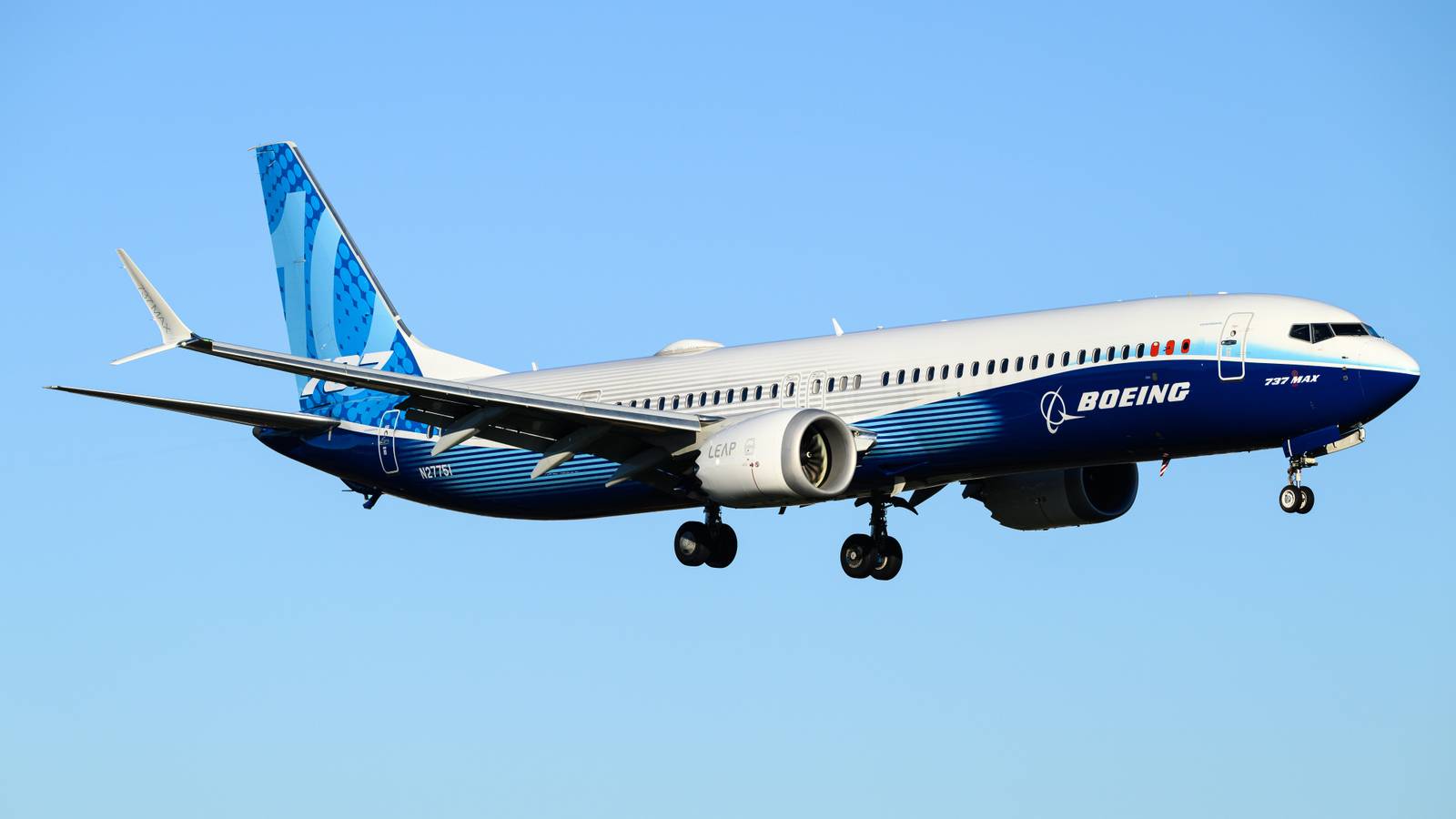
As with all other modern narrowbody aircraft, the Boeing 737 MAX offers a taxi allowance between its Maximum Takeoff Weight and its Maximum Taxi Weight. This is related to ensuring the aircraft can actually take off with its maximum fuel capacity (by weight) in edge cases, as well as being related to safety margins. Since the type first entered service in the 1960s, the margin on the 737 has been decreasing over time and reached a new record low in October 2026, when the FAA certified the MAX 10. The taxi allowance is not particularly important, and when it comes to adding fuel capacity, it is only relevant in a small minority of cases. The vast majority of missions do not require Boeing 737s to operate at their maximum fuel capacities. That said, to some extent, the declining margins can be seen as another example of upgraded generations of 737s being constrained by an aging 1960s design. Here is what to know about why the 737 can be loaded heavier at pushback than at takeoff. Taxiing Burns Approximately 1% Of Pre-Takeoff Fuel Credit: Markus Mainka l Shutterstock Boeing has engineered its popular 737 MAX to support a ground weight higher than its Maximum Takeoff Weight mostly for operational flexibility, structural safety margins, and regulatory certification. For the purposes of this article's headline, Boeing certifies a higher Maximum Taxi Weight of around 500 lbs (around 227 kg) over its MTOW. This allows airlines to load extra 'taxi fuel' at the gate without the need to sacrifice passengers or cargo. While only a small percentage of its overall fuel volume and aircraft weight, airliners do consume a measurable amount of fuel before they even take off. The APU, starting the engines, and ground taxiing all consume fuel and burn off the aircraft's excess weight before it commences its takeoff roll. A Boeing MAX or A320neo typically consumes 300 to 650 lb (135 to 295 kg) of fuel on a normal departure between refueling and the takeoff roll. During periods of heavy congestion, ground holds, or winter de-icing, this can be as much as 1,000+ lbs (450+ kg). A MAX 8 has a total fuel capacity of 46,063 lb (20,894 kg) of fuel. The pre-takeoff consumption represents around 0.7% to 1.4% of its total fuel volume. That said, they are typically not fully fueled. In these cases, the amount of onboard fuel burned before the take-off roll can be as much as 2% to 4% for a typical two- to three-hour flight. Safety Margins & MTOW Certification Flexibility Credit: lorenzatx l Shutterstock As a general rule, aircraft are routinely built to be able to be considerably more capable than what their sticker certifications suggest. To meet the strict FAA and EASA airworthiness standards, aircraft airframes are required to be built with substantial structural and aerodynamic safety margins. Aircraft are designed to survive hard landings, strong gusts, and minimum climb gradients during a single-engine failure. Yet another reason is that Boeing (and other airplane manufacturers) often design aircraft with greater structural capability than required for their standard operating configuration. This allows their aircraft to be certified and sold with different maximum take-off weight (MTOW) variants. For example, the A321neo family comes with multiple certified weight variants including 89, 90.5, 93.5, and 97 (A321LR) tonnes. The heavier A321XLR is more extensively modified. This means that an airline can purchase an A321neo certified at 89 tonnes when the same base aircraft family offers higher certified weight variants. The main advantage of operating an 89-tonne certified aircraft is to reduce weight-based airport and air navigation fees. It doesn't necessarily have a lower empty weight or dry operating weight compared with a 93.5-tonne aircraft. Preserved The 737 Next Generation's Taxi Allowance Credit: MH.Chuang l Shutterstock The Boeing 737 MAX's taxi allowance has actually decreased relative to its predecessor, the Boeing 737 Next Generation (NG). The MAX family inherited the 737NG certification baseline. Boeing opted to keep the 500 lb taxi allowance that the older NG came with and chose not to recertify it for a larger ground-maneuvering margin. In fact, Boeing has retained the 500 lb margin across all its generations and variants of the 737 from the 1960s 737-100 Original to the new MAX 10. However, the MTOW of these aircraft has not remained static. Over time, the MTOW has grown, squeezing the margin more and more. Aircraft family Absolute taxi margin Percentage above MTOW (per Boeing) Airbus A220 1,000 lbs (454 kg) 0.71% (A220-100), 0.68% (A220-300) COMAC C919 882 lbs (400 kg) 0.53% (STD) Airbus A320neo 882 lbs (400 kg) 0.53% (A320neo HGW), 0.40% (A321neo) Boeing 737 Original 500 lbs (227 kg) 0.39% (737-200) Boeing 737 Classic 500 lbs (227 kg) 0.36% (737-300) Boeing 737NG 500 lbs (227 kg) 0.29% (737-800) Boeing 737 MAX 500 lbs (227 kg) 0.28% (MAX 7), 0.27% (MAX 8), 0.26% (MAX 9), 0.25% (MAX 10) The original 737-100 was built with a standard MTOW of 97,800 lb (44,361 kg) and an MTW (ramp) of 98,300 lb (44,588 kg). This was a margin of around 0.51% in the initially certified version (around 0.39% with the more popular 737-200). It is not possible to list all the subvariants of each generation here, but MTOW went up, and the margin went down. The taxi allowance of 500 lbs remained constant. The 737-400 Classic had a basic MTOW of 138,500 lb (62,823 kg) and a ramp weight of 139,000 lb (63,049 kg), or around 0.36%. The popular 737-800 (NG) came with an MTOW of 155,500 lb (70,534 kg) and an MTW (ramp) of 156,000 lb (70,760 kg), or a margin of 0.32%. Variation Across The MAX Fleet Credit: Ian Dewar Photography l Shutterstock The MAX family comes with four basic variants and one subvariant with differing MTOWs, while the taxi allowance remains constant. All four MAX variants are (finally) all certified. The shortened MAX 7 (also includes the BBJ MAX 7) has an MTOW of 177,000 lb (80,286 kg) and a ramp weight of 177,500 lb (80,513 kg). Being the lightest MAX variant, it offers a taxi allowance margin of 28%, the highest of the family. Next is the popular MAX 8 with a baseline MTOW of 181,200 lb (82,191 kg) and ramp weight of 181,700 lb (82,418 kg). Here, the margin remains at 0.28% due to rounding. The heavier BBJ MAX 8 falls to 0.27%. The high-density 737-8-200 (popular with low-cost airlines like Ryanair) has the same MTOW and ramp weights as the MAX 8. Unlike the A321XLR, it has more doors as the main modification, not heavier tanks. The margin remains 0.28%. The stretched MAX 9 is certified for an MTOW of 194,700 lb (88,314 kg) and a ramp weight of 195,200 lb (88,541 kg), causing the margin to fall to 0.26%. Finally, the extra-stretched MAX 10 pushes the margin to the family's lowest at just 0.25%. Its MTOW is 197,900 lb (89,766 kg) and ramp weight is 198,400 lb (89,992 kg), making it the heaviest. The Boeing MAX's MTOW Margin Is Comparatively Small Credit: Rudzenkas l Shutterstock It would be wrong to think of the MAX as being special with the weight margin or Boeing being some sort of over-engineering designer. Almost the opposite is true of modern narrowbody aircraft. With a taxi allowance of 500 lb (227 kg), Boeing gives a margin of around 0.27% above the MTOW. The main rival, the A320neo, has a taxi allowance of 882 lbs (400 kg) or a margin of around 0.51%. The margin is a little smaller on the A321neo, at around 0.43%, but still significantly more than the MAX 8 and MAX 9. These margins are also greater on the Airbus A220 and Embraer E-Jet E2. The A220 offers a much greater taxi allowance of 1,000 lbs (454 kg) despite being a much smaller aircraft. This is a margin of around 0.68%. The E-Jet E2 has a smaller absolute taxi allowance, 441 lbs (200 kg). However, these regional Embraer aircraft are also much smaller, and so the margin above MTOW is 0.33%, placing it ahead of the MAX. Meanwhile, the MAX's erstwhile Chinese competitor, the COMAC C919, offers an 882 lb (400 kg) allowance and a margin of around 0.53%. The pre-sanctioned Russian MC-21 was to offer an allowance of 441 lbs (200 kg) or 0.25%. This made the MC-21 similar to the MAX. Replacements Are On The Way Credit: Pavel1964 l Shutterstock Continuously updating the 1960s-era Boeing 737 has plenty of issues. One of the biggest recurring issues is its short landing gear, making it difficult to accommodate modern large-diameter engines under the wings. This led to the infamous MCAS software and the MAX crashes in 2017 and 2018. Other issues include the comparatively heavy aluminum airframe and narrow cabin (making it extra squishy in economy). The shrinking taxi margin is regarded as a minor operational nuisance on edge-case missions, rather than a major problem. Both Airbus and Boeing are starting work on their clean-sheet narrowbody replacements expected to debut in the mid-to-late 2030s. Efforts are in their early stages, and few details have been released; Boeing is considered behind Airbus in the design and development cycle. These aircraft are targeting a 20–25% lower fuel burn. They are expected to make use of thermoplastic composites, next-generation engines, perhaps folding wingtips, and other improvements. It is reasonable to assume they will be designed with room for future growth. It would also be reasonable to assume Boeing would take the opportunity to boost the taxi allowance margin to around 0.5% to 0.7%, in line with industry norms.
Why Boeing Built The 737 MAX With The Ability To Take Off Overweight, Even Though It Can't Legally & Operationally
Full Article
Original Source
Read the full article at Simpleflying →KhanList aggregates and links to publicly available news content. We do not host full articles from third-party sources. Always verify important information with original sources.