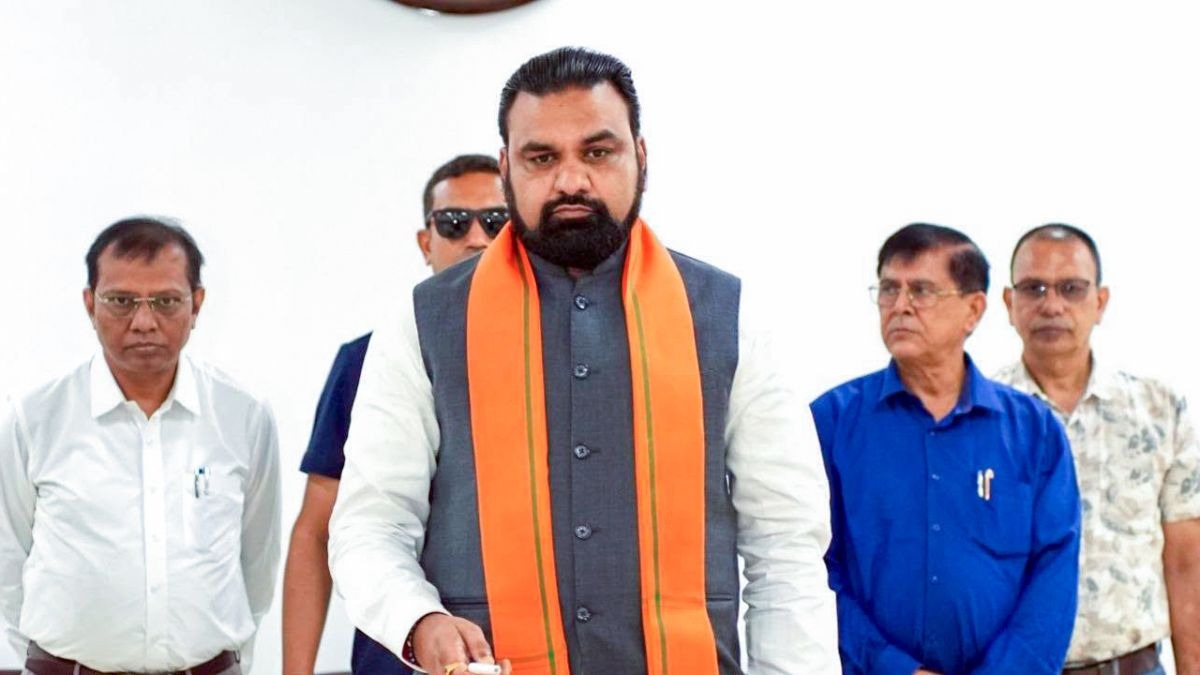
The victorious Prashant Kishor has shown that a coalition of anti-BJP voters and disenchanted NDA supporters is electorally forgeable in BiharThe Bankipur by-election that Prashant Kishor won handsomely to end the BJP’s decades-long dominance on the seat was never merely about one urban constituency in Patna. It was also the first political test of chief minister Samrat Choudhary, who took charge of Bihar in April.More significantly, it marked the BJP's first electoral examination after taking control of the Bihar government in its own right, bringing to an end 36 years of state politics defined by the ‘social justice’ leadership of Lalu Prasad Yadav and Nitish Kumar.The BJP's decisive defeat in a constituency it had held for nearly three decades—and one vacated by its own national president Nitin Nabin—has, therefore, acquired significance far beyond the poll arithmetic. It is an unmistakable caution bell for the new chief minister and a reminder that inheriting power is one thing and consolidating political legitimacy is quite another and time-taking.For years, the National Democratic Alliance (NDA) in Bihar enjoyed a structural electoral advantage. A substantial section of the voters—particularly among the urban middle class, upper castes and Extremely Backward Classes (EBCs)—supported the NDA not merely because they endorsed its governance but because they feared the return of the Rashtriya Janata Dal (RJD). That anti-RJD sentiment acted as the coalition's political insurance. Even dissatisfied voters remained within the NDA fold because they saw no acceptable alternative. Kishor's campaign in Bankipur dismantled that advantage. By repeatedly assuring voters that a Jan Suraaj Party victory here would neither topple the NDA government nor facilitate the RJD’s return, he lowered the psychological cost of voting against the BJP. His argument was simple: the by-election was not about changing the government but about asking the BJP to provide Bihar with better leadership.In doing so, Kishor persuaded two voter blocs that rarely move together—traditional anti-BJP voters who increasingly viewed the Jan Suraaj Party rather than the RJD as the principal challenger, and sections of the BJP's support base that wanted to register dissatisfaction without strengthening the RJD. That shift is potentially more dangerous for the NDA than conventional anti-incumbency because it strikes at the very foundation of the coalition's electoral arithmetic.Kishor’s victory by over 19,000 votes is particularly noteworthy for chief minister Choudhary because it risks being interpreted as a referendum on his leadership. Unlike the 2025 assembly election, in which he was not projected as the chief ministerial face, Bankipur became the first contest in which voters judged Choudhary as the head of the Bihar government.The rejection was emphatic. When a ruling party loses a constituency vacated by its own national president despite deploying the chief minister, senior ministers and an array of star campaigners, the verdict cannot be dismissed as a local aberration. It reflects a deeper erosion of political goodwill.That erosion is also linked to the question of leadership. Four months into office, Choudhary is still looking to emerge from the long shadow of Nitish. While he has announced an ambitious governance agenda and projected an image of decisiveness, he is yet to acquire the political capital and personal credibility that Nitish accumulated over nearly two decades.Nitish's greatest asset was not merely his schemes but the widespread perception that he remained firmly in control of the administration. Even his critics often acknowledged that the system ultimately answered to him. That perception has yet to crystallise around Choudhary.Despite repeated promises of administrative transformation, many voters continue to encounter bureaucratic inertia, delayed decision-making and official indifference. The challenge for Choudahry is not a lack of intent but lack of visible outcomes. Increasingly, there is a perception that while political authority has changed at the top, the bureaucracy continues to function much as before. The government has announced new initiatives, but implementation seems to lag, reinforcing the impression that the administration remains driven more by bureaucratic routine than political urgency.Adding to the perception challenge have been a series of law-and-order controversies that have diluted the momentum generated by Choudhary's early anti-crime campaign. Soon after taking office, his strong rhetoric against criminals and the promise to restore the fear of law had raised expectations of a more assertive administration. However, subsequent incidents—including the controversial police encounter killing of Bharat Tiwari in Bhojpur and the recent alleged use of the AK-47 assault rifle by the police in Siwan while firing at protesters—have complicated that narrative.While the government has defended the police, the episodes have contributed to a perception in some quarters that the chief minister is yet to establish the degree of command over the administrative and policing apparatus that the office demands.Whether justified or not, such incidents have also allowed the Opposition to argue that the government's promises of a decisive administration have yet to translate into visible control on the ground. For a government barely four months old, perception can become reality remarkably quickly.The absence of Nitish from day-to-day politics has made that challenge even more acute. For years, his personal credibility acted as a stabilising force within the NDA, helping absorb public dissatisfaction even when governance faltered. Since stepping aside, Nitish has maintained a notably low political profile. So that protective shield has disappeared. The BJP is now being judged on its own leadership, its own governance and its own administrative capacity.The Bankipur verdict should, therefore, concern not only the BJP but the government it leads. It indicates that sections of the electorate already expect faster delivery, stronger political direction and more visible administrative control than witnessed so far. More importantly, it demonstrates that the NDA can no longer assume that dissatisfied supporters will stick with it simply because they are unwilling to vote for the RJD.That is perhaps the most enduring political lesson from Bankipur. The BJP's biggest electoral challenge may next come from a challenger capable of attracting both anti-BJP voters and disenchanted NDA supporters simultaneously. Kishor has shown that such a coalition is electorally possible. Whether he can replicate it across Bihar remains uncertain. But if Bankipur is an early warning, is the BJP-led government in Bihar waking up to it?Subscribe to India Today Magazine- EndsPublished By: Akshita JollyPublished On: Aug 5, 2026 17:51 IST
Why BJP's Bankipur defeat is an early warning for Samrat Choudhary
Full Article
Original Source
Read the full article at Indiatoday →KhanList aggregates and links to publicly available news content. We do not host full articles from third-party sources. Always verify important information with original sources.