
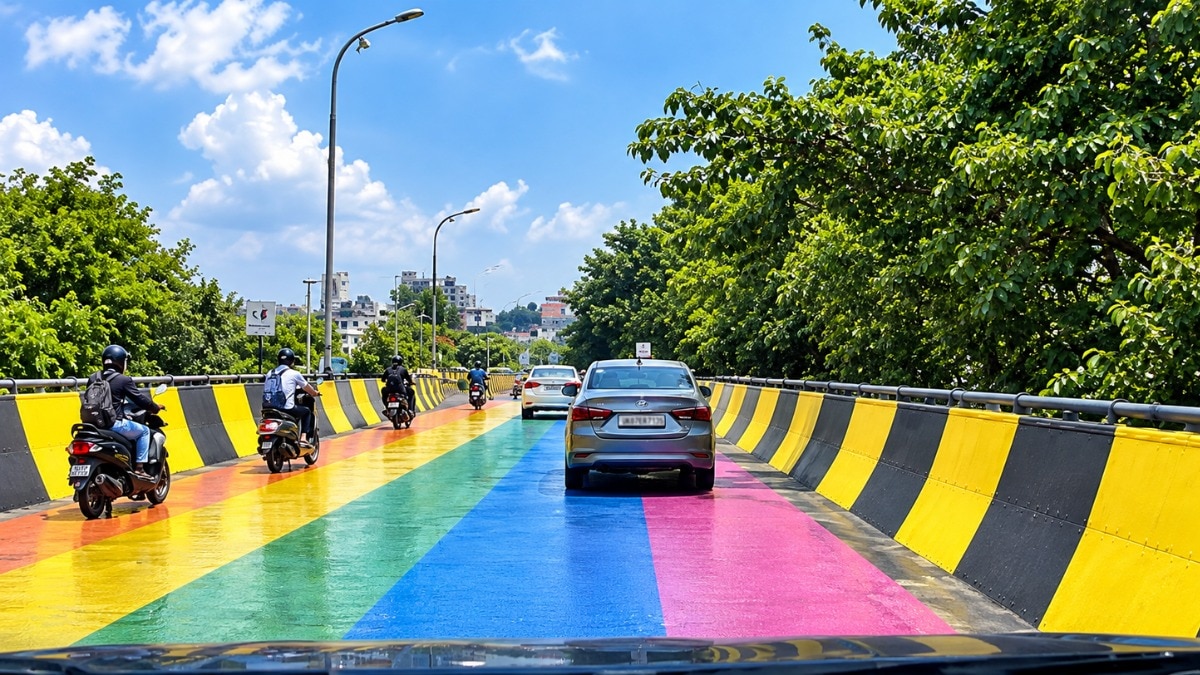
Kolkata’s rainbow-coloured roads, painted as part of a beautification drive ahead of Durga Puja, have triggered a road-safety controversy after videos purportedly showing motorcycles skidding on a rain-soaked flyover went viral on social media. The West Bengal government has asked the police to examine the incident, an official said. The chief minister, however, expressed scepticism over suggestions that the paint could have caused the accidents, saying he had no information to establish such a link.“Do accidents happen because of painting? How many flyovers have witnessed accidents?” CM Suvendu Adhikari asked reporters, visibly irritated when questioned about the incident. He said he would not comment further without knowing the full details.The controversy comes as Kolkata undergoes a colourful makeover ahead of the festive season, with stretches of roads, flyovers and bridges painted in bright hues. While the initiative has been presented as an effort to beautify the city and showcase its cultural heritage, complaints from motorcyclists about slipping tyres and glare from the freshly painted surfaces have raised questions about the choice of materials and their suitability for roads used by motor vehicles.A video posted on Facebook by a user named Sayandeep Lahiri went viral on Wednesday. Accompanied by the sarcastic caption, “Who knows why so many people skidded on such a beautiful road?”, the footage, apparently recorded on a vehicle’s dashboard camera, shows three motorcyclists falling in succession on the rain-soaked Chingrighata flyover. The authenticity of the viral footage has not been independently verified. The incident has fuelled allegations that the painted surface becomes slippery when wet. Motorcyclists have also complained that the bright colours cause glare in sunlight, potentially affecting visibility. Speed brakes were later installed at some of these bridges, while the paint was removed elsewhere.Urban development and municipal affairs minister Agnimitra Paul, who is overseeing the beautification initiative, said the police and administration were investigating the complaints. “One motorcycle fell. It hit another motorcycle in front of it. We do not know why it fell. The matter has been brought to the notice of the police and administration,” Paul said.She maintained that the paints used on the roads were anti-skid and should not, by themselves, cause vehicles to lose traction. Nevertheless, she said the government would examine the circumstances surrounding the reported accidents. The chief minister had directed the authorities to look into the complaints, she added.Paul acknowledged a separate concern over the intensity of the colours. “I have heard that the colours are dazzling people’s eyes. We will look into that. If people are facing difficulties, alternative arrangements will be made,” she said.The minister said the initiative had received a positive response from residents ahead of Durga Puja, the first major festive season since the BJP came to power in West Bengal.Safety concerns over glossy paintsThe Gariahat flyover in south Kolkata, the Chingrighata flyover in the east and a stretch of Red Road in central Kolkata are among the locations where road surfaces have been painted in rainbow colours. Traditional Bengali decorative art, or alpana, has also been drawn near the Park Circus seven-point crossing and the Gariahat flyover as part of the effort to highlight the city’s cultural heritage.Paul said the work had been undertaken with safety guidelines in mind and that the paints would wear off within a few months. She also rejected suggestions that the rainbow colours were intended to represent the LGBTQ+ community or any particular social group. “These rainbow colours have not been used on Kolkata’s roads with any particular community in mind. We have undertaken this initiative to highlight the city’s heritage, harmony and the spirit of togetherness,” she said, adding that the work had not been funded through taxpayers’ money but by companies using their corporate social responsibility (CSR) funds.However, environmentalists and opposition parties have questioned whether the materials used are appropriate for carriageways, particularly on stretches frequented by two-wheelers. Environmentalist Somendra Mohan Ghosh said he had written to both Paul and Adhikari to raise concerns over the use of glossy paints on motorable roads. “I am worried; glossy oil paint on a motorable road is dangerous and should not be allowed. You can never paint the whole wheel-track area with ordinary house paint,” Ghosh said.He said glossy surfaces could become particularly hazardous when wet, as water, oil or diesel could significantly reduce the friction between tyres and the road. “Gloss forms a smooth film. When wet with water, oil or diesel, the friction coefficient drops to a very low level. Two-wheelers and cars will skid,” he said. The coefficient of friction measures the resistance between a vehicle’s tyres and the road surface. A reduction in friction can compromise a vehicle’s grip, particularly during braking or manoeuvring on a wet surface.Ghosh pointed to the Indian Roads Congress’s IRC:35-2015, the Code of Practice for Road Markings, as the relevant framework for road markings in India. He argued that conventional glossy or oil-based paints should not be indiscriminately applied to surfaces intended for vehicular traffic. Road-marking materials, including suitable thermoplastic compounds, offer advantages in terms of technical performance, durability and reflectivity, he said, adding that specific thermoplastic materials are recommended for markings on national highways and major roads.Ghosh also warned that painting roads could conceal potholes and other surface defects, increasing risks for commuters. Peeling paint, he added, could eventually leave the roads looking worse rather than improving their appearance.Environmental and social activist Naba Dutta questioned whether the rationale behind painting roads in bright colours had been adequately explained and whether the impact on road users had been sufficiently assessed.Opposition demands accountabilityThe incident has also drawn criticism from the opposition Congress, the Mamata Banerjee-led All India Trinamool Congress (AITC) faction and the CPI(M), which have questioned the safety implications of the beautification drive.“The freshly painted flyover has turned into a death trap, with bikes skidding and accidents occurring at the very first spell of rain,” the Mamata AITC said in a post on X, sharing video clips of the reported incidents and demanding accountability from Paul. “The people of Bengal deserve safe roads, not dangerous infrastructure.”State Congress general secretary Ashutosh Chatterjee wrote to Paul and Kolkata Municipal Corporation commissioner and administrator Smita Pandey, flagging potential road-safety hazards associated with painting carriageways with conventional paints. Chatterjee argued that glossy paints should not be used indiscriminately on surfaces meant for motor vehicles because they could reduce tyre grip and increase the risk of skidding.CPI(M) leader Partha Pratim Biswas also criticised the decision to paint flyover roads. “This is against road safety rules and violates the principles of road construction by using shiny glossy paint particles when it endangers the lives of motorists and bikers, particularly during rain,” he said.The government’s investigation will now have to establish whether the reported falls were caused by the painted surfaces or other factors. Until then, the viral footage has left the administration facing questions over whether the drive to give Kolkata a festive makeover adequately accounted for the safety of those using its roads.Chief minister announces more Durga Pujas, tea garden bonusSeparately, Adhikari announced that the number of community-organised Durga Pujas in West Bengal had crossed 58,000 this year, with another 800 clubs receiving permission to organise celebrations.The chief minister had earlier put the number of Pujas at 57,400. Speaking at a press conference at Nabanna on Wednesday, he said another 800 clubs had approached the police for permission and had been granted approval, making them eligible for government assistance of Rs 1 lakh each. “Earlier, there were 45,000 Pujas. This year, there are more than 58,000. Thirteen thousand new Pujas,” Adhikari said. “Change is precisely this! This is for those who could not understand what the change had been.”The chief minister also announced a 20 per cent bonus for workers of closed tea gardens ahead of the festive season, contrasting the figure with the 16 per cent bonus announced by then chief minister Mamata Banerjee last year. “Last time, Mamata gave a 16 per cent bonus. We have given a 20 per cent bonus. Twenty per cent is the maximum. It does not go beyond that,” he said.Adhikari said 19,524 workers in tea gardens that had been closed since 2023 would receive an additional 50 kg of rice and Rs 5,000 each from the state government. The workers ordinarily receive 35 kg of rice, he said, adding that the additional rice and financial assistance would be provided as festive support. The money would be transferred directly to their bank accounts through the labour department. “A small effort by a government that cares for people,” he said.Adhikari also announced that Union Home Minister Amit Shah would visit West Bengal on October 17. He said Shah had visited Belur Math during the festive season in the past, and that invitations had been extended to the prime minister, the BJP’s national president and Union ministers to visit the state this year.Subscribe to India Today Magazine- Ends
Why bikes are skidding on Kolkata's rainbow roads
Full Article
Original Source
Read the full article at Indiatoday →KhanList aggregates and links to publicly available news content. We do not host full articles from third-party sources. Always verify important information with original sources.