
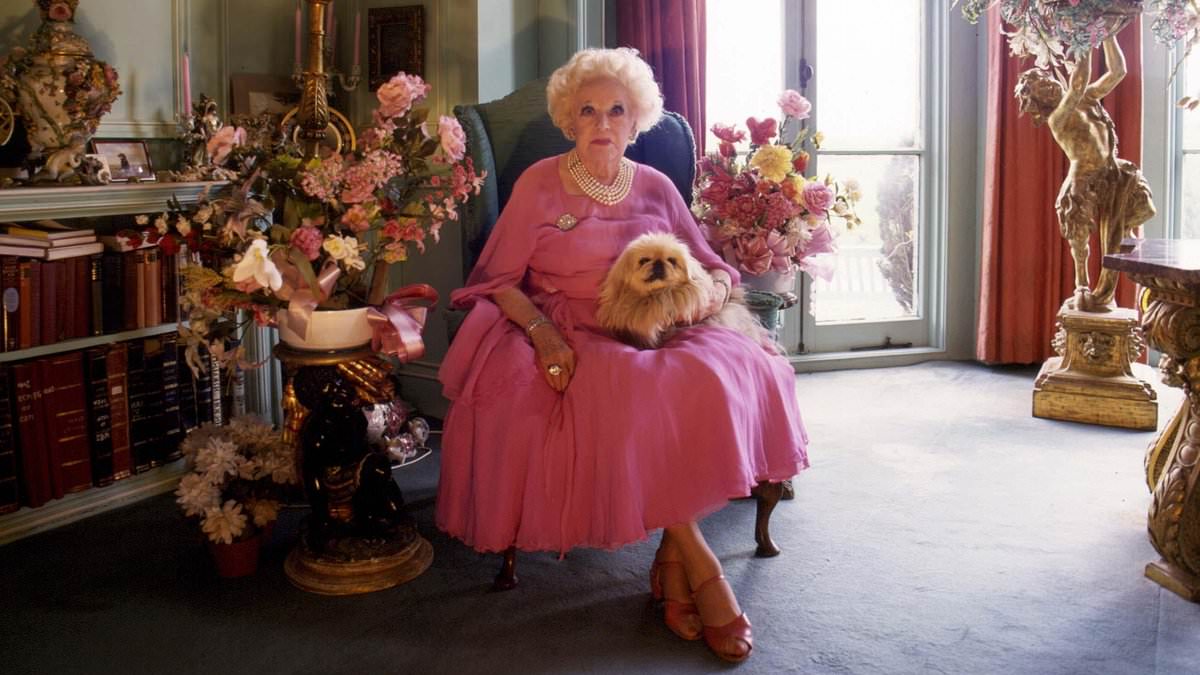
Wish you were here, Dame Barbara. And the eerie thing is that it feels like she is here, perhaps hiding behind a salmon pink chaise longue and about to appear in a puff of talcum powder, shouting 'Cooee, darling'.Because Camfield Place, near Hatfield, where Barbara Cartland lived for 50 extraordinary years, is exactly how it was when she died in 2000, aged 98.'Nothing should be moved in the house from the way I left it,' she wrote in a document, How To Open Camfield Place To The Public. 'Cars carrying the public will come in through the main gates… coaches can come in through the tradesmen's entrance.'It hasn't quite worked out like that but her two granddaughters, Tara and Iona McCorquodale, are keeping the flame alive - with guided tours, weddings and other social gatherings.At the same time, a new biography of Cartland by Matthew Sweet has just been published. In 2008, he wrote to Cartland's son, Ian McCorquodale, suggesting the idea of a biography and claiming to have the perfect qualifications to write it.'I have written a Doctor Who spin-off about alien bookworms who eat their way through the Cartland oeuvre and, consequently, express themselves in quotes from her work,' he said in the letter.To his credit, Mr McCorquodale, who died three years ago, gave his consent to this unusual pitch, because, one might surmise, he knew his mother was one of the most unusual women ever to have lived. Not exactly an alien but certainly someone who occupied a different planet from the rest of us.She wrote 723 books in her lifetime and set a Guinness World Record for the most novels published in a single year, when in 1976 she chalked up 23. Only Agatha Christie and Shakespeare surpass her 750 million sales. Dame Barbara in her Hertfordshire home in 1996. Humourist Arthur Marshall said she had 'the white and creamy look of an animated meringue Barbara believed women should not have sex before marriage but she said 'a man should certainly not be a virgin on his wedding night, you want one person who knows what he is doing'After she died, Mr McCorquo-dale discovered 151 books waiting to be published, all of which have been printed as part of the 'Pink Collection', as opposed to the original 'Eternal Collection'.But she never wrote a word. Instead, she went about her business by reclining on a cream sofa in the library, propped up by cushions. Then, while wearing a chiffon cocktail dress, offset by pearls, and cradling a fluffy Pekingese, she would dictate up to 8,000 words a day to a rota of five secretaries, who sat out of view of Barbara, lest they disturbed her concentration. They were under instructions not to speak or fidget and had to suppress a sneeze.Once her words had been taken down in Pitman shorthand, they were typed up by the secretaries and the manuscripts dispatched in Barbara's white Rolls Royce to her editor in London, with pink ribbons tied round them.The editor would make no changes and deposit the final proofs at Claridge's Hotel, where Barbara dined every Wednesday for 50 years. She was given her own table, with the linen colour coordinated to match whatever she was wearing. 'Women should wear pretty clothes and look like women. Why must they try to be men?' said Barbara, who was famous not just for her flamboyant dresses and hats but her false eyelashes and mascara. But not the usual kind of mascara.Rather, she was in the habit of using Meltonian black shoe cream (advertised as producing a 'mirror shine for a high gloss reflection'), which she applied with a toothbrush.The late TV critic Clive James described her eyes as looking 'like the corpses of two small crows that had crashed into a chalk cliff'. Humourist Arthur Marshall said she had 'the white and creamy look of an animated meringue'.None of this ridicule - or criticism that her books had flimsy, recycled plots about dashing heroes falling madly in love with demure virgins - bothered her in the slightest. Her fans around the world adored her.One loyal reader wrote to her, lamenting how she had been unable to have children. By return, Barbara dictated a letter back saying: 'Rubbish, you must keep wishing what you want.' Several months later, the woman wrote again, saying she was pregnant. Dame Barbara remained the architect of her life right up until her death - and even afterwards Dame Barbara's home in Hatfield in Hertfordshire. The house is exactly how it was when she died in 2000In modern parlance, Barbara was comfortable in her own skin, which, as it happens, is appropriate because she used to lift her collapsed skin up to her ears with Sellotape as a DIY face-lift in her later years.Barbara was not exactly to the manor born. Her father's family made some money via a Birmingham metalworks company but it went bust, after which her grandfather killed himself. Then, her father died in the First World War.She was devoted to her mother, Mary (known as Polly), who, as Barbara might have put it, came from a different social strata and was anxious that her daughter should marry up.Consequently, sporting dresses leant to her by her friend Norman Hartnell, who later became the Queen's couturier, Barbara was seen at all the right places - Royal Ascot, Goodwood, the Cowes Regatta on the Isle of Wight - and was presented at Buckingham Palace as a debutante in 1919.In London, she became one of the Bright Young Things, which meant attending endless parties. This made her well-placed to contribute snippets to newspaper gossip columns.At one point, she had her own such column in the Daily Express, owned by Lord Beaverbrook, whose diary shows that Barbara came to his suite almost daily at 5pm in the Hyde Park Hotel for some personal sub-editing.Barbara believed women should not have sex before marriage. Conversely, she said 'a man should certainly not be a virgin on his wedding night, you want one person who knows what he is doing'. She claimed to have received 49 proposals of marriage - before opting for Alexander McCorquodale (known as Sachie).It was a frightful marriage, which ended when Barbara found love letters in Sachie's wallet - and sued for divorce in 1936, only for Sachie to counter-sue, alleging that she was having an affair with his cousin Hugh McCorquodale, whom she married four years later. The Great Dictator: A Life of Barbara Cartland is published by Hodder & StoughtonSachie and Barbara's marriage had produced a daughter Raine, who went on to marry the 8th Earl Spencer, father of Diana, Princess of Wales, making Barbara her step-grandmother.Diana was an habitual reader of Barbara's books - and it's probably fair to guess that Charles wasn't. 'I am awfully keen for Prince Charles to marry someone young and innocent, because I am such a believer in virginity,' said Barbara. 'I only wish I could write the lovely story for them. It would be a proper Barbara Cartland love affair.'It certainly didn't turn out that way, but Barbara wasted little time in seizing the moment. As rumours circulated about an engagement in 1981, Barbara, with Raine's help, threw herself into promoting Barbara Cartland's Romantic Tours in collaboration with British Airways and an American travel agent.It offered tea with Barbara at Camfield Place after luncheon with a 'real earl and countess [Raine and Lord Spencer] at their 16th century ancestral home [Althorp], replete with fine French furniture, magnificent paintings and rare porcelain'. Private Eye went to town, suggesting that the prospect of having Raine's 'grotesque old mother' at the wedding - needless to say, she wasn't invited - was giving Charles second thoughts about proposing.There was, of course, no fairytale ending to the marriage of Charles and Diana - but it was not for want of trying by Barbara. She wrote to Charles, warning him about the public's view over the treatment of his wife and suggesting that they should be reconciled and live happily ever after under the same roof.She told Charles to 'wear a uniform of some sort or something less regal' and make a live address to 'unite the whole nation'. This echoed much of what she wrote in the final volume of her autobiography, I Reach For The Stars, in 1994.'We must now rally to our flag, our country and above all to our belief in ourselves… with the help of God and our prayers, England will be great again and lead the world as we have in the past.'What isn't so widely known is that Barbara was an early voice against the rise of Nazi Germany. Visiting Berlin in 1935, she was chilled by the sight of armoured vehicles roaring through the streets and channelled her impressions into her 1936 book, Dangerous Experiment.She also served as a Tory on Hertfordshire County Council for some nine years. She founded the National Association of Health and co-founded the Romantic Novelists' Association.She was a great believer in vitamins and supplements, taking up to 100 a day herself, and thought the reason socialists could be gloomy and bad-tempered was they suffered from vitamin deficiency.She fought relentlessly for a better standard of care homes, improved pay for midwives and, perhaps more surprising than anything, she championed the cause of the Romany people and opened the country's first Romany camp in Hertfordshire, which was named Barbaraville.Her views on feminism were first detailed in 1965 in Woman - The Enigma. 'The passion of the feminist movement came, in the main, from man-hating, embittered, sex-starved spinsters,' she wrote. 'They loathed men and wanted them. They demanded rights because they had not the power, nor the attraction of love as women.'She was once asked by an interviewer if she was 'quite sure' about her take on feminism. 'Dame Barbara is quite, quite sure. Being sure is what Barbara Cartland excels at,' she replied.Barbara remained the architect of her life right up until her death - and even afterwards. 'Take an ordinary sheet, put it round me and fasten it at the top, the bottom and the sides. This is the bag which you have to have if you do not have a coffin. Over that, I want to be covered with a pink cover such as the one on my bed at the moment.' That pink cover is still on her four-poster bed - and no one has slept in the room since she died.Barbara decreed that she should be buried in the garden under an oak tree planted during the reign of Elizabeth I. She wanted a tape-recording of Perry Como singing I Believe, after which 'you can tell the local people I am dead'.Granddaughter Tara remembers how, on her death bed, Barbara began mumbling words and phrases that did not seem directed at those in the room.'She was muttering as if she was dictating a new novel,' says Tara. 'There was obviously a story in her head.'Wish you were here, indeed, Dame Barbara.The Great Dictator: A Life of Barbara Cartland is published by Hodder & Stoughton (£25). Tours of Camfield Place, including tea, cost £38 per person (camfieldplace.co.uk)
Why Barbara Cartland thought men shouldn't be virgins on their wedding night... so one person knew what they were doing!
Full Article
Original Source
Read the full article at Dailymail →KhanList aggregates and links to publicly available news content. We do not host full articles from third-party sources. Always verify important information with original sources.