
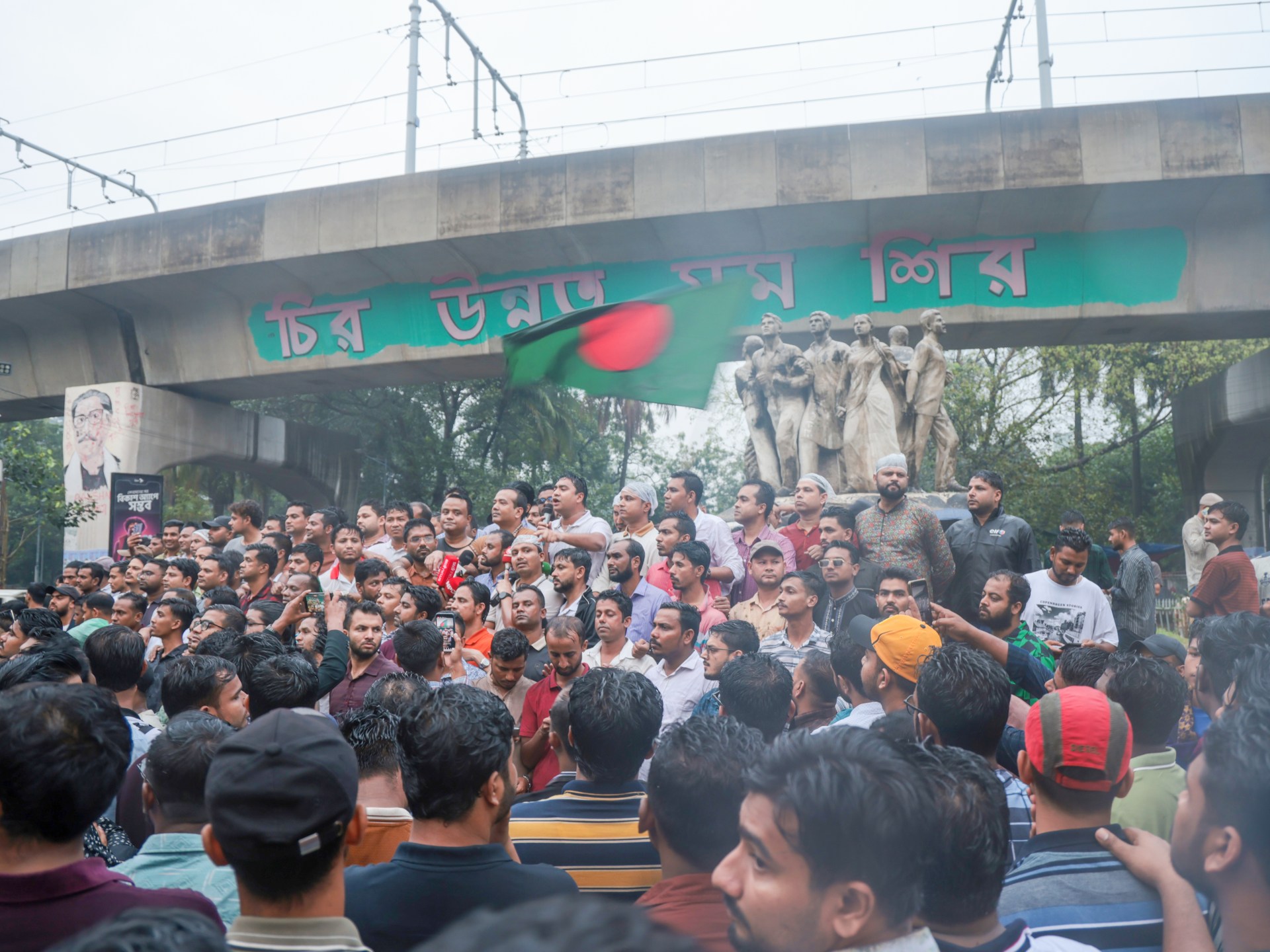
Bangladesh has deployed paramilitary troops to help contain a wave of violence that erupted after supporters of former Prime Minister Sheikh Hasina staged protests against the government’s rejection of the ousted leader’s planned return to the country.At least four people have been killed and police stations, banks and even the ancestral home of the former interim leader and Nobel Peace Prize winner, Muhammad Yunus, have been attacked in a week of violence.Recommended Stories list of 3 itemslist 1 of 3Bangladesh forms wage board as garment workers protestlist 2 of 3Bangladesh garment factories disrupted as protests continue for third daylist 3 of 3‘Going hungry’: Garment workers in Bangladesh say wages barely cover needsend of listViolence erupted after supporters of Hasina’s now-banned Awami League party took to the streets as part of weeklong protests that overlapped with the anniversary of the former leader’s death sentence last year. Bangladesh’s International Crimes Tribunal sentenced Hasina to death in absentia for crimes against humanity related to the 2024 student-led protests.Earlier this month, Hasina requested a new passport and identity card to allow her to return to Bangladesh. She has been living in self-imposed exile in India after fleeing the country in the wake of the July 2024 student-led uprising.But the Bangladesh government, led by Prime Minister Tarique Rahman, says she is a convicted criminal, and she can only return under the extradition treaty with India.Rahman has blamed India for the unrest. “It is not only that; they have not looked at the interests of Bangladesh and its people. At the same time, the country across the border, where they have fled to, is their master… To satisfy those masters, they have again started conspiring against Bangladesh and its people,” Rahman said in parliament on Friday.So why does Hasina still want to return to the country, and are the recent protests spontaneous or orchestrated?Here’s what we know:What do we know about the deadly protests?Since mid-November, arson attacks and violence have been reported across 28 districts of Bangladesh.At least four people have been killed in the political violence since November 14, including three political activists and a bus worker who died when his vehicle was torched, according to local media reports.Two men from the ruling Bangladesh Nationalist Party (BNP) were killed in the Narail district, according to the AFP news agency. In retaliation, BNP supporters set ablaze more than a dozen homes belonging to Awami League supporters in the district.A Narail resident, who asked not to be identified for fear of reprisals, said as many as 50 houses had been damaged in the district.“We are terrified by the clashes,” he told AFP. “We have asked our women and children to stay inside unless it is absolutely necessary.”Late Wednesday, police said the ancestral home of Yunus was set on fire in the port city of Chittagong. It was not immediately clear who was behind the blaze.“Criminals set fire to the eastern side of the house. The area was being used as a storeroom,” Chittagong Metropolitan Police spokesman Aminur Rashid said, adding there were no casualties.Yunus, who was targeted by Hasina during her term in power, has faced hostility from her supporters. Grameen Bank, set up by Yunus, said 22 of its branches were subject to arson attacks.State news agency BSS reported that 90 additional platoons of the paramilitary Border Guard Bangladesh (BGB) had been deployed nationwide.National police chief Md Ali Hossain Fakir told BSS that security had been restored in Gopalganj, Hasina’s hometown and a longstanding stronghold of her party.“I urge the peace-loving people of this area to stand against those involved in sabotage and disorder,” he added.Khandakar Tahmid Rejwan, lecturer of global studies and governance at the Independent University, Bangladesh (IUB) and contributing analyst at the United States defence think tank Jamestown Foundation, told Al Jazeera that the protests do not appear to be entirely spontaneous in nature.“If they were genuinely organic and spontaneous, one would arguably expect to see broader public mobilisation and participation across different parts of the country. Instead, what we are witnessing is a concentration of protest activity in areas such as Gopalganj, Faridpur, and Madaripur, which have traditionally served as strongholds of the Awami League’s support base,” he said.He noted that while sporadic protests and demonstrations have also been reported in other parts of the country, their scale and geographical spread, at least so far, suggest localised unrest rather than a nationwide mobilisation.“Although these incidents are concerning from the perspective of public order and political stability, the available pattern of mobilisation does not, at this stage, indicate a level of nationwide momentum that could fundamentally challenge the incumbent government’s position,” he added.What triggered the violence?The recent protests began soon after the government rejected Hasina’s request for her passport and identity card on November 9. Hasina served as prime minister from 1996 to 2001, and again from 2009 to 2024, but her nearly 15 years of iron-fist rule have been slammed by human rights organisations.She was sentenced to death in absentia for crimes against humanity over her deadly crackdown on the student-led protests in 2024. As many as 1,400 people may have been killed in the violence, according to United Nations estimates.Hasina has, however, denied these charges and told the Reuters news agency on November 9 that she intended to return to Bangladesh and surrender before a court. Her aides added the date would be announced once various formalities were completed.But her request has been denied by the current government.“Bangladesh does not give passports to terrorists who kill thousands of people and flee. It will work under the current extradition arrangements with India to pursue and get the terrorist Hasina handed over,” State Minister for Foreign Affairs Humaiun Kobir said earlier this month.The Bangladeshi prosecutor Md Aminul Islam, who secured the death sentence for Hasina at the Dhaka-based International Crimes Tribunal, said she will be executed if she returns home.“Sheikh Hasina has no option but to face the execution of the verdict,” Islam told reporters.Protesters have also been calling for the ban on Hasina’s party to be lifted and detained leaders and supporters of the party to be released from prison.Why does Hasina want to return to Bangladesh?Hasina still enjoys support among a section of the population, while many others want to see her hanged.Her return could also worsen political tensions as Prime Minister Rahman’s government tries to restore stability two years on from the 2024 uprising.But her game plan behind why she wants to return is unclear.Some analysts have questioned whether Hasina genuinely intends to return to face the law.Others have questioned whether she is using the promise to revive her political fortunes from self-imposed exile in India. New Delhi, her close ally for decades, has sheltered her since she fled Dhaka in August 2024. But her continued presence has become a point of contention between the two countries.Rejwan believes there are several interconnected factors behind Hasina’s renewed emphasis on returning to Bangladesh.“First, there is the domestic political context. It has been nearly 10 months since the incumbent government assumed power, and during this period, it has faced a number of challenges, including inflationary pressures, economic stagnation and a fuel crisis. While these difficulties are not entirely homegrown and are, to a considerable extent, linked to broader geopolitical and global economic developments, it remains difficult to communicate these complexities to the general public. Their everyday consequences inevitably affect public morale and confidence in the government,” he said.“Secondly, there is the ongoing political debate surrounding whether the Awami League should remain proscribed or be allowed to resume its political activities,” he added.He noted that several international actors and civil society voices have advocated lifting the temporary ban and allowing the party to return to mainstream political activities, potentially following the prosecution and sentencing of those responsible for the atrocities committed during the July 2024 uprising.“Thirdly, there is India’s role, which cannot be entirely overlooked. Sheikh Hasina and several Awami League leaders and activists who fled Bangladesh following the collapse of her government in August 2024 have reportedly continued to receive varying degrees of support from India. There have also been discussions and speculation about whether New Delhi has been exploring possibilities for negotiating her safe return to Bangladesh, potentially under arrangements that would ensure her security, including protection under the custody of the Bangladesh Army,” he added.Mushfiqul Fazal Ansarey, a senior Bangladeshi diplomat, said that Hasina does not intend to return to face her sentence. “In my assessment, her talk of a comeback is intended to rally supporters and destabilise Bangladesh,” he told Al Jazeera.The violence, Ansarey said, has extended abroad, with Awami League supporters reportedly attacking Nahid Islam’s entourage in Romford, east London. Islam, who was part of the student-led uprising, is a member of parliament.“Arson, killings and intimidation cannot be presented as political protest. The neighbouring country should ensure that its territory is not used to organise or incite violence against Bangladesh.”What are the political ramifications of the Awami League protests?Besides deploying police forces to contain the protests, in an effort to build unity, Prime Minister Rahman has held talks with Shafiqur Rahman, the leader of the opposition party Jamaat-e-Islami.The Jamaat’s Secretary-General Mia Golam Porwar told the Bangladeshi newspaper The Daily Star that the two leaders viewed the meeting positively and hoped it would strengthen democracy in the country.“If this initiative is taken with the intention of moving forward with everyone on board, it will be good. We want to view it positively. If the initiative genuinely has good intentions, we want it to succeed,” he said on Sunday.Rejwan, from the Independent University of Bangladesh, said that from the Awami League’s perspective, one of the most unfavourable political developments would be the possible convergence of political interests between the BNP and Jamaat-e-Islami, particularly if their existing political differences were set aside in the interest of preventing the Awami League from regaining political ground.“Beyond the Awami League, Jamaat-e-Islami remains one of the few political organisations in Bangladesh with an established grassroots organisational structure, a relatively disciplined cadre base, and extensive networks of political mobilisation. This gives the party a significant organisational capacity to counter the Awami League’s own entrenched political networks and grassroots mobilisation,” he said.He highlighted that another crucial variable is the extent of residual popular support for the Awami League.“If Sheikh Hasina were to return to Bangladesh, how would the politically dormant but ideologically sympathetic sections of the population respond? Would her return reactivate sections of the Awami League’s grassroots support base, or would the party’s political isolation and organisational setbacks limit its ability to mobilise them?” he said.“Ultimately, the sustainability and effectiveness of any BNP–Jamaat political understanding aimed at containing the Awami League’s political resurgence would depend not merely on elite-level negotiations but also on the ability of both parties to manage their competing political interests and respond to the evolving sentiments of the wider electorate,” he said.
Why Bangladesh descended into violence ahead of Hasina’s planned return
Full Article
Original Source
Read the full article at Aljazeera →KhanList aggregates and links to publicly available news content. We do not host full articles from third-party sources. Always verify important information with original sources.