
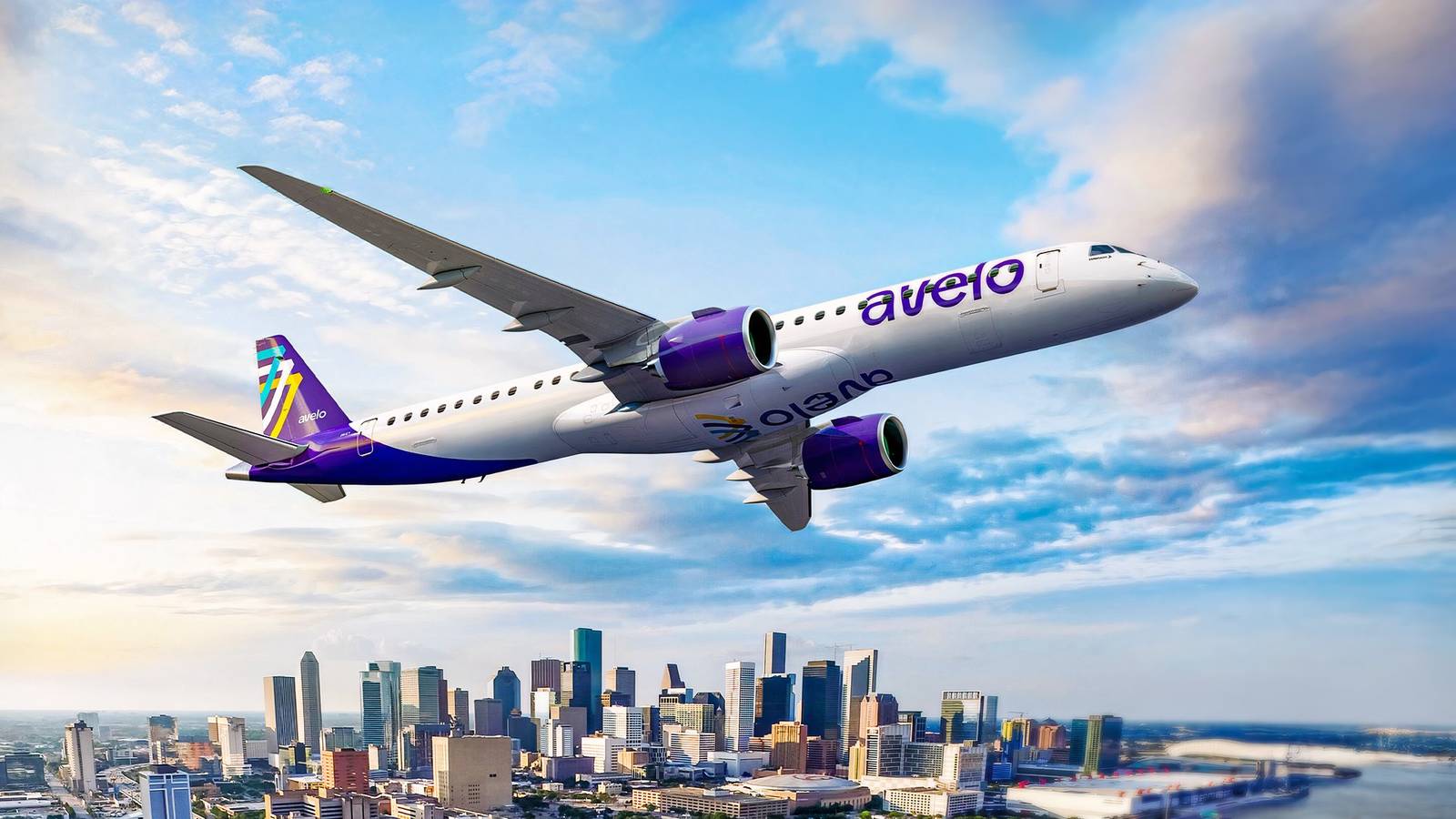
Published Nov 29, 2026, 2:00 PM EST An aviation writer, pilot, and flight operations professional who sees aviation from both sides of the cockpit door. With a background in aeronautics, safety, and human factors, she brings curiosity, firsthand experience, and a love of the details that turn aircraft and airports into stories worth telling. Avelo Airlines built its early network around a straightforward formula: one aircraft family, one basic operating model, and enough seats to make low-cost point-to-point flying work. Now, the airline is preparing to complicate that formula with an aircraft smaller than its Boeing 737s, with no middle seats, that won't begin arriving until 2028. The choice could reshape how Avelo thinks about capacity, routes and growth. The airline is not abandoning its Boeing 737 fleet, but it is abandoning the idea that one aircraft size can support every stage of its expansion. A firm order for 50 Embraer E195-E2s, with purchase rights for another 50, gives Avelo a second aircraft type and a different set of network possibilities. The bigger question is why an airline that has emphasized operational simplicity would willingly introduce that complexity now, and what the 140-seat E2 is expected to accomplish that a 737-800 cannot. Why Avelo Needs A Smaller Jet Credit: Markus Mainka|shutterstock Avelo's decision becomes easier to understand when its existing fleet is viewed through the demands of its growing network. The airline currently operates 737 aircraft, including the 737-800, which provides substantially more capacity than the 140-seat configuration planned for the E195-E2. That capacity can be valuable when demand is strong, but it can also make thinner routes harder to sustain if an aircraft is consistently larger than the market requires. The E195-E2 gives Avelo another capacity level without forcing the airline to abandon its basic point-to-point strategy. Its planned 140-seat layout will retain two seats on each side of the aisle, eliminating the middle seat while giving the airline a smaller aircraft with which to test routes that may not support 737 capacity as consistently. That distinction matters for an airline that has continued adding destinations rather than concentrating its network around a few large hubs. The timing also matters. Avelo's expansion at McKinney National Airport (DTX) in Texas begins with 737-800s, not E2s. Commercial service began on November 11, and the airline has established itself as the airport's anchor commercial tenant. The E195-E2 therefore represents a longer-term change to the network rather than the aircraft that will launch McKinney service, making its eventual role less about replacing today's operation and more about changing what Avelo can consider next. What Makes The E195-E2 Different Credit: kamilpetran|shutterstock For Embraer, its E195-E2s sit in an important space between traditional regional aircraft and the larger narrowbodies that dominate US airline fleets. For Avelo, its appeal is not simply that it is smaller. The aircraft provides mainline-style capacity in a package designed to operate routes where putting a larger aircraft into service may not make as much economic sense. That gives Avelo another tool for matching aircraft capacity with demand instead of treating every market as a 737 market. The planned 140-seat configuration is particularly significant because Avelo is not using the E2 simply to create a smaller version of its existing product. The 2-2 cabin means every passenger gets either a window or aisle seat, while the aircraft also offers features such as in-seat power and large overhead bins. For an airline competing partly on product simplicity, the absence of a middle seat gives the E2 a tangible, passenger-facing distinction from the larger aircraft already in the fleet. Avelo ordered 50 E195-E2s with purchase rights for another 50 in September 2025. The firm order was valued at approximately $4.4 billion at list prices, and the aircraft were originally expected to begin arriving in 2027. Avelo's current plans now point to 2028, giving the airline additional time to build its 737 network before the E2 begins changing the balance of its fleet. But the aircraft's most visible difference will not be on the runway at all. Why The No-Middle-Seat Cabin Matters Credit: Aerospace Trek|shutterstock The no-middle-seat configuration is more than a marketing detail because it changes the value proposition of a smaller aircraft. Avelo can offer passengers a cabin in which every seat is either at the window or aisle, while still operating fewer seats overall than it would on a 737-800. That creates a potentially useful combination for an airline that needs to keep fares competitive while giving travelers a reason to choose its service over alternatives. The configuration also gives Avelo greater freedom in how it thinks about demand. A 140-seat aircraft does not need to fill as many seats as a 737-800 before a route reaches a comparable level of utilization, and that can matter when demand fluctuates by season, day of the week, or destination. Avelo could therefore use the E2 to support markets with enough passengers for nonstop service but not enough consistent demand to justify a larger aircraft year-round. That logic becomes particularly interesting when applied to the airline's broader growth strategy. Avelo has continued building a network of nonstop routes rather than relying on a traditional hub-and-spoke structure, meaning aircraft size can directly influence which city pairs make sense. The E2 could give planners another option between launching a route with a 737 or not launching it at all. The more revealing test will be where Avelo puts that flexibility once the aircraft enters the network. How McKinney Sets Up The Strategy Credit: SevenMaps|shutterstock McKinney provides a useful look at the type of expansion that could eventually benefit from a two-size fleet. The airline will base three 737-800s there, making the Texas airport an important part of its network well before the first E195-E2 arrives. The airport's new 46,000-square-foot commercial terminal is being built around Avelo's operation, with four initial gates, room to expand to six and 980 parking spaces. Avelo is expected to create approximately 150 jobs through its McKinney operation. By December 2026, the airline plans to have nine nonstop destinations from the airport, adding Atlanta, Denver, Nashville and New Orleans to the original five. That is a substantial network for an airport entering scheduled commercial service, and it creates an early test of how much demand the market can support. McKinney Expansion Planned Details Commercial service begins November 11, 2026 Initial aircraft 3 Boeing 737-800s Initial destinations 5 Planned destinations by December 2026 9 New destinations in expansion Atlanta, Denver, Nashville, and New Orleans Terminal 46,000 square feet Initial gates 4 Future capacity Up to 6 gates Parking 980 spaces Expected local jobs Approximately 150 The significance of E2 is that Avelo will have actual data from McKinney before the aircraft arrives. The airline can see which markets sustain demand, which fluctuate, and which require more or less capacity. The E195-E2 could eventually become useful not only for new destinations from McKinney, but also for adjusting the size of existing markets as the network matures. That makes the cost of flexibility the next part of the equation. What Avelo Gives Up For That Flexibility Credit: fifg|shutterstock Adding the E195-E2 will inevitably make Avelo's operation more complicated. A single aircraft family can simplify pilot training, maintenance planning, spare parts, scheduling, and crew utilization. Introducing the E2 means managing another type across those areas, which creates costs that would not exist if Avelo simply continued expanding its 737 fleet. That tradeoff only makes sense if the additional aircraft type creates opportunities that outweigh the added complexity. The E2 does not need to replace the 737 to do that. Its value can come from letting Avelo place fewer seats into markets where a 737 would be hard to fill consistently, while keeping the larger aircraft available for routes with stronger demand. In that model, fleet complexity becomes a network tool rather than an operational objective. There is also a strategic advantage in having purchase rights for another 50 E2s. Avelo does not have to commit immediately to a 100-aircraft E2 fleet. It can learn from the first deliveries, evaluate route performance, and decide whether the aircraft is producing the flexibility the airline expects. The remaining uncertainty is whether those benefits will justify the added complexity at scale. The 2028 Test That Matters Most Credit: M-Production|shutterstock By the time the first E195-E2s arrive, Avelo's network should look considerably different from what it is today. McKinney will have had time to establish its nine-destination network, while other markets will provide the airline with more information about where its 737s work well and where capacity becomes a constraint. The E2 will enter that environment with a defined purpose: give Avelo another way to grow without automatically adding the same number of seats to every market. The strongest test will therefore not be the size of the order or the novelty of becoming the first US airline to operate the E195-E2. It will be whether Avelo can use the aircraft to open or sustain routes that would be difficult to justify with a 737-800. If the E2 allows the airline to maintain more frequencies, experiment with thinner markets, or adjust capacity without sacrificing its point-to-point model, the second fleet type could become a meaningful competitive advantage. That would also change the meaning of Avelo's original fleet strategy. Operational simplicity has value, but simplicity is not necessarily the same thing as efficiency when an airline reaches a different stage of growth. Avelo is effectively betting that the network opportunities created by a 140-seat aircraft will justify the additional machinery, training, and planning required. For Avelo, the real value of the E195-E2 will be measured not by how many seats it carries, but by how many routes become possible because it carries fewer.
Why Avelo Airlines Is Abandoning Single-Fleet Simplicity To Fly 140-Seat Embraer E2s With No Middle Seat
Full Article
Original Source
Read the full article at Simpleflying →KhanList aggregates and links to publicly available news content. We do not host full articles from third-party sources. Always verify important information with original sources.