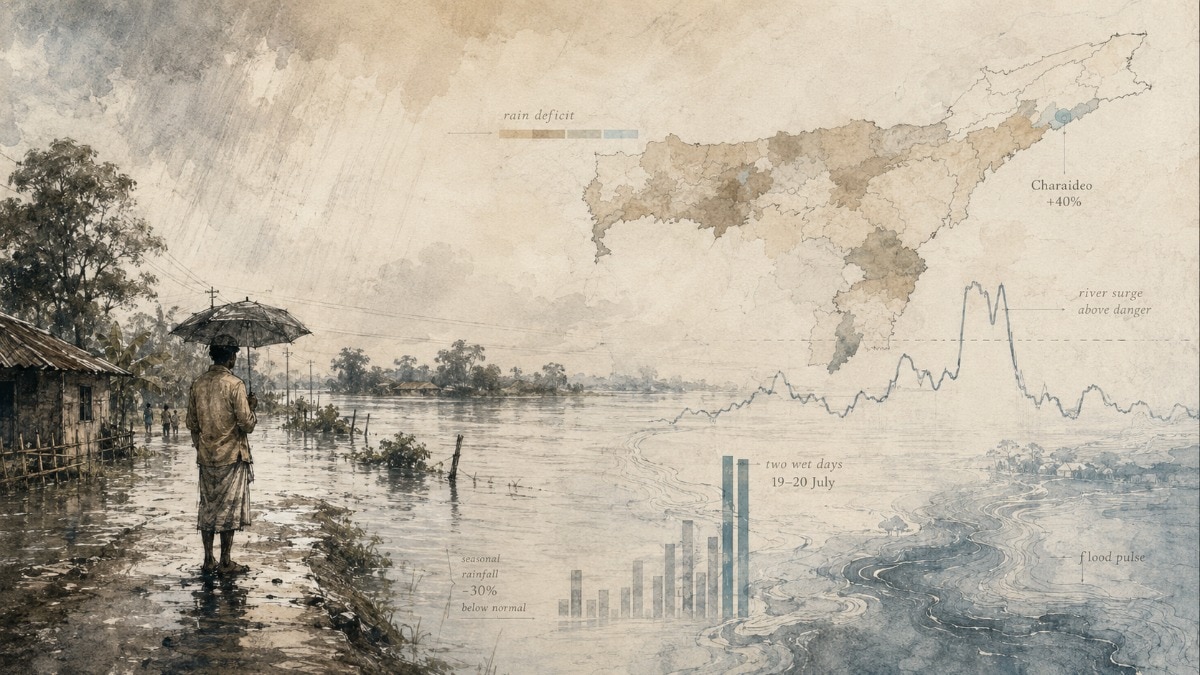
The state has had 30% less rain than normal since June. It went underwater anyway, because the rain it did get arrived in two days.Seven people drowned in Sivasagar district on Tuesday, taking Assam's flood toll for the season to 75. Another 32,477 people spent that night in relief camps. And Assam has had 30 per cent less rain than normal this monsoon.Those figures belong together.From June 1 to July 28, the state recorded 19,913 mm of rain against a normal of 28,487 mm, per the India Meteorological Department's district rainfall bulletin. Twenty-three of the 33 districts with published figures were at least 20 per cent below normal. Then the rain came all at once.On July 19 and 20, Assam had its two wettest days of the season. The Dhansiri River at Numaligarh crossed its danger mark within hours and stayed above it for 210 hours, more than eight days. That is what a deficit monsoon looks like when its rain is compressed into a handful of days, and it is the pattern flood managers across the Brahmaputra valley now have to plan for. A DRY SEASON, INTERRUPTEDAveraged across the state, those two days delivered 28 and 40.3 mm of rain. Golaghat took 161 mm across the pair, the most of any district measured over its full area.Rivers responded immediately. The Dhansiri (South) at Numaligarh crossed danger on July 19 and peaked the next day at 79.67 m, 1.25 m above the mark, Central Water Commission gauges showed. The Brahmaputra at Neamatighat crossed danger too, for 46 hours. Between them, the two gauges spent 256 hours above the line.WHERE THE WATER WENTBy July 28, the floods had reached 622 villages across 21 revenue circles in seven districts, Assam's disaster management authority reported. Charaideo was worst affected with 1,42,756 people hit, followed by Sivasagar with 97,074, and Jorhat with 57,371.About 45,342 hectares of cropland were submerged, most of it in the two worst-hit districts. Sivasagar alone lost 22,276 hectares, and Charaideo 16,652, in the weeks when the transplanted sali paddy is establishing. The state opened 81 relief camps and 34 distribution centres.Set those districts against their rainfall, and the pattern is clear. Six of the seven are below normal for the season. Nagaon is 60 per cent short. Sivasagar, which has the largest share of its area under water, is 35 per cent short.One of the seven has surplus rain, and it is the worst affected of all. Charaideo is 40 per cent above normal, the only Assam district well above the line, and it accounts for the largest displaced population in the state.NOT ALL OF IT IS ASSAM'S RAINOne finding complicates the picture, and it matters for planning.Comparing daily rainfall with hourly river levels shows the Dhansiri at Numaligarh tracks rain falling on Assam itself, and does so the same day. The upper Brahmaputra gauges do not. Dibrugarh and Neamatighat move more closely with the rain in Arunachal Pradesh, upstream. Dhubri, at the state's downstream exit, lags upstream rain by about five days.Assam's flood risk is therefore only partly a function of Assam's rainfall. A district can be 60 per cent short of rain and still go under, because the water arriving in its rivers fell somewhere else. Nagaon is the clearest case in this spell. Radar mapped nine per cent of the district under water at the flood's peak, in a district 60 per cent short of rain for the season.IS THE RAIN BUNCHING UP?This season, two days accounted for an outsized share of the shortened monsoon. Whether that is becoming the norm in Assam is a separate question, and one this analysis does not answer. Establishing it would need the share of seasonal rain falling on the wettest few days, measured across several decades. The 2026 monsoon is consistent with that pattern. It is not evidence of it.WHAT IT COSTSThe two headline numbers moved in opposite directions on Tuesday. The death toll rose to 75, Deccan Herald and ANI reported. The affected population fell to 3.32 lakh as water drained away.Chief Minister Himanta Biswa Sarma announced an additional Rs 5 lakh from the Chief Minister's Relief Fund for the families of those who died, taking total assistance to Rs 9 lakh. More than one lakh severely affected families are to receive Rs 15,000 each.Every gauge that crossed the danger mark is back below it. Receding water and restored normality are not the same thing. More than 32,000 people were still in relief camps as the levels fell, and the seven deaths were counted on a day the flood was already easing.Assam's embankments, evacuation triggers and relief pre-positioning are calibrated against seasonal rainfall. A monsoon that delivers 70 per cent of its usual rain but concentrates it into two or three days will keep producing this outcome: dry soils and low river levels, then a burst that no drainage system can absorb.If a 30 per cent rainfall deficit could put 3.32 lakh people out of their homes, a normal monsoon delivered the same way would be worse. The rain gauges say this was one of Assam's driest monsoons in years. The 32,477 people who slept in relief camps on Tuesday night would not recognise the description.- EndsPublished By: Pathikrit SanyalPublished On: Jul 29, 2026 19:18 IST
Why Assam is flooding despite one of its driest monsoons
Full Article
Original Source
Read the full article at Indiatoday →KhanList aggregates and links to publicly available news content. We do not host full articles from third-party sources. Always verify important information with original sources.