
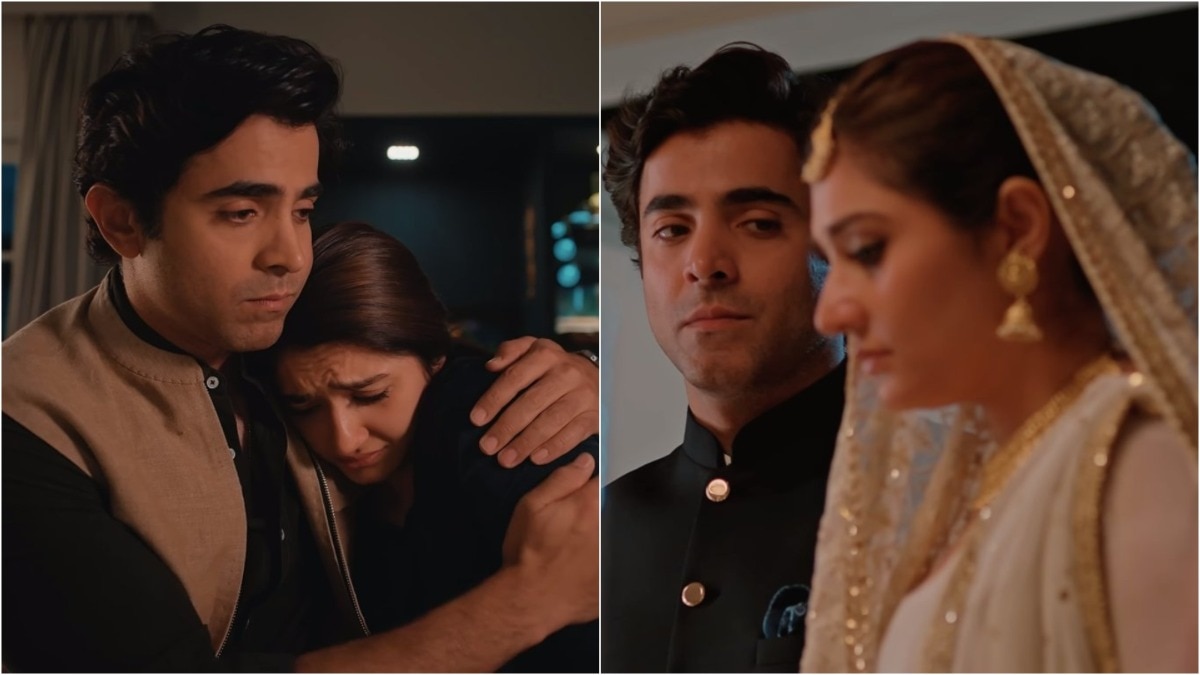
Somewhere between dating disappointments, situationships and the seemingly endless search for a man who knows how to communicate, women have found themselves falling for someone who doesn't even exist. Meet Abu Bakar, played by Sheheryar Munawar Siddiqui in Pakistani drama Dar-e-Nijaat, who has quietly become the internet's latest green flag. And judging by the conversations around him, quite a few women wouldn't mind having a man like him in their lives.The latest episode, which finally saw Abu Bakar confess his love for Zaryab (Dur-E-Fishan Saleem), has only intensified the yearning. But what makes the confession particularly beautiful is that it doesn't feel like a man claiming his right to be loved back. It feels like someone finally finding the courage to tell a woman what she means to him, while understanding that she may need time to process it. He tells her, in many ways, that she has been the colour in his life since the day he first saw her. And there is something incredibly tender about watching a man who has loved quietly for so long finally put those feelings into words.Perhaps that's Abu Bakar's biggest charm. He isn't in a hurry to make Zaryab love him. He doesn't expect her to forget her past, reciprocate his feelings or suddenly become the wife he has imagined. He understands that she has been hurt, that love hasn't been particularly kind to her and that trusting someone again isn't as simple as deciding to move on. He gives her space.And that, in itself, is a form of love we could do with seeing more often. Abu Bakar is portrayed as a calm, deeply respectful, and patient figure (Photo: Screengrab) In a world where relationships are often reduced to expectations, entitlement and the constant need for reassurance, Abu Bakar makes tenderness look incredibly attractive. He doesn't make Zaryab feel guilty for having loved someone before him, hold her past against her or question her worth because of it. He knows what she has been through and doesn't expect her to heal on his timeline.And perhaps that's what women are responding to. The idea of having someone who doesn't make them regret being vulnerable. Someone who can look at a woman with a past, her share of mistakes, heartbreaks and emotional baggage, and still see her for who she is today. Someone who doesn't make her feel she has to earn the right to be loved. Then there are the little things: the extra toffee he brings home, looking out for her comfort, helping her with an earring, picking up her phone and slippers when she throws them away in anger, or simply switching on the air conditioner. These are not grand romantic gestures, yet, somehow, they make viewers pause, rewind and swoon. Abu Bakar notices, remembers and pays attention. His affection isn't restricted to moments when he wants to impress Zaryab. It finds its way into the most ordinary parts of their everyday life.And honestly, isn't that where love is supposed to show up? His relationship with Zaryab unfolds slowly, with plenty of emotional ups and downs (Photo: Screengrab) There is also something reassuring about a man who doesn't let his ego dictate the terms of a relationship. When Zaryab snaps at him, he doesn't retaliate. When she is angry, he tries to understand what's hurting her instead of reacting to what she says. He seems to recognise that sometimes the person in front of you is dealing with a hurt that has very little to do with you. That doesn't make him weak. It makes him emotionally secure.Perhaps one of the most interesting aspects of Abu Bakar's character, though, is his relationship with faith. He is a God-fearing man whose beliefs clearly matter to him. Yet, unlike Zamil (Nameer Khan), who uses religion to judge Zaryab and question her choices, Abu Bakar understands that faith is a deeply personal relationship between an individual and God. He doesn't appoint himself the judge of her past or morality. When Zaryab questions her own character, he reminds her that he has no right to judge her and that her relationship with God is hers to navigate.There is something particularly beautiful about this portrayal. His faith doesn't make him harsher towards people; it makes him more conscious of how he treats them. He doesn't use religion to establish moral superiority or turn his beliefs into a weapon against someone else. Instead, his kindness seems to stem from the very principles he believes in. And that distinction makes him stand apart. Many viewers see him as the perfect, selfless man, but he has his flaws too (Photo: Screengrab) Of course, Abu Bakar isn't necessarily a perfect man, nor should he be treated as one. There is an interesting contradiction in his character that Sheheryar has also spoken about. The actor has described him as a people-pleaser with a saviour complex, someone who feels responsible for rescuing people. His instinct to look after everyone could well become his biggest emotional burden. But that makes him considerably more interesting than a character written simply to tick every green-flag box.Writer Umera Ahmed, too, has questioned why qualities such as kindness, empathy and forgiveness are often treated as extraordinary when they should ideally be the foundation of human relationships. And perhaps that's the larger conversation Dar-e-Nijaat has inadvertently sparked. Why does a man who respects a woman's past, listens to her and treats her with consideration seem so exceptional that audiences have collectively decided he deserves his own fan club?Of course, falling for a fictional character and navigating an actual relationship are two very different things. Real people come with contradictions, difficult days, misunderstandings and emotional limitations. No partner can get everything right all the time. But that doesn't make the qualities Abu Bakar represents unrealistic or unreasonable to expect. Audiences in Pakistan and India love him for being different from the usual aggressive male leads (Photo: Screengrab) Perhaps women aren't looking for a man who can anticipate every need or always knows the right thing to say. They want someone who makes the effort. Someone who doesn't make love feel like a constant negotiation, turn vulnerability into a weakness or treat a woman's past as a measure of her worth.Abu Bakar may be fictional, but the yearning he has inspired is very real. And perhaps it isn't even about wanting a man who loves you unconditionally. It's about wanting someone who makes the world feel a little less difficult to navigate. Someone whose presence feels like reassurance rather than another emotional responsibility.If a fictional man has managed to make women across borders yearn for that kind of love, perhaps the question isn't why Abu Bakar is so special. It's why such uncomplicated tenderness feels so extraordinary in the first place.- Ends
Why are women yearning for Abu Bakar, the fictional man from PTV's Dar-E-Nijaat?
Full Article
Original Source
Read the full article at Indiatoday →KhanList aggregates and links to publicly available news content. We do not host full articles from third-party sources. Always verify important information with original sources.