
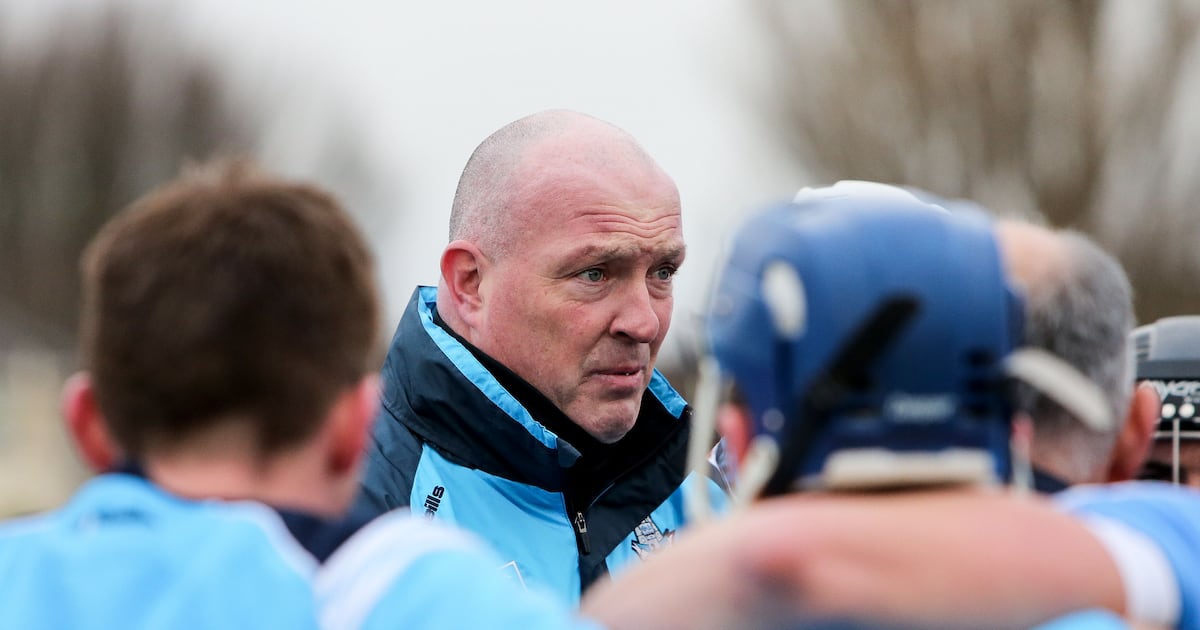
Pat Gilroy is one of the children of the revolution. When Seán Doherty lifted Sam Maguire above his head in the Hogan Stand on September 22nd, 1974, it capped a season for Dublin that no one saw coming.The pivotal moment in that All-Ireland final win over Galway was Paddy Cullen’s penalty save from Liam Sammon. It was Cullen’s eighth Championship campaign with the Dubs. For the first seven, they were cannon fodder, not even making a Leinster final. Now, he stood beside Doherty, taking in the most extraordinary scenes as the Dublin faithful sang a soccer anthem – You’ll Never Walk Alone.A phenomenon had been born. Gaelic football took a grip on the city like never before.Even though Gilroy was just a couple of months short of his third birthday, he was there in 1974. His father, Jackie, was a friend and St Vincent’s clubmate of Kevin Heffernan, so maybe he had an inkling that something special was going to happen and that young Pat should witness it.READ MOREIt started there, and Gilroy has no idea how many All-Ireland finals he’s been to since, but he knows one he definitely missed. He had tickets for this year’s football decider but gave them away.He is unsure if and when he will step through the doors of Croke Park again. The relationship is fractured. Divorce may well be inevitable.Gilroy never left the GAA, but he increasingly feels that the GAA is leaving him behind. An untethering began at the end of 2024, when he resigned from the Croke Park Board due to his discomfort at the direction of travel.Dublin manager Pat Gilroy celebrates the final whistle with selector Mickey Whelan in All-Ireland Senior Championship Final in 2011. Photograph: Morgan Treacy/Inpho “For the first time in 50 years, I’m not involved in anything in the GAA – apart from being a member of Vincent’s – and have no stress,” he said. “It’s not the GAA I grew up in, it certainly seems to me that it’s heading in a professional direction.“The initials of Croke Park are CP and I call it Caesar’s Palace. Now I was on the Croke Park Board, I was on the Strategic Review Committee and the people who are involved in management there are good people. Peter McKenna could run any stadium in the world.“I had no problem with rugby and soccer being in Croke Park when they had no stadium, but I’m scratching my head when we cut our calendar back and our kids are going back to school and talking about going to see Manchester United at Croker. “Yes, it does generate revenue, but for what? The more money we have, the more we’re going to put more demands on the players, and then it has to become professional. I think these are all unintended consequences.“Man United v Leeds ... that’s why I call it Caesar’s Palace because it’s just a revenue generator, and that’s not Peter McKenna’s fault. He’s doing a great job, but he’s doing it with the hand he’s dealt, which is ‘we need more money’.”[ Manchester United edge Leeds at Croke Park as GAA puts price on the pricelessOpens in new window ]Gilroy wasn’t asked to serve the GAA on high-level committees just because of his football achievements. He has had a hugely successful business career and is a former president of the Ireland-France Chamber of Commerce and served on the Ibec national council.He was awarded the Chevalier of the Ordre du Mérite in November 2015 in recognition of his work in developing a French business in Ireland. By any metric, Gilroy is a heavy hitter.Pat Gilroy watches his Dublin team warm up in 2012. Photograph: James Crombie /Inpho It’s no surprise, then, that in 2008, he was headhunted for the GAA’s most powerful role, that of Ard Stiúrthóir, following the retirement of Liam Mulvihill. What happened next was the start of a souring of Gilroy’s relationship with the GAA.“That was where my trust in the organisation was damaged,” he said. “I was approached to put my name forward for it. I said that I would if the process was strictly confidential because I had a really good job with a really good company in Dalkia, and I had to be very careful because I hired all these people there.“I believe that they leaked my name to show that they had a process with credible candidates. I steered a million miles away from anything to do with it after that. I was very disappointed at what went on.”The GAA declined to comment on the matter when approached by The Irish Times.Gilroy feels that the modern GAA is akin to the Titanic. The lights are on, the music’s playing, and the dancefloor is full - but icebergs lie ahead.“People say all the time that the GAA is in a great place. Really? Hurling is dying in front of our eyes. We’re probably down to a three-team competition in terms of the All-Ireland. You’d expect Kilkenny to come back but the rest? How can you say the association is great when that is happening? We’ve had this boost from the new football rules, 100 per cent that was ballsy. That was great, and it was radical.“But we need radical moves in other places. The GAA is now run like an American multinational with a board of directors and a CEO and all that. In 1980, I think maybe the GAA had five full-time employees. Now, there’s a wage bill of around €20 million. How did that happen? Is all that for the good? Pat Gilroy as St Vincents manager in 2024: his reached the semi-final. Photograph: Tom Maher/Inpho “I tried from 2016 to last year to get the point across on amateur status but felt I was in a minority so I left and I won’t be going back. But I worked with others of a similar view and we came up with a good alternative to the current semi-pro set-up where some are paid officially, and some unofficially. It was a follow-on from the strategic plan during Larry McCarthy’s presidency, which was excellent. “I do realise it’s hard to do too many things at once and the changes to football, in fairness, have been excellent.”A conversation took place in a Croke Park dressingroom this summer that told us much about the current GAA.The crestfallen players of a prominent football county sat silently just minutes after exiting the Championship. Then the S&C coach took to the floor and told them he’d be drawing up a new training programme for the 2027 season that they would start in the gym the following Wednesday.To their credit, the players gave him short shrift but it was a reminder that the much-praised split season doesn’t really exist for many.“The good player starts playing games in January and finishes with the club in October or November, usually. He’s expected to train all year round,” said Gilroy.The argument is always made that the bulk of the money generated by Croke Park is pumped back into the games. Gilroy, though, feels that much of it is spent on ever-increasing bills for things such as S&C and nutrition, and that the gaping money pit is there at club as well as county level.St Vincents' Pat Gilroy gathers with teammate Niall Dunne despite the attention of Redmond Barry and Cormac McNallen of UCD, in the Dublin senior football final. Photograph: Morgan Treacy/Inpho “This year, I was involved with the senior footballers in Vincent’s, came in as a defensive coach at the end of May. Michael Savage, a great guy, is the manager. He stepped up to the plate,” said Gilroy.“But the reality of it was, through injuries and other things, you were only getting about a third of the panel at every training session. I did two months of it, and it wasn’t getting any better. Now the fellas that were there were really trying hard, but I think there were too many training sessions. The reason there’s too many training sessions is because that’s what everyone is doing, and that’s the expectation.“I went on holiday and, when I came back, I found myself getting cranky in a training session. I told Mike I needed to step away. Talking to lots of people who were involved at elite level, they’re going ‘it’s a runaway train’. I think we all just need to take a good pause and think about it.”During the week, Gilroy was rummaging around at home and came across his tactical plan for the 2011 All-Ireland final win over Kerry. It consisted of eight words on a scrap of paper. That was just 15 years ago. A different world.Pat Gilroy's tactics note to himself ahead of the 2011 All-Ireland final against Kerry Earlier this decade, Gilroy had a spell as Vincent’s hurling manager, and they were pipped in the Dublin semi-finals in both years. “We trained hard but I got rid of the GPS units, took a light touch to nutrition, did the S&C between myself and the physio. We wanted to give them some of their lives back,” he said.“I think some of them missed their trinkets and, after I left, the trinkets were back the following year. Vincent’s didn’t do as well. To me, that showed how confused we are as an organisation.“What I call the GAA’s Junior B problem is an issue. Bar Jarlath Burns, how many running the show have played at intercounty? Now, you do need the full range. You need the guy that was only a Junior B player but got involved in administration very early.“But I think you need people too who have the intercounty experience. You need a balance. You need people who were strong club players. You need junior players and intercounty hurlers and footballers.“With the GAA now, there’s a higher level of people who played at a lower level. They’re highly capable but they almost get hypnotised by the intercounty razzle dazzle and think ‘oh, we better not touch that’. They’re star-struck by intercounty and don’t want to tackle the runaway train.”When Kilkenny needed a new hurling manager this summer, they asked Gilroy to be part of the selection committee tasked with sifting through the candidates. Gilroy lists off counties where he has conducted coaching clinics - it stretches well into double figures. He mentions two prominent Leinster counties where he helped with strategic plans for the future. In most counties, he says he came across successful business people involved in clubs who have no interest in getting involved at County Board level. That doesn’t surprise him.Gilroy must hold the record for the shortest Sunday Game career. He was invited on as a guest pundit at the end of 2020 for a debate with former Meath manager Andy McEntee which focused on Dublin’s dominance. Instead of the perennial call to split Dublin, Gilroy’s solution was different and equally radical - the amalgamation of other counties.Nearly six years on, Gilroy isn’t for rowing back. GAA growth in the capital needs more clubs and more land and, of course, more housing, but official predictions are that Dublin will have a population of over two million by 2050. Gilroy feels that will inevitably impact on the playing fields.“Unless we’re absolute idiots, Dublin should win everything. If Dublin gets itself properly organised, which it will, that will happen,” he said. “I laugh when people go on about the tradition of the counties. Who put the counties there? The British. We didn’t have counties before that, we had túatha. The túatha was more or less like a GAA club. Why are we so wedded to the county system – a British system? Manager Pat Gilroy and Alan Brogan celebrate winning the All-Ireland final in 2011. Photograph: Donall Farmer/Inpho “Dave Hickey keeps pointing me to the Brehon laws and how Ireland operated for thousands of years and I think deep down inside of all Irish people, that Brehon structure is in us. It’s what we do, and when you read it, you’d say it’s nearly like communism, but it’s not. I would call it meritocracy but also, if you’re doing well and another fella is doing crap, you look after him.“If GAA people want to go the Caesar’s Palace route and go professional, I’ll stay as a member but I’ll probably get involved in something else because I like the amateur ethos. I like what it brings to people’s lives. There have been times in the last year when I’ve thought that I should have encouraged my kids to play other sports, because they were good at them. The way it’s going, they might have been better off at something else. “For 10 years, I have tried to influence the GAA from the inside. It’s time to try other things. I trust that the GAA will end up where its members want it to be and that’s not up to me to decide. I could be wrong on the pro thing but my eyes tell me I’m not.”
‘Why are we so wedded to the county system – a British system?’: Pat Gilroy on the GAA’s future
Full Article
Original Source
Read the full article at Irishtimes →KhanList aggregates and links to publicly available news content. We do not host full articles from third-party sources. Always verify important information with original sources.