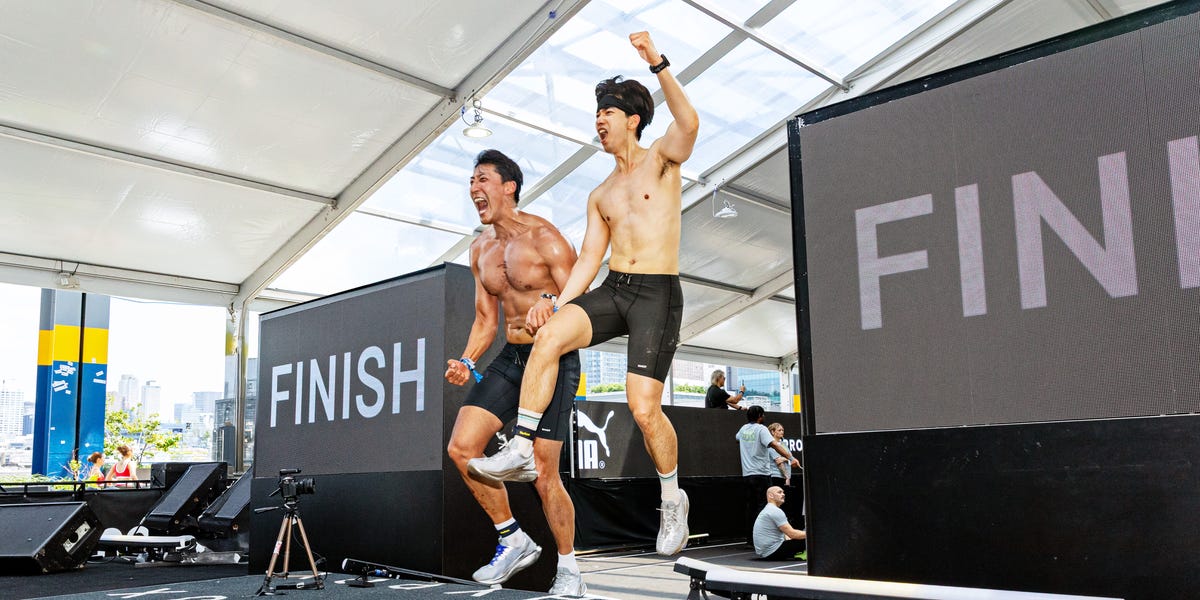
GIACOMO FORTUNATO5 min readTHE MORE HUNTER McIntyre, three-time Hyrox world champion, strains to push the 198-pound sled up the steep incline, the more its magnetic resistance, jacked to its max setting, pushes back. Oh, and his trainer, Sam Calavitta, topped the sled with two 110-pound dumbbells.It’s a fitting metaphor: McIntyre pushing himself to improve, weighed down by the threat of Hyrox’s growing legion of rivals. “It’s not about ‘Can you push a sled?’ ” he says. “It’s about ‘Can you survive?’ ” McIntyre is a prominent figure atop the ranks of the multievent sport of Hyrox, but the competition is open to anyone. Hyrox is projected to have 2.5 million participants next year, according to Keith Barlow, the director of Fittest PR, a media agency that has worked with Hyrox for the past five years. That’s up from the estimated 1.8 million this year, and a massive leap from the 550,000 in 2025.Zach CraigHunter McIntyre, three-time Hyrox world champion and veteran of the obstacle course racing craze of the 2010s, strides through a competition.You probably know the type of person lining up for events like this: They take on the CrossFit Open every year or post mud-soaked pics from the World’s Toughest Mudder. These everyday racers aren’t on McIntyre’s level, though—and they’re not trying to be. They’re just looking for exercise that’s more engaging than a standard gym split—and chances to compete.Adam and Liz Walter, both 42, from Paradise Valley, Arizona, say Hyrox gave their fitness new focus. “I feel like for the last 10 years, I was stuck in the same workout,” says Adam, who takes Hyrox classes and has two races under his belt. “Doing a Hyrox workout, it was the next level.” Liz has also finished two. “It brings out the inner athlete in you,” she says. “You leave there every day feeling accomplished.”While McIntyre is among the sport’s biggest names, Hyrox is just as focused on making competitors like the Walters feel as if they’re stars, with plenty of ’gram-worthy moments as they race. But where did this wave of fitness competitions come from and what’s next?From Function to Fast-Paced CompetitionTHE MODERN RISE of nonprofessional competitive fitness began in the 1990s. That’s when “functional training,” which mimics everyday actions and prioritizes healthy movement over muscle mass, became popular. By the early 2000s, innovators combined functional movement with aerobic elements to create obstacle course races (OCRs), like Spartan Race and Tough Mudder in 2010.A year later, CrossFit held its first Open, an event consisting of a different workout test administered by local affiliate gyms each week for five weeks, with an international database tracking the leaders. By 2018, the Open was the largest single participatory sporting event in the world, drawing nearly half a million competitors. These events—and the shirt-soaking training that fuels them—matched what the average gymgoer thought an effective functional workout should be. “People misunderstand what fitness training is over the long term,” says Conor Heffernan, PhD, a historian of physical culture at Ulster University in Belfast. “We’re primed to think effective workouts are where we’re drenched and say, ‘Oh my god, I can’t walk tomorrow.’ ”GIACOMO FORTUNATOHyrox racers compete against each other at the New York City course earlier this year. The event, held over two long weekends, hosted 41,480 athletes across 14 divisions.Group-based training was also a plus. “Despite the surge in popularity of running clubs, purely endurance sports carry an air of solitude,” says Ben Feiden, a certified functional strength coach at NYC’s Performance HQ. It helped that the CrossFit Open and OCRs allowed normies to compete in the same workouts as the events’ growing cadre of professionals. Fitness was no longer just something you did to stay in shape or train for a sport—it was a proving ground for everyday athletes to measure themselves against others.Competition is also a stronger motivator for exercise than other forms of social interaction, like direct community support or even social media accolades, according to a University of Pennsylvania study. Competition heightens the already powerful hit of dopamine from exercise, says Luis Torres, a certified mental performance consultant at Premier Sport Psychology. “You’re getting it from the community, from the energy, from exercise itself, and from completing something.” It’s the pull of the pack—a factor that a whole new kind of competitive fitness has maximized.Enter HyroxFUNCTIONAL FITNESS COMPETITIONS hit a rough patch a while back. Tough Mudder went bankrupt in 2020. Spartan Race failed as a TV sport. CrossFit became mired in controversies. Yet from the ashes of mud runs and WODs, Hyrox emerged, focused on elevating what its forebears established: the everyman athlete.Hyrox prioritizes visuals, with cameras along its courses. Races end with a podium photo moment, a shareable status symbol that can kick-start conversations IRL.GIACOMO FORTUNATOHyrox is also even more accessible, fitness-wise. It doesn’t have the high-skill moves of CrossFit or the extreme obstacles of an OCR. Hyrox consists of the sled push and pull, farmer’s carry, rower, SkiErg, burpee broad jump, sandbag lunges, and wall balls. It’s billed as challenging but achievable for everyone. (Older racers are often highlighted on the brand’s social media channels.) Eric Bibb, a CrossFit coach in Columbia, South Carolina, says his experience at Chicago’s event last year showed him that Hyrox “was a bucket list thing for many people who were there.”And unlike the failed competitions of the 2010s, Hyrox is standardized: eight exercises with one-kilometer runs between them. “Every great sport has a scoring system that people immediately understand.… In a marathon, it’s sub-three hours,” Barlow says. “In Hyrox, it’s sub-60 minutes.”The event has now been around long enough (10 years in 2027) that its initial novelty is wearing off. While Hyrox still has runway for growth and innovation, rivals are emerging.Back to the Future?BARLOW WANTS TO elevate competitive fitness with a new event he hopes will have an appeal similar to Hyrox’s. And—plot twist—he’s partnered with CrossFit to build it. Xenom debuted in June in Dallas. Unlike Hyrox’s short races, Xenom is a two-day, 10-station affair that blends technical, skill-based strength moves with a standardized structure.“If you’ve got six months’ experience lifting in a gym, doing gymnastics and stuff, you can come and do our most basic version,” Barlow says. The goal is to create a shareable “Super Bowl moment” that hasn’t existed in the CrossFit space.GIACOMO FORTUNATOXenom is not the only new competition, either. There’s Adidas’s ATHX (a time-capped event rather than a race), APEX (Hyrox as NFL Combine), METRIX (a pairs event with five stations plus a DJ), and DEKA (Spartan’s indoor fitness race offering various divisions).The rise of these competitions is positive, says Heffernan, because it means more people are trying strength training—and with what we know about the motivational power of competition, it’s more likely they’ll keep at it. And McIntyre appreciates the opportunity to keep chasing podiums. “The global interest of seeing who’s the best at something is very fun,” he says.So whether you’re racing for first place or just a PR, there’s a spot in these events for you. You’ll be almost guaranteed to get a good sweat that will ignite your inner competitor—and score a few great pics for social media.This story originally appeared in the Summer 2026 Issue of Men’s Health.SUBSCRIBEGreg Presto is a fitness and sports reporter and videographer in Washington, DC.
Why Are We All So Competitive About Fitness?
Full Article
Original Source
Read the full article at Menshealth →KhanList aggregates and links to publicly available news content. We do not host full articles from third-party sources. Always verify important information with original sources.