
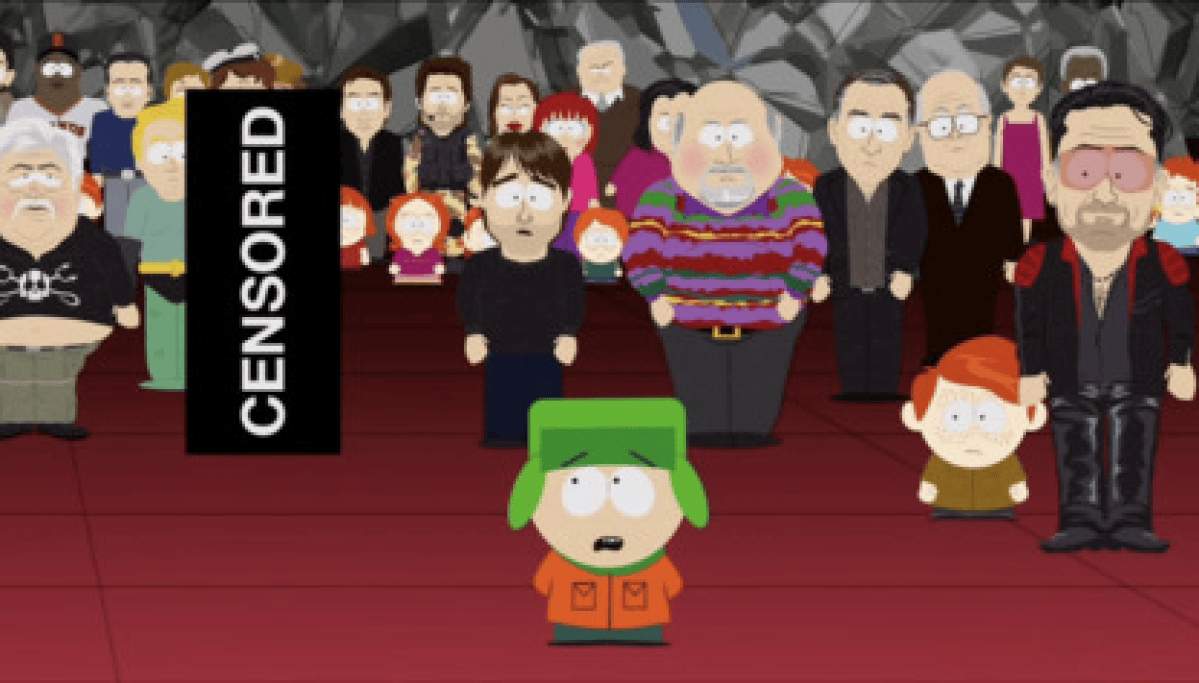
Unlike Europe, America prioritizes the rights of the individual to speak freely over an individual’s offense at what has been said. This is a very precious and important distinction. It’s disappointing, then, that a show renowned for speaking freely self-censors when it comes to Islam.The eclectic cartoon South Park centers on the residents of a fictional Colorado town and delivers a take-no-prisoners approach to comedic social commentary. Now in its 29th season, creators Trey Parker and Matt Stone secured a $1.5 billion deal with Paramount in 2025. But the show’s credibility comes with an unhealed, 25-year wound: the continued absence from Paramount’s online streaming service, Paramount+, of five previously aired episodes. One was edited by Parker and Stone to mock Comedy Central’s attempts at censorship, most notably, with Muhammad’s image replaced by a black box inscribed “censored.”But it’s clear the censors have won. Today, these episodes remain unavailable on Paramount+. Paramount presumably fears that putting them back online might alienate Saudi Arabia, the United Arab Emirates, and Qatar. Those Islamic-governed nations were key investors in Paramount’s acquisition of Warner Bros. Discovery. And while they do not have board votes as part of the agreement, their financial influence and potential for future investment will weigh heavily on executive minds. They know that those nations would react with fury against any decision to broadcast content that satirizes Islam. Of course, Paramount also knows that rereleasing the episodes risks increasing the threat it faces from Islamic terrorists. That security concern is legitimate. Although there is no Quranic ban on creating images of Muhammad, the practice is viewed as outrageous by most Muslims. The Danish Jyllandsposten newspaper’s 2005 publication of cartoons depicting Muhammad led to furious protests by Muslims, for example.Protests are one thing. But some Muslims adopt more expansive notions of the Islamic doctrine of “Hisbah,” or the responsibility to right what they see as desecrations of God’s will. Salafi hard-liners, Khomeinists, and an array of other Islamic fanatics view Hisbah as an ordained grant to enforce behavior. The French satirical magazine Charlie Hebdo learned this the hardest way. Like Jyllandsposten, it also published cartoons of Muhammad. In 2015, terrorists attacked Charlie Hebdo’s offices, killing 12. This history causes understandable concern for Paramount and for South Park‘s creative team. Still, the American creative reality must necessarily extend beyond fear.Charlie Hebdo offers a lesson here. The magazine has republished cartoons of Muhammad multiple times since the attack that killed many of its staff. It has also invested in security, alongside the French authorities, to better protect its staff. Paramount should adopt the same approach. Parker and Stone may not feel the creative need to develop a new Muhammad episode, but they demand their previously aired episodes return online.After all, South Park‘s identity depends on viewer expectations that it will mock anyone and anything in just about any manner. The show has satirized Catholics, Evangelicals, Jews, Scientologists, Tom Cruise, atheists, the physically disabled, the mentally disabled, black Americans, white Americans, Hispanic Americans, Native Americans, Al Gore, Russians, Australians, Kristi Noem, Chinese, Mexicans, Mongolians, Japanese, Saudis, Koreans, Mormons, Michael Jackson, Kanye West, Satanists, Donald Trump, Barack Obama, racists, Pam Bondi, transgender people, woke people, and ginger-haired people. And many, many, many more people and racial, social, religious and national identities.The notion that Islamic fanatics should get a veto on South Park‘s past and present content is antithetical to foundational American values. This isn’t simply about the value of free speech, but the American responsibility to rebuke those who seek to intimidate the performance of these rights. It is absurd that, respectively, 25 years, 20 years, and 16 years after these episodes were first aired, American viewers remain hostage to Islamist fanaticism.This is a not insignificant victory for jihadists and their supporters.Groups such as ISIS and al Qaeda view their ability to constrain the democratic rights of others as a key marker of their success. Even if the number of victims in any one terrorist attack is limited, the impact of that attack is greatly amplified when it scares many others into changing their behavior. Similarly, each submission to a threat not to say, do, or broadcast something dilutes a society’s freedom at large. It prioritizes the injustice of fanatics over the majority’s rights to discourse and the pursuit of happiness. It then further chills the willingness of others to act freely.CHINA’S SPACE DIPLOMACY BELIED BY RUSSIA’S NUCLEAR WEAPON SATELLITEParker and Stone do themselves a disservice here. By yielding to Paramount’s diktats even 25 years later, they prove that their creativity does indeed have its limits. In turn, they create an expectation that there are concerns both known (those touching upon Islam, for example) and as yet unknown that the creators will avoid satirizing in the future (again, what influence will Qatar, the UAE, and Saudi Arabia have on Paramount/Parker/Stone minds?).Yes, South Park continues to lead the media in matching crass humor to sharp commentary. Yet, in their submission to fear, Paramount, Parker, and Stone fundamentally constrain this show’s otherwise defining representation of American freedom. They should take a better example. Namely, to borrow from another Parker and Stone creation, the movie Team America, that the only response to terrorists is a simple one: Paramount did not respond to requests for comment.
Why are South Park’s Muhammad episodes censored 25 years later?
Full Article
Original Source
Read the full article at Washingtonexaminer →KhanList aggregates and links to publicly available news content. We do not host full articles from third-party sources. Always verify important information with original sources.