
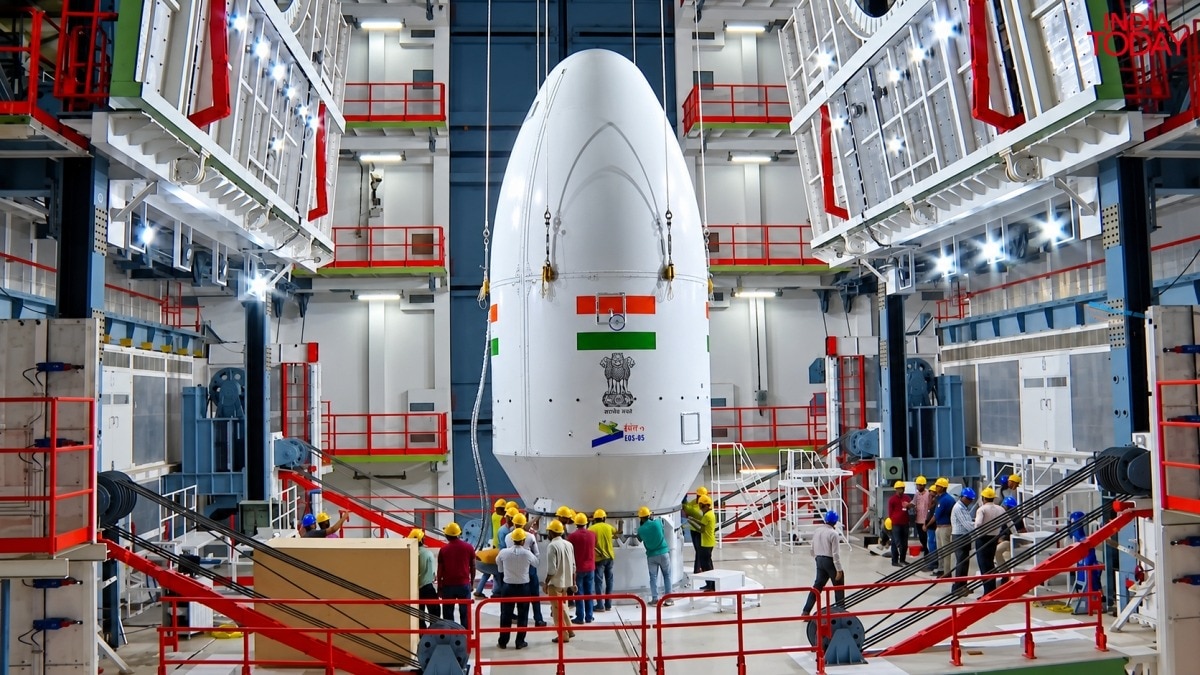
Employee associations from several Isro centres have sought a written clarification from V Narayanan on the agency's future role.The associations represent around 5,000 employees, or about 27% of Isro's stated workforce of 18,100. (Photo: Generative AI by India Today)India's space sector is opening up to private companies at a pace not seen before. But inside the Indian Space Research Organisation (Isro), sections of the workforce are asking a fundamental question: How far will this privatisation go, and what will happen to Isro's own role in building rockets, satellites and running launch infrastructure?That question has now reached the top of the organisation.Following the successful launch of the GSLV F-17/EOS-05 mission on September 4, a report in The Times of India said employee associations from several major Isro centres wrote to Isro Chairman and Department of Space Secretary V Narayanan, seeking official clarification on the government's plans.The five-page letter, signed by nine representatives of employee associations from centres including VSSC, SDSC, URSC, LPSC, SAC, NRSC and IPRC, reflects growing unease among sections of the workforce. These associations represent around 5,000 employees, or about 27% of Isro's stated workforce of 18,100.So, what exactly are they worried about?WHAT DOES “PRIVATISATION OF ISRO ACTIVITIES” MEAN HERE? The concern is not simply that private companies are entering India's space sector.Since 2020, the government has been pushing for greater private participation across the space ecosystem. The idea is to allow companies to design, manufacture and operate space systems while Isro increasingly focuses on research and advanced technology development.The employee associations say they support legitimate private participation and commercialisation. What worries them is the possibility that activities currently performed inside Isro itself could progressively move outside the organisation.Their concerns intensified after Pawan Goenka, chairman of IN-SPACe, while speaking at Business Today's India @ 100 Economy Summit, said that eventually Isro would not manufacture launch vehicles and that this work would be carried out by private companies or public sector undertakings. For employees, that raises a much bigger question: If Isro stops building its own rockets, how much of its existing engineering and manufacturing capability will remain within the organisation?WHAT IS ALREADY BEING TRANSFERRED?The letter points to the transfer of SSLV technology and production technology to Hindustan Aeronautics Limited (HAL).It also highlights the ongoing bidding process for technology transfer of the LVM3, India's largest launch vehicle, as well as similar efforts involving the PSLV.The associations also refer to reports that routine satellite manufacturing could eventually move outside Isro and that new launch infrastructure, including the Space Launch Complex at Kulasekarapattinam in Tamil Nadu, could be opened to private entities.Their problem, they say, is not necessarily each individual move.It is the absence of a clearly communicated overall policy explaining where Isro's own responsibilities end and private participation begins.WHY DOES PRIVATISATION MAKE ISRO EMPLOYEES ANXIOUS?Isro employees argue that building a rocket is not simply a manufacturing job.Designing, integrating, testing and launching a rocket involves decades of accumulated expertise, institutional memory, safety procedures and technical capabilities.The associations fear that if these activities progressively move outside Isro, the organisation could lose some of the very capabilities it took decades to build.They also worry about what happens to the people currently doing this work.If private companies begin undertaking activities that are currently performed inside Isro, employees fear there could be less in-house work, fewer promotions, fewer opportunities for skill development and eventually reduced recruitment.The letter even raises the possibility that some existing employees could become surplus or be redeployed while similar work is carried out by private contractors using technology developed by Isro.And there is another concern: what happens to strategic autonomy?The associations argue that keeping critical launch-vehicle development, testing and launch operations within a public institution provides a particular level of accountability, quality control and safety oversight.They fear that moving too much of this capability outside Isro could dilute those safeguards. That question has now reached the top of the organisation. (Photo: PTI) ISRO ALREADY HAS A MANPOWER PROBLEMThe irony is that the concern over shrinking recruitment comes at a time when Isro itself has significant vacancies.Government data shows that as of February 2026, a total of 15,529 people were in position against 18,142 sanctioned posts. This gap means the agency is operating with a vacancy of about 14.4 per cent.The government has said efforts are underway to fill these vacancies.For the employee associations, however, the fear is that greater outsourcing of core activities could make the manpower situation worse by reducing the need for future recruitment.“Existing employees may be rendered surplus, or redeployed, or left without meaningful work while the same tasks are performed by private contractors using publicly developed technology. Regular recruitment to Group A, B and C posts — already constrained by vacancies and attrition — will further decline, denying opportunity to meritorious youth who look to Isro as a public career of honour, not as a private contractor's workforce,” the letter reads.ARE ISRO EMPLOYEES AGAINST PRIVATE COMPANIES?Not exactly.This is perhaps the most important distinction in the entire debate.The associations explicitly say they are not hostile to Indian industry and are not opposed to legitimate commercialisation through NSIL, Isro's commercial arm.Their demand is for a clear line between “enabling private participation” and “dismantling Isro's own realisation capability.”In other words, they are asking: Can India build a strong private space industry without weakening Isro itself?They also want greater transparency around the transfer of technology developed using public money.WHAT CLARIFICATION DO THEY WANT?The associations want Dr V Narayanan, who is both Isro chairman and Secretary of the Department of Space, to provide a written clarification on the future role of Isro, including its responsibilities for launch vehicles, satellites, infrastructure, staffing and recruitment.They have also sought structured discussions between the Department of Space and recognised employee associations.The larger issue is therefore not simply private versus government.It is about deciding what India's national space agency should look like in the next decade, whether Isro remains an organisation that both develops and builds India's major space systems, or increasingly becomes a research and technology organisation while private companies and PSUs take over much of the actual realisation of launch vehicles.And that is precisely why sections of the Isro workforce are anxious: they say they have not yet been told where that line will be drawn.- EndsPublished By: Sibu Kumar TripathiPublished On: Sep 6, 2026 07:30 IST
Why are Isro employees seeking clarification from govt over privatisation?
Full Article
Original Source
Read the full article at Indiatoday →KhanList aggregates and links to publicly available news content. We do not host full articles from third-party sources. Always verify important information with original sources.