
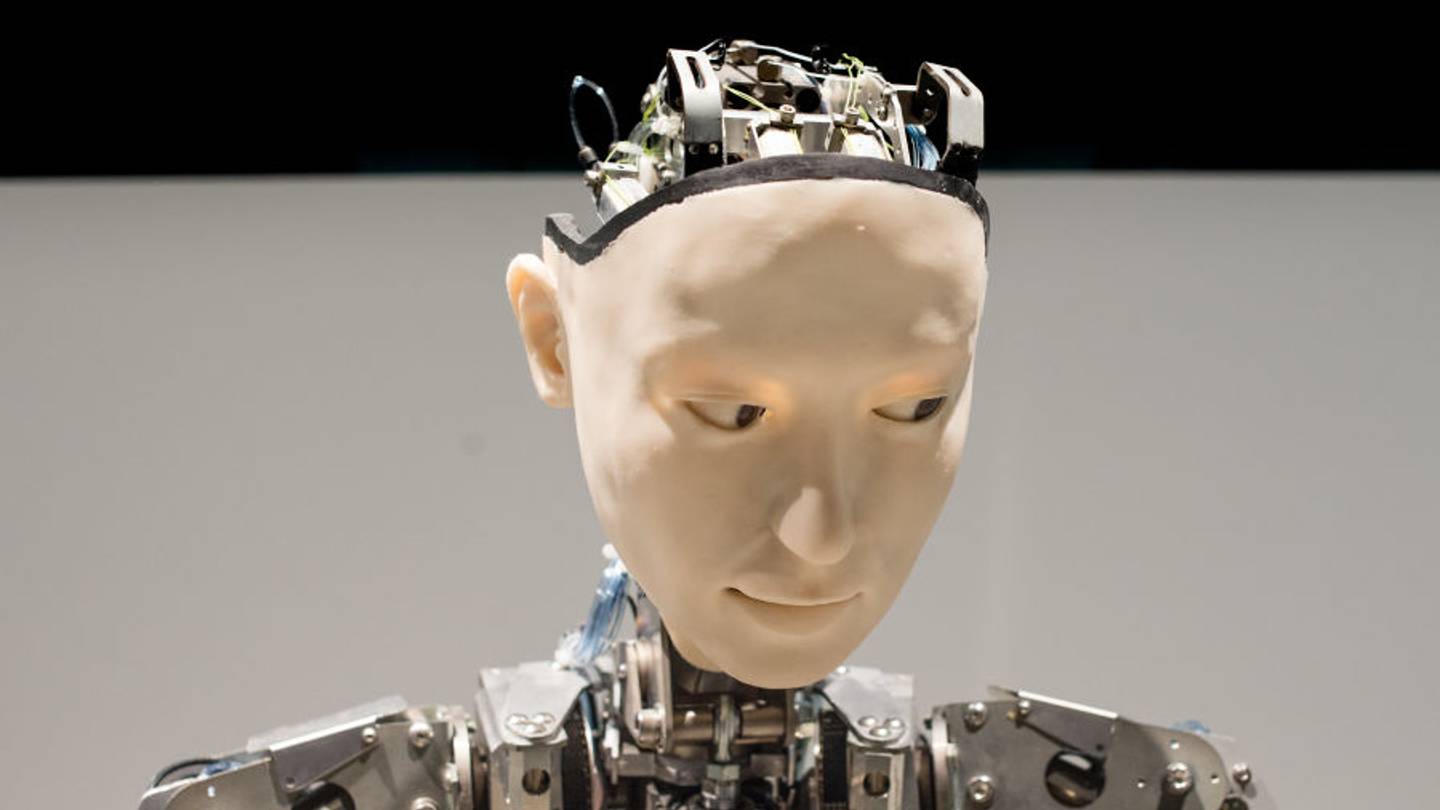
Thanks to a creepy makeup trend on TikTok, the phrase “uncanny valley” has fallen into wider use in recent years (and became even more of a talking point when that same makeup technique was used to unsettling effect in the horror blockbuster Obsession earlier this year). But far from being simply a synonym for creepy or unsettling, the phrase “uncanny valley” itself has a rather more specific meaning and origin story behind it. Strictly speaking, “uncanny valley” refers to the feeling of unease a person experiences on seeing or encountering something that is designed to appear lifelike but ultimately falls short, making it seem eerily almost-but-not-quite human. Humanoid robots, AI-generated faces or voices, synthetic dolls, toys, puppets, waxworks, and computer-generated characters might all fall under this definition, creating an ever-greater feeling of creepiness the more lifelike something tries to become. The Origins of the Uncanny ValleyAFP via Getty ImagesBoth the term uncanny valley and the theory behind it were the work of noted Japanese roboticist, Masahiro Mori. A professor at the Tokyo Institute of Technology, he spent more than 40 years working in the field of robotics (Honda’s famous ASIMO robot was developed by one of his proteges), and in the 1970s developed a pioneering bipedal humanoid robot, utilising a new kind of knee joint to walk upright on two legs. Alongside this, however, Mori became increasingly interested in human attitudes toward increasingly humanoid robots, and theorized that the more human-like a robot becomes, the more people’s attitude toward it changes—and not always for the good. Simple, bare, functional robots, such as those that work on industrial assembly lines, Mori theorized, elicit next to no response from people at all. The more human-like a robot becomes, however, the more people begin to feel an affinity with it. An upright-walking toy robot with a face, for instance, instantly feels more recognizably human-like than a whirring and clanking metal arm assembling parts in a car factory, and so it naturally resonates with us more readily. But as robots continue to become more lifelike, there eventually comes a tipping point, where things become almost too close to the real thing. Eventually, our natural affinity or empathy with these almost-but-not-quite robots and humanoids disappears, and collapses into eeriness. Mori plotted this trajectory on a line graph, showing with a rising line that as a robot becomes more humanlike, our affinity with it increases; but as it approaches a 100% human likeness, our affinity not only drops away, but plunges into revulsion and negativity, creating a noticeable dip on the graph that extends far below the x-axis. And this noticeable negative dip is what Mori named the “uncanny valley.” Why Human Likeness Can BackfireAdmittedly, Mori’s original theory was initially based more on his own intuition than any empirical studies, and so was intended more as a commentary on robot design than anything else. “Pointing out the existence of the uncanny valley was more of a piece of advice from me to people who design robots rather than a scientific statement,” he later explained, making it clear that he saw the valley not as a problem to be overcome, but rather a phenomenon that robotics designers should be aware of. Humanoid robots, he ultimately believed, should be intentionally made less lifelike, rather than risk alienating or unnerving the people who encounter them. But what causes the uncanny valley in the first place? Well, not even Mori himself could answer that—although science is busy trying to find an explanation. In 2019, a team of neuroscientists at Aachen University in Germany found that interacting with humanoid robots sets two parts of the brain in action: the medial prefrontal cortex, which responds with a kind of “human detection” signal, and the ventromedial prefrontal cortex, which converts this first response into a “likeability valuation.” This package of information is then dealt with by the amygdala, which creates an emotional response. The FutureVALENTIN FLAURAUD/GettyImagesTheir research not only proved that the uncanny valley exists, just as Mori had theorized, but found that not everyone responds in the same way, with some having a far more negative reaction than others. As a result, it seems the valley is unavoidable, and there is no single robot design that pleases (or terrifies) everyone. The solution in the future, ultimately, might not be to aim for ever greater human-like features in an effort to “solve” the uncanny valley, but to follow Mori’s advice and intentionally make robots appear less human to avoid any kind of reaction at all. Read More:
Why Are Creepy Things Called 'Uncanny Valley'?
Full Article
Original Source
Read the full article at Mentalfloss →KhanList aggregates and links to publicly available news content. We do not host full articles from third-party sources. Always verify important information with original sources.