
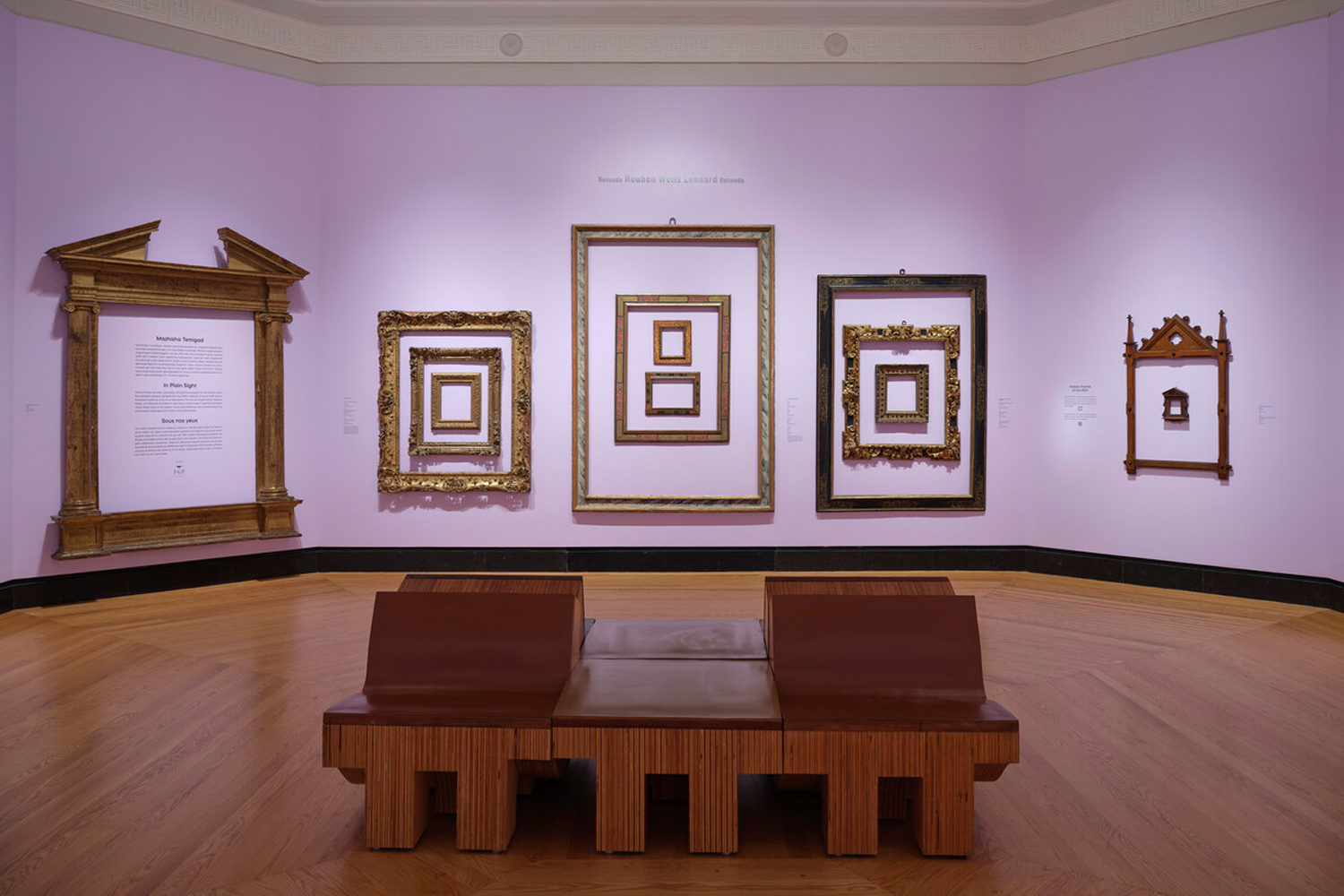
A new display at the Art Gallery of Ontario presents a rich array of empty frames, putting the spotlight on the overlooked artisanship that goes into these protective and decorative objects November 17, 2026 7:45 a.m. A new exhibition in Canada argues that picture frames are artworks in their own right. Art Gallery of Ontario In 1671, a frame maker named Mary Ashfield received an important commission from the city of London. She was asked to make eight frames to ornament portraits of the “fire judges,” a group of legal experts who presided over property disputes in the chaotic aftermath of the 1666 Great Fire of London. The portraits were life-size and would be displayed for all to see at the Guildhall, an administrative center in the heart of the city. The paintings’ frames had to be suitably monumental—and Ashfield, a skilled craftswoman, rose to the challenge. One of the wooden frames that Ashfield produced for the series now hangs on the walls of Toronto’s Art Gallery of Ontario (AGO), where it is the centerpiece of a new exhibition titled “In Plain Sight: Highlights From the AGO’s Collection of Historic Picture Frames.” Ashfield’s frame is towering in height and carved with intricate, swirling forms. Originally gilded, the frame was later painted black, and it stands in dramatic contrast to the lavender walls of the exhibition space. The portrait that was once paired with this frame has been lost: Like all 37 of the frames featured in the exhibition, Ashfield’s work is displayed without a painting inside, allowing its beauty and grandeur to shine. Mary Ashfield's frame for the "fire judges" series is the largest of the picture frames featured in this photo of the exhibition. Art Gallery of Ontario Mounting empty frames on museum walls is a “provocation,” says Adam Harris Levine, the AGO’s associate curator of European art. “In Plain Sight” challenges visitors to appreciate frames as artworks in their own right rather than as supporting acts to the pictures they border. Spanning the 15th through early 20th centuries and sourced from across Europe, the frames on view are carved, painted, covered with wood veneer or inlaid with rare stones—an arresting range of decorative techniques. These works of art “have always been standing right there in front of us,” Levine says. “But we’ve always been directing our visitor to look at the painting inside.” An overlooked art form By nature, frames exist at the edge of the spotlight. They are created to protect, define and complement other artworks; they aren’t supposed to steal the show. “If the frame is the right frame, [it] will not impede the artwork,” says Martin Kotler, a retired frames conservator who worked at the Smithsonian American Art Museum (SAAM) in Washington, D.C. for 44 years but wasn’t involved in the AGO exhibition. “It will amplify the artwork in a really quiet way.” Installation view of "In Plain Sight: Highlights From the AGO’s Collection of Historic Picture Frames" Art Gallery of Ontario Those who cherish frames feel that the artistry of the genre and its influence on other art forms are too often overlooked. When Kotler began working with frames in the 1980s, scholarship on the subject was sparse. “I would go to a library and find no books” on picture frames, he recalls. “But every year, there were at least three to five brand new books on Picasso.” Inside museums, frames have often been treated with ambivalence—or worse. It was once common practice for art collectors and cultural institutions to remove original frames from paintings and replace them to suit shifting tastes, sometimes destroying unwanted frames in the process. In the 1800s, for example, gilded French frames from the preceding century were a popular choice in galleries. They “became the lingua franca for ‘fancy,’ this universal placeholder for elegance,” Levine explains. “People wanted frames that look like this on every single picture they have, whether it was a Rembrandt or a Spanish Renaissance painting.” When Kotler arrived at SAAM, he was confronted with the opposite aesthetic. In the 1970s, around 100 gold frames at the museum had been covered with bronze paint and subsequently replaced with wood frames that were painted gray. Most curators at the time “knew nothing” of frames, the conservator recalls, and “decisions about what is ‘correct’ [for framing an artwork] were based on gut reactions.” Prejudice against the decorative arts may explain the lack of reverence for frames over the course of their history. In the past, frames were typically made by one or more workers skilled in carving, joinery, carpentry or gilding—crafts that weren’t traditionally considered as important as fine arts like painting and sculpture. The inner frame seen here exemplifies the Renaissance revival style, while the outer one is typical of the Gothic revival style. Art Gallery of Ontario It wasn’t until the 1990s that scholarship on frames “really begins to take off,” according to Eric Birkle, the AGO’s curatorial fellow in European art, who curated “In Plain Sight” alongside Levine and Julia Campbell-Such, the museum’s assistant conservator of frames. This rise in academic interest happened to coincide with two major donations of European frames to the AGO in 1994 and 1997. Gifted by an anonymous collector, the trove totaled more than 1,200 frames, most of them empty. Curators staged an exhibition to showcase standouts from the first donation in 1995. But they still had much to discover about the windfall that had come into the museum’s possession. When Levine joined the AGO in 2020, he found “that lots of [the frames]—like hundreds and hundreds and hundreds of them—had been sitting in storage.” Levine invited Hubert Baija, a retired senior frames conservator at the Rijksmuseum in Amsterdam, to spearhead a comprehensive survey of the AGO’s frames. The goals of the project, which began in 2023, were to gain a precise understanding of the items in the collection, to conserve them, and to reframe artworks in the museum so that paintings would be matched with frames that originated from the same time and place. Campbell-Such was hired to work with Baija and absorb his vast knowledge of historic frames. The project continued after Baija’s departure, with Birkle joining the team in 2024. The group’s research revealed that “we really do have one of the best collections of picture frames in the world,” Levine says. “The assessment that we undertook really just underscored the quality, and the depth and the breadth.” A multifaceted history Drawing on this robust collection, “In Plain Sight” explores the evolution of the freestanding picture frame. “There’s always going to be, throughout the history of time, supports and boundaries for the end and the beginning of a painting,” Levine notes. But the concept of a four-sided frame that could be removed and exchanged only emerged in the late 15th century. Previously, wooden frames were a fixed component of artworks—either carved into the wood panel on which the art was painted or made separately and attached to the painting. Such frames “began as protective edges for religious paintings,” art historian Richard R. Brettell wrote in The Art of the Edge: European Frames 1300-1900. But they could also be highly decorative. One prominent form of devotional art during the Middle Ages was the altarpiece, which featured paintings or sculptures surrounded by elaborate frames that mimicked the architecture of churches. Large-scale altarpieces were often installed in places of worship. In both construction and symbolism, the artwork and its frame were connected. A 14th-century altarpiece by the Italian Gothic artist Cenni di Francesco Public domain via Wikimedia Commons The freestanding frame came about “largely as the result of the privatization and secularization of the painting” during the Renaissance, according to Brettell. Portraits that were made for domestic spaces, for example, proliferated during this period and required a simpler frame than altarpieces. “Sometimes they are quite small, quite movable, where it makes sense to have an interchangeable frame,” Levine says. Later, in the 17th and 18th centuries, surfaces for painting—like canvas, wood panels and metal sheets—were sold at markets in regular sizes. This, in turn, drove demand for frames in standard dimensions. One of the earliest standalone frame types was the Italian cassetta, which had a simple profile with a flat, central band and raised moldings on the inner and outer edges. An elegant example is on view in the exhibition. Decorated with sgraffito, a technique that involves scratching a layer of paint to reveal the gilding underneath, the frame entered the collection paired with a 20th-century artwork. “We realized over the past five years, during our research project, that this was actually one of the oldest frames under our roof, from the late 1400s or early 1500s,” Levine says. Did you know? Framing Leonardo da Vinci In 2017, Salvator Mundi, a painting of Jesus attributed to Leonardo da Vinci, went under the hammer for $450.3 million, becoming the most expensive artwork ever sold at auction. Ahead of the Christie’s sale, a New York City company reframed the painting in a 16th-century cassetta worth an estimated $40,000 to $50,000 in its own right. Some frames in the gallery are mounted within one another, highlighting the innovative flourishes of frame makers working in the same period and place. Three frames, for example, embody the drama of the Spanish Baroque but reflect distinct regional styles. One frame is austere and black, painted with gold details. Another is carved with an ornate, flame-like design, while the third is dotted with carvings in the shapes of precious stones. The exhibition similarly showcases three opulent frames from France, where the craft of frame-making was centered at the Parisian court during the 1600s and 1700s. Each of the frames represents a different style that borrows its name from a reigning monarch; together, the frames reveal how designs became increasingly elaborate over time. French frames of the Louis XV revival style (outer), Louis XIV style (middle) and Louis XIII style (inner) Art Gallery of Ontario The smallest one, a Louis XIII-style frame from the first half of the 17th century, features intricate carvings, but its silhouette is relatively simple. It is mounted within a Louis XIV-style frame, dated to between 1643 and 1715, which is adorned with floral motifs and foliage that projects out from the corners of the frame. The largest of the trio has sweeping curves along its edges and is covered with delicate flowers—details that are characteristic of the playful Rococo style that emerged during Louis XV’s reign in the 18th century. But when studying the reverse of the frame, curators found “something very revealing,” Birkle says: “round saw marks.” He adds, “It’s very likely that this frame was made in the latter part of the 19th century, when [circular saws] became common to use, specifically in frame-making.” The frame was, in other words, a revival of an earlier style. Just like the paintings they hold, frames encode stories about politics, society and culture during their era of origin. According to Birkle, the Louis frames reflect the “excess and exuberance” that characterized the French court during the height of the monarchy. As resentment over social inequality grew in France, decadent aesthetics associated with the aristocracy fell out of favor. The more restrained neo-Classical style was dominant in the years before and after the French Revolution. But a “second Rococo” movement emerged during the restoration of the monarchy in the 19th century, and lavish designs returned to art forms like frame-making. A trio of Dutch frames featured in the exhibition Art Gallery of Ontario At the AGO, a group of Dutch frames from the 16th and 17th centuries is less ostentatious than its French counterparts but conveys similar signals of luxury. The frames are either covered with a veneer of ebony or painted to emulate the dark hardwood, which was extracted from tropical regions through the Dutch colonial trade. Because it was difficult to harvest, ebony was rare and expensive—and its desirability in Europe led to devastation in colonized lands. On the island of Mauritius, for instance, swaths of ebony forests were destroyed. The ebony trade also relied on the labor of enslaved people, who were transported to Mauritius to harvest this coveted resource. The exhibition’s frames “contain all kinds of invisible and visible labor,” Levine says. Most of the items on view cannot be attributed to a specific person or workshop; the names of frame makers were rarely preserved due to the craft’s status as a secondary art form. Ashfield is a notable exception, not only because details of her biography are known but also because it was unusual for a woman in 17th-century England to make picture frames. The job was physically demanding, especially at the large scale in which Ashfield worked. Her prominence in the field, according to Levine, “really defies our expectations about what we thought women were and weren’t allowed to do at this time.” A new chapter The moment may be right for frames, with their rich and complex history, to find appreciation among a wider audience. In recent years, members of Generation Z in particular have exhibited a growing interest in crafts. Hobbies like needlepoint, knitting and pottery are rising in popularity among people seeking a creative outlet for the stresses of modern life. Birkle also points to a “rejection of this bland, corporate, minimalist environment” that has prompted a demand for vibrancy in decor. “There’s this desire, I think, for detail and for the reintroduction of color and ornament into spaces,” he says. Kotler believes that exhibitions like “In Plain Sight” are an important step toward fostering enthusiasm for the genre of presenting frames without pictures. Back in 2006, he collaborated on a small display of empty frames at SAAM’s Luce Foundation Center. Spotlighting frames in this way “allows the viewer … to see the nuance of the art,” he says. Hubert van Ravesteyn's Still Life With Walnuts, Tobacco and Wine, before (left) and after (right) the 1671 work was reframed Art Gallery of Ontario The curators of “In Plain Sight” hope that after exploring the exhibition’s array of empty frames, visitors will be inspired to contemplate the interplay between frames and the paintings they hold. The AGO has committed to reframing its artworks with frames from the same country and time of origin because “we are trying to return to the original aesthetic intentions of the artist,” Levine explains. Among the paintings that have been reframed in recent years is a 1671 work by the Dutch artist Hubert van Ravesteyn. Titled Still Life With Walnuts, Tobacco and Wine, the painting features a black background that emphasizes the light caressing the objects in the foreground. The artwork was once paired with an 18th-century gilded frame that “absolutely did not suit the painting,” Levine says. It was replaced by a 17th-century Dutch frame with an ebony veneer, which melds into the still life’s shadowy tones. At times, curators have turned to the museum’s collection of historic frames when working with contemporary artists. The AGO recently acquired a portrait by Kimani Beckford, which depicts an unnamed Black boy in front of a verdant Jamaican landscape. Beckford wanted a historic frame for his painting, and the museum’s staff suggested a large gold frame dating to the 18th century. At the time, British colonizers ruled Jamaica and extracted wealth from the island through the exploitation of enslaved workers. The AGO paired Kimani Beckford's portrait of an unnamed Black child with an 18th-century gold frame. Art Gallery of Ontario Displayed together, the portrait and its frame subvert this fraught history. Dressed in a crisp white shirt and burgundy blazer, surrounded by a glistening border, Beckford’s subject is commanding and regal. As Levine says, it is a “powerful statement to decide who gets the grandeur of these portraits and these frames.” “The frame,” he adds, “can make meaning.” “In Plain Sight: Highlights From the AGO’s Collection of Historic Picture Frames” is on view at the Art Gallery of Ontario in Toronto through November 7, 2027. The frame at left in this photo was decorated with sgraffito, a technique that involves scratching a layer of paint to reveal the gilding underneath. Art Gallery of Ontario You Might Also Like Get the latest History stories in your inbox. More about: Art Art History Artists Arts and Crafts Canada Colonialism Crafts European History Exhibitions Exhibits France London Museums Painters Painting Renaissance Slavery Smithsonian American Art Museum Smithsonian Institution
Why Are All 37 of the Picture Frames in This Exhibition Empty? The Frames Themselves Are the Stars of the Show
Full Article
Original Source
Read the full article at Smithsonianmag →KhanList aggregates and links to publicly available news content. We do not host full articles from third-party sources. Always verify important information with original sources.