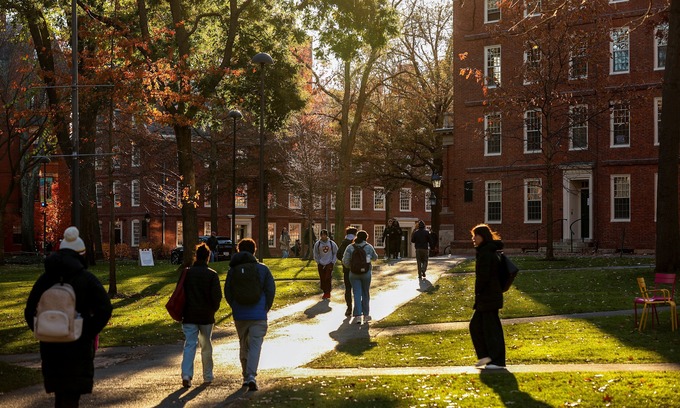
Admissions officers at universities in the U.S. choose students that fit into a class rather than those with excellent academic results, officials from the University of Michigan and Dartmouth College said at a seminar in Vietnam. Erica Sanders, assistant vice provost and executive director of undergraduate admissions at Michigan, said the school adopted a test-optional policy in 2024 and remains test optional for the current cycle.Scores are not what decides an application, Sanders said.Christina Moreland, associate director of admissions at Dartmouth, said the college still runs a holistic review, a practice it has used since 1921.Dartmouth reinstated its SAT and ACT requirement in 2024, joining Yale, Brown, MIT and Georgetown, with Princeton following for fall 2027 entry.Officers work through a set of questions on each applicant. The first is whether the student can handle the academic pressure.Others cover what they have done with the opportunities available to them, what they care about, and what they would bring to the campus.Admissions staff at both schools still read every application individually, Sanders said, despite the spread of artificial intelligence through teaching and learning.At the final stage, officers pick students who fit together into a class that matches each school's priorities. Thus, applicants with very high scores would be turned away while others with thinner records but a distinctive profile get in.Students should not chase a template that is not who they are, or take on activities purely to fill an application, or assume a research project is needed to convince a committee, the two said at the seminar on U.S. higher education trends held by IIG Vietnam and the College Board last month.They also warned against rushing the essay or using it to list achievements. Students walk on campus at Harvard University in Cambridge, Massachusetts, U.S., Nov. 19, 2025. Photo by Reuters Sanders said U.S. universities are recruiting harder abroad as the domestic pool shrinks.Research by the Western Interstate Commission for Higher Education, funded in part by the College Board, projects that U.S. high school graduates peaked in 2025 at 3.9 million and will fall to 3.4 million by 2041, a drop of 13%.Sanders said applicants should weigh five factors when choosing among the more than 4,000 U.S. universities she counted.The first is whether to go public or private. Public universities tend to be large with broad academic offerings, while private schools are smaller and more specialized.The second is the route in. Rather than entering a four-year university directly, international students can start at a community college and transfer, which gives them time to adjust to the language and the classroom.The rest are location and the community around the campus, the cost and what scholarships are available, and what the school offers outside the classroom.U.S. institutions hosted 1,177,766 international students in the 2024-2025 academic year, according to the Institute of International Education's Open Doors report.Vietnam sent 25,584 of them, up from 22,066, becoming the fifth-largest source country after India, China, South Korea and Canada.Michigan ranks third among U.S. public universities and 20th overall in the 2026 U.S. News & World Report rankings, with 34,454 undergraduates. It hosted 11,929 international students in 2024-2025, more than all but 10 U.S. institutions.Dartmouth, a member of the Ivy League, enrolls about 6,900 students, including 4,637 undergraduates.
Why applicants with top scores still get rejected by US universities
Full Article
Original Source
Read the full article at E →KhanList aggregates and links to publicly available news content. We do not host full articles from third-party sources. Always verify important information with original sources.