
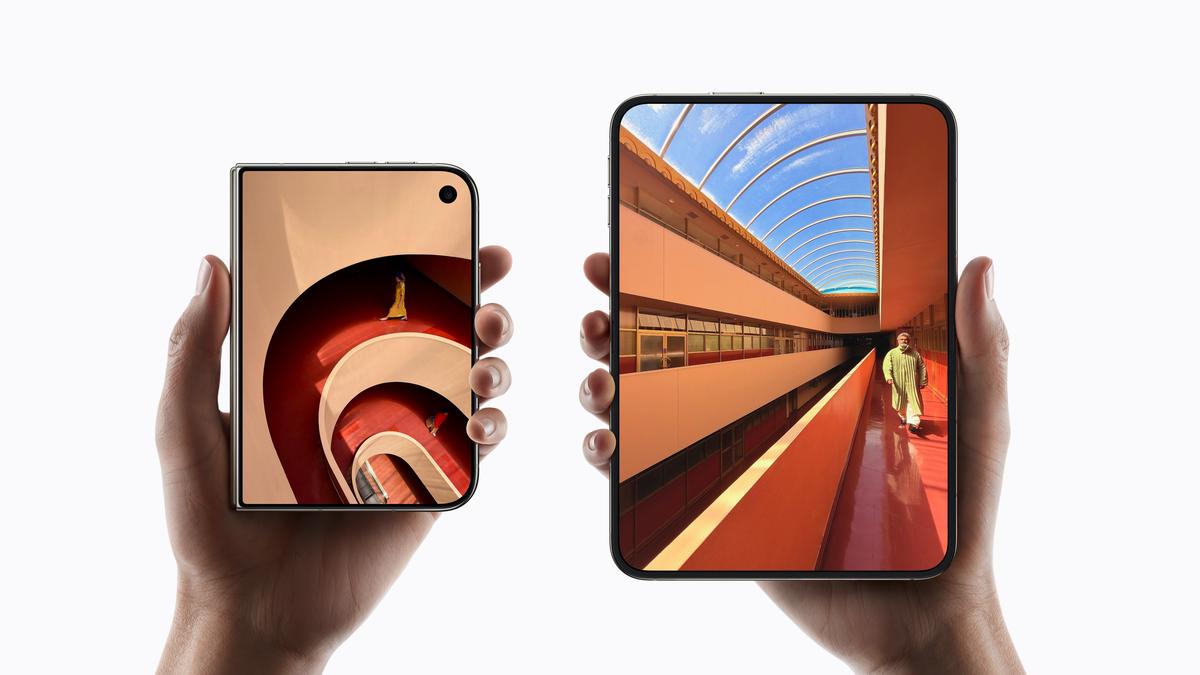
Once, ending a phone call felt like a small dance. Your thumb would find the hinge, give a gentle push with your wrist, and then the conversation would come to a neat close with a satisfying snap. It felt decisive, in a way that simply tapping a red icon hasn’t quite captured. The call was finished, the phone was shut, and for a little while, your availability was perfectly clear. A titanium frame and hinge support a device that houses two batteries, several cameras, and an operating system that constantly detects which screen is active Nearly two decades of glass rectangles have trained that gesture out of us. Smartphones have become faster, brighter, and better at almost everything, but their physical vocabulary has narrowed. We tap, swipe, and occasionally pinch. Even as the devices have absorbed the camera, diary, television, wallet and office, their shape has settled into such familiarity that a new phone can often pass unnoticed until its owner names the model.Apple’s iPhone Duo brings back what might be called the snapback: the pleasure of a phone that changes state in your hand.This nostalgia extends beyond the Motorola Razr, though many who remember closing one against their palm will feel a familiar appeal. It’s a yearning for a time when phones had personalities reflected through their movements. They flipped open, slid out, swiveled, or opened sideways to reveal keyboards. The mechanism determined how the phone was carried, stored in a pocket, or answered quickly. The subtle sounds became a natural part of everyday life. Smart Take can recognise when a group appears ready and capture the photograph automatically The Duo captures that special moment without suggesting that technology can revert to simpler days. It isn’t a nostalgic reissue with a small screen and large buttons. Instead, it’s Apple’s most complex iPhone, featuring a 5.4-inch outer display and a 7.6-inch foldable inner screen. A titanium frame and hinge support a device that houses two batteries, several cameras, and an operating system that constantly detects which screen is active and the phone’s orientation.Apple is arriving late to folding phones, of course. Samsung and several Chinese manufacturers have already spent years working through their awkward creases, fragile hinges and unusually thick bodies. Indian buyers do not need to be introduced to the form. Instead, Apple is trying to make the fold feel less like an engineering exhibition and more like a natural part of using an iPhone. Sitting on a table, it can support itself during a video call, workout, or family shot, so you don’t have to hold it the whole time This distinction really shines through when you leave the Duo partly open. Sitting on a table, it can support itself during a video call, workout, or family shot, so you don’t have to hold it the whole time. Whether on a busy desk or an airplane tray, one half becomes the screen, while the other serves as a sturdy stand. When fully opened, the bigger display comfortably fits two apps side by side, making multitasking a breeze without feeling cramped.These are practical advantages, but the more interesting changes involve other people. Duo Preview allows the person being photographed to see the frame on the outer display. It alters a familiar domestic ritual in which one person controls the camera while everybody else waits to inspect the result. Smart Take can recognise when a group appears ready and capture the photograph automatically, while Kid Cue uses an animation near the lens to draw a child’s attention towards the camera. The iPhone Duo begins at ₹2,99,900 in India Such features may sound modest beside the larger promises made for artificial intelligence, but they acknowledge how photographs are actually made in Indian homes. Someone is usually calling another person into the frame, coaxing a child to look up or balancing the phone against an object so that the photographer can join the family. The Duo’s intelligence is most convincing when it solves these ordinary inconveniences without turning the occasion into a technology demonstration.Its fold also introduces a surprisingly social quality to an object that has spent years becoming more private. The conventional smartphone belongs almost entirely to the person looking at it. The Duo can open towards someone else, allowing a photograph, map, document or video to occupy the space between two people. A larger screen does not automatically make a device more communal, but the act of unfolding it creates an invitation that a fixed rectangle rarely does. Duo Preview allows the person being photographed to see the frame on the outer display This experiment inevitably comes with a formidable price tag. The iPhone Duo begins at ₹2,99,900 in India, with the 2TB version reaching ₹4,49,900. Even by Apple’s standards, it sits in a different financial category from the iPhone 18 Pro, which starts at ₹1,64,900, and the ₹1,79,900 Pro Max. The Duo is not priced as the logical next step in the iPhone range. It is being sold as an entirely new proposition, the iPhone elite, if you will.By comparison, the iPhone 18 Pro refines the familiar rectangle. Its variable-aperture main camera, three 48MP rear cameras, longer battery life and new burgundy finish offer considerable upgrades, but they reveal themselves gradually through use. The Duo announces its novelty the moment you open it. One is an accomplished continuation of the smartphone as we know it; the other asks whether its shape might become expressive again.This release includes no standard iPhone 18, with the iPhone 17 and iPhone Air remaining in the line-up. The iPhone 18 Pro and Pro Max go on sale in India on September 18, while pre-orders for the Duo begin on October 16 before availability on October 23. Pre-orders for the Duo begin on October 16 before availability on October 23 The old flip phone made closing a conversation unusually satisfying. Apple’s foldable is more interested in what happens when the phone opens: a larger workspace, a steadier camera and a screen that can be shared rather than guarded. Yet the snap remains important because it restores a boundary that the smartphone gradually erased. When the Duo closes, something is visibly finished.After many years of similar-looking iPhones, Apple has introduced a new device that does more than just change what appears on the screen: it also changes how you hold and interact with it. It’s exciting to think that the future of smartphones might come down to rediscovering a gesture we thought was gone. This new approach invites us to reconnect with a more intuitive way of using our devices, making the experience even more personal and engaging.
Why Apple wants us to fold the phone again
Full Article
Original Source
Read the full article at Thehindu →KhanList aggregates and links to publicly available news content. We do not host full articles from third-party sources. Always verify important information with original sources.