
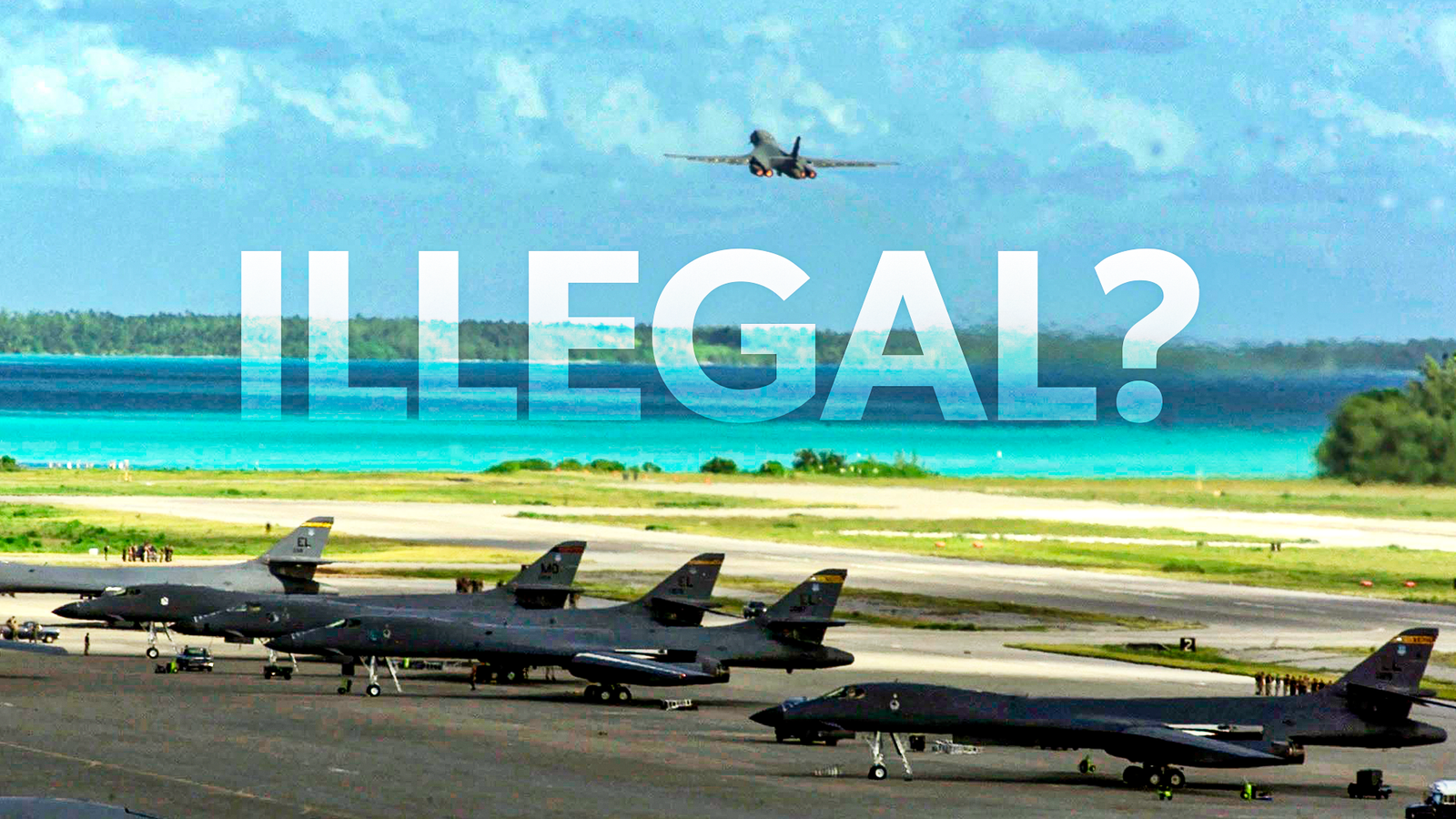
Published Nov 20, 2026, 1:00 PM EST Passionate about promoting aviation, the beauty of flight and the science behind it, Antonio is an avid reader of aviation magazines and books, and he loves visiting airshows all over the world, taking photos and writing about airplanes and helicopters as well. He is currently based in Palermo, Sicily. One of America’s most important bomber bases sits on an island the United States has never owned, that the world’s highest court says Britain should have returned, and whose future now hangs on a treaty that has been signed but cannot take effect. Diego Garcia is a coral atoll in the Indian Ocean with a runway of roughly 12,000 feet (3,659 meters), according to SKYbrary. Few overseas airfields matter more to American long-range airpower. Few stand on shakier legal ground. That creates a problem far bigger than a dispute over a line on a map. Britain, Mauritius, the displaced Chagossians and Washington each have competing interests in Diego Garcia, but the most important question for the US military is much more practical: can America be certain it will still have unrestricted access to one of its most strategically useful bomber bases? The answer depends on a treaty signed in 2025, an agreement dating back to 1966, and a dispute that has yet to be resolved. How Did A Remote Atoll End Up In Legal Limbo? The story starts with a map redrawn at the last minute. According to Al Jazeera, Britain separated the Chagos Archipelago from Mauritius in 1965, three years before Mauritian independence, and later built a base with the United States on Diego Garcia, the largest island. Between 1968 and 1973, as the same report notes, authorities removed an estimated 1,400 to 1,700 Chagossians. Many ended up in Mauritius and the Seychelles, and returning without permission became illegal. The human cost still echoes: Olivier Bancoult of the Chagos Refugees Group told Al Jazeera that mourners at one funeral scattered sand from Chagos into an elder’s tomb, honoring his unfulfilled wish to die in his homeland. Chatham House explains that the 1965 separation was agreed at a London conference in exchange for £3 million, after which the UK created the British Indian Ocean Territory and kept it out of Mauritius’s independence. In 2019, the International Court of Justice advised that the separation was unlawful and that the UK should end its administration as quickly as possible. The opinion is not legally binding, Chatham House stresses, but the UN General Assembly endorsed it. Critical Legal Thinking adds that the Court’s vote was thirteen to one, and that Britain let the UN’s six-month deadline pass. The dispute therefore became more than a question of colonial history: Britain was still administering the territory containing an active US military base, making the future of Diego Garcia inseparable from the sovereignty dispute. Negotiations followed instead, and in May 2025, London and Port Louis signed a treaty. That raises an awkward puzzle: if the deal hands sovereignty to Mauritius, why was it sold as a way to protect the base? What Does The 2025 Treaty Actually Do? Credit: Steve Travelguide | Shutterstock Signed on May 22, 2025, the treaty would let Mauritius exercise sovereignty over the whole archipelago while the UK keeps rights over Diego Garcia for an initial 99 years, as reported by Al Jazeera. For the US military, that distinction is critical: Mauritius would gain sovereignty, but the arrangement is designed to preserve continued British and American use of the airbase. Chatham House says the lease can be extended. Critical Legal Thinking puts the extension at 40 years, lists payments of £165 million a year for three years, then £120 million a year, and says the British Indian Ocean Territory would cease to exist as a legal entity. It also describes a 24-nautical-mile (about 28 miles, or 44 km) buffer zone where nothing can be built without UK consent. For Chagossians, the deal opens only part of the door. Resettlement is allowed on islands other than Diego Garcia, but UN Special Rapporteurs observed in June 2025, as Critical Legal Thinking recounts, that the agreement was reached without Chagossian consent. Why do a lease and a buffer zone matter so much? Because of what flies from there. As Simple Flying reports, the Northrop B-2 Spirit has an unrefueled range of about 6,000 nautical miles (11,112 km), and crews have flown missions lasting more than 40 hours. Meanwhile, Simple Flying’s analysis of the B-52 notes that the veteran bomber can carry up to 70,000 lb (32,000 kg) of mixed ordnance. Both types need a runway and a legal right to use it. The Treaty At A Glance: Term What the sources say Sovereignty Mauritius, over the whole archipelago Diego Garcia lease 99 years, extendable by 40 Payments £165 million a year for 3 years, then £120 million a year Buffer zone 24 nautical miles (about 28 miles / 44 km) Resettlement Outer islands only, not Diego Garcia Status Signed, not in force But a treaty only works if the other treaty, the older one, lets it. And the older one contains a sentence that has now become the most argued-over line in the dispute. Why Does A 1966 Agreement Still Decide Everything? Credit: US Air Force That older paper is the 1966 US-UK agreement governing the American military presence on Diego Garcia. Chatham House describes it as granting extensive basing rights for an initial 50 years, renewing automatically for 20 more, to 2036. Its first clause says the territory remains under UK sovereignty. That wording is now at the heart of the dispute because the 2025 treaty would transfer sovereignty to Mauritius while preserving the military arrangement. The pause in Lords debate followed a Conservative amendment claiming that ratification would breach the 1966 agreement. For Washington, the issue is therefore not simply who owns Diego Garcia, but whether the legal framework supporting American access to the airbase can survive the change. Experts disagree sharply. The Chatham House analysis argues that the clause was written to reassure London, not to bind it forever, noting that either side can terminate the arrangement with two years’ notice. It also points out that Secretary of State Marco Rubio publicly welcomed the 2025 deal, which, in its view, cost Washington any right to object. The Mauritius Times sees a tighter bind: the 1966 notes do not override the new treaty under UK law, but they stop London from finalizing a transfer without American consent, leaving what it calls a legal deadlock. Both readings point to the same hinge: a formal exchange of letters from Washington. Which raises the obvious question. Why would the United States risk so much over one island? Why Is Washington So Protective Of This Base? Because few places can do what Diego Garcia does. Simple Flying explains that overseas hubs such as Diego Garcia and RAF Fairford regularly host American bombers, but typically support only one bomber type per deployment. It adds that few foreign bases can sustain B-2 operations for long, because stealth coatings are sensitive to humidity and contamination, so each deployment is a carefully planned logistics exercise. In other words, the base is only as dependable as the legal right to use it. The base also has a political cost because its military role is inseparable from the sovereignty dispute. Al Jazeera reports that Mauritius has stated that strikes launched from Diego Garcia against Iran breached international law. International relations consultant Bruno Donat argues the treaty could give Mauritius more leverage over how the base is used. The Mauritian group Lalit wants the base closed entirely; its spokesperson, Lindsey Collen, warns that Mauritius might become a target if its land is used this way. Chagossian leader Olivier Bancoult says his community is opposed to war but is running out of time. That leaves Washington facing a difficult calculation: preserving access to the base is strategically valuable, but its future use is becoming increasingly tied to the political and legal terms under which Mauritius accepts the arrangement. With stakes that high, a frozen treaty is not a small bureaucratic hiccup. So who pulled the brake, and when? Who Froze The Deal, And What Happens Now? Washington’s tone shifted in stages. Chatham House notes that by February 2025, President Trump seemed “inclined” to back the arrangement. By January 2026, Al Jazeera reports, he was criticizing it harshly and questioning whether it protected the base. In the same month, per Critical Legal Thinking, the House of Lords added amendments requiring a Chagossian referendum and the suspension of payments if the base became militarily inoperable. Weeks later, the Trump administration withdrew support and refused the exchange of letters needed to amend the 1966 treaty. The Mauritius Times says the UK placed the handover in a “deep freeze” as of April 15, 2026, and Al Jazeera adds that the government told Parliament the bill could not finish its passage before the session ended on April 29. Critical Legal Thinking says the bill was paused with no plans to reintroduce it, although the Mauritius Times notes that London still says it is engaging with both capitals and considers the treaty the best way to secure the base’s long-term future. Meanwhile, the Mauritius Times notes that the territory’s administration paused new visitor-permit applications for the outer islands on March 31. However, the story did not end in April. In September, the UK and Mauritius returned to discussions, with Burnham saying he wanted to work with Mauritius and the United States on a solution that would secure the continued operation of Diego Garcia and protect national security. By November, the discussions had moved beyond simply trying to revive the stalled treaty. Burnham said Britain was talking to Washington about how to “recast” the arrangement so it better addressed American concerns, describing Diego Garcia as a priority because of its strategic significance. He also suggested that the recently negotiated Greenland arrangement between the US and Denmark might offer a model for finding a solution. What Will Decide Diego Garcia’s Fate? According to Al Jazeera, British Prime Minister Andy Burnham said on September 21 that the UK would work with Mauritius and the US on a way forward that secures the base. Five days later, Mauritian Prime Minister Navin Ramgoolam flew to London to meet National Security Adviser Jonathan Powell. Mauritius, for its part, still calls its sovereignty non-negotiable, while sharing little about the substance of the talks. Donat argues Mauritius should keep engaging the African Union, small island states, the Commonwealth Secretariat, and sympathetic US lawmakers to build pressure on Washington. In June, Al Jazeera adds, Chagos Refugees Group members traveled to the UK to lobby every major party except Reform UK. The test is simple to state and hard to pass: will Washington send the letters? If not, the Mauritius Times notes, Mauritius has threatened to sue the UK for financial loss, though London says there are no legal grounds. Time is also a factor, since Al Jazeera says Chagossians born on the islands are now between 53 and 100 years old. Even they are divided: some, led by UK-based Misley Mandarin, favor resettlement under British sovereignty. For the US military, however, the question ultimately comes back to the runway. Diego Garcia's value does not come from the legal status of a line on a map, but from what that isolated airfield allows American aircraft to do. B-2s and B-52s can use it as a long-range operating hub in a part of the world where equivalent alternatives are limited. That makes the future of the base a strategic aviation question as much as a diplomatic one. Critical Legal Thinking offers a blunt verdict: where the base goes, sovereignty bends. For a visual primer, Wendover Productions explores the dispute in its October 2026 video, America’s Most Illegal Military Base. But the unresolved question is no longer simply who owns Diego Garcia. It is whether the United States, Britain, and Mauritius can create a legal framework stable enough to keep one of America's most important overseas airbases operating for decades to come.
Why America’s Most Controversial Overseas Military Base Sits In Legal Limbo
Full Article
Original Source
Read the full article at Simpleflying →KhanList aggregates and links to publicly available news content. We do not host full articles from third-party sources. Always verify important information with original sources.