
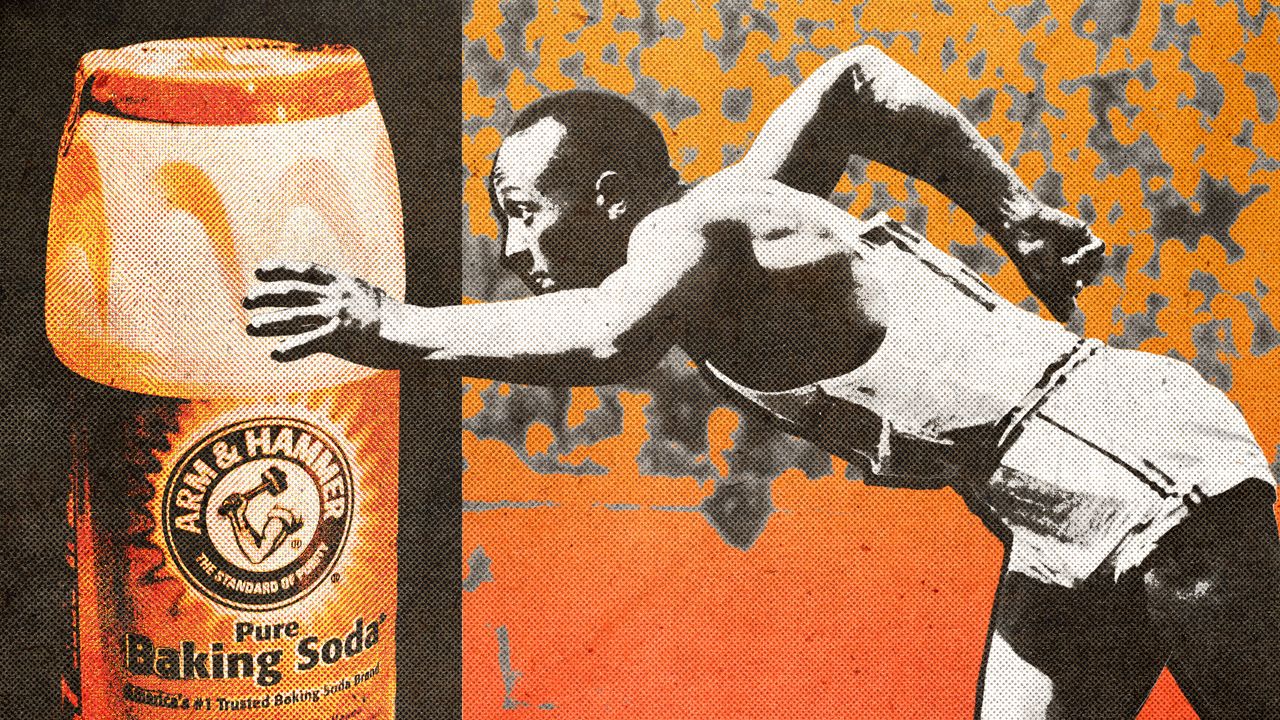
After the Kenyan long-distance runner Sebastian Sawe became the first person to officially break the 2-hour marathon barrier in London this past April—a historic feat that had been anticipated for decades—he held up his Adidas supershoe with his winning time penned on the side: 1:59:30. He’d smashed the previous world record of 2:00:35, set by Kelvin Kiptum in 2023, by more than a minute. That moment made Sawe and his carbon-plated footwear instant stars. But beyond Sawe’s training and shoes, a small sliver of the accomplishment may also have been indebted to another weapon in his arsenal: bicarb. To fuel his blistering 4:33 minutes-per-mile pace (4:33 minutes per mile!), Sawe drank a formula of sodium bicarbonate—more commonly known as baking soda—sold by the Swedish company Maurten, for which he’s a sponsored athlete.He joins an increasingly large list of endurance athletes who’ve taken to downing the substance as a way of eking out whatever competitive edge they can. Molly Seidel, the 2020 Olympic marathon bronze medalist who has since become an ultrarunner, the running legend Eliud Kipchoge, and the reigning 800-meter Olympic champion Keely Hodgkinson are also sponsored by Maurten and have taken bicarb during competitions. Yomif Kejelcha, who placed second at the London Marathon and broke the 2-hour barrier just behind Sawe, has trained and raced using bicarb from the brand Santamadre, which sponsors him. In 2018, the International Olympic Committee recognized bicarb as one of five supplements that show evidence of enhancing athletic performance for elite performers. The question is: Is it worth taking for non-superhuman athletes? We spoke to experts to find out.What is bicarb?Bicarb is just a fancy new term for what most of us know as baking soda (a.k.a. the orange box you leave in the back of your fridge to keep it from smelling). But the white powder is more versatile than you might realize: As an antacid, it can relieve heartburn, and in hospital settings, it’s used to buffer anesthetics and reduce pain. Perhaps most surprising of all is its effect on exercise performance. Studies on consuming bicarb for its athletic benefits date back to the 1930s. Its use has been investigated in running, cycling, martial arts, soccer, rugby, hockey, basketball, rowing, and swimming—mostly showing gains in events ranging from 45 seconds to 10 minutes. Research indicates that it can improve performance during short-term high-intensity exercise and delay the onset of exhaustion. In 2021, the International Society of Sports Nutrition went so far as to make a statement based on a “comprehensive review of the literature” that bicarb “improves performance in single- and multiple-bout exercise” for both men and women.The problem historically, however, has been that consuming baking soda, typically by ingesting it orally as a tablet or drink mix, can cause gastrointestinal distress when taken in the amounts needed to see athletic improvement. “In the past, the first thing sodium bicarbonate hits when it hits your stomach is hydrochloric acid, and that combination leads to carbon dioxide, so the digestive issues were primarily incredible bloating, gas, diarrhea,” says Guillem Gonzalez-Lomas, MD, an orthopedic surgeon who specializes in sports medicine at NYU Langone. Not what you want on performance day.The challenge has been to create a bicarb system that circumvents those GI issues. Andy Sparks, Maurten’s research innovation manager, tells me they’ve done it by putting bicarb in gastro-resistant capsules that float in a hydrogel, which bypasses the stomach and its acids, allowing even those with sensitive guts to take it with minimal discomfort.How does bicarb work?When you exercise at a high intensity—running or cycling at your VO2 max, for example—your body rapidly uses carbohydrates and produces lactate. That increase in lactate contributes to acid build-up in the blood—through an excess of hydrogen ions—and a low pH, called acidosis. At a certain level, acidosis inhibits muscle contraction, which causes a burning sensation. After Lance Armstrong recovered from cancer and resumed his training, tests reportedly showed that his blood’s lactate levels were “astonishingly low,” contributing to the myth that Armstrong was physiologically special because his body didn’t produce as much lactate. It’s worth noting that lactate, often confused with lactic acid, isn’t necessarily bad. By itself, “There’s no evidence lactate causes fatigue,” says Michael Lindinger, PhD, an exercise physiologist and editor of the European Journal of Applied Physiology. “Lactate is an important fuel source for all cells.”Sodium bicarbonate, which is mildly alkaline, acts as a buffer that helps neutralize acid. “When you take sodium bicarbonate in the presence of acidosis, the blood pH will rise, becoming less acidic and more basic. When that happens, and the skeletal muscles are performing under high-intensity exercise, you can slightly reduce the acidosis and have an improvement of performance,” Simeon Cairns, PhD, one of the world’s authorities on muscle fatigue and a professor at Auckland University of Technology, says.“Bicarb is keeping the cell at its optimum pH for longer,” adds Gonzalez-Lomas. That optimal pH has been shown to allow athletes to perform at a faster maximum speed and to maintain a fast pace through multiple intervals of exercise—for example, when kicking at the end of a race or sprinting repeatedly across a soccer pitch.Another promising result of consuming bicarb an hour or two before a race or game is it can reduce people’s perception of pain and, with it, their perception of how much effort they’re exerting during exercise. “It seems to do something to pain perception,” Gonzales-Lomas says. “If you don’t feel as much pain, you may feel motivated to work harder for longer, because pain is a signal that people eventually have to heed,” he says.Cairns points to a 2014 study in Experimental Physiology on 10 volunteers that indicates as much. “With severe acidosis, lactate and acidosis can induce muscle pain,” he says. “People have injected these things into people’s muscles, and people have rated the pain, and it goes up if you use really high levels of lactate combined with acid. These are experimental studies where sodium bicarbonate can attenuate the pain—showing that it’s feasible.”To test whether that would result in athletes performing better, Maurten set up time trials in which they told athletes to run or cycle a specified distance as fast as they could, but didn’t provide any other feedback. “It becomes essentially a completely self-paced but blind experience,” Sparks says. “They’re going to do that exercise based on how they feel. When we did it in an endurance setting, what we found in a trial with a placebo and the Maurten Bicarb System is that the oxygen cost is the same, the heart rate is the same, the cadence on a bike, so the speed at which they’re pedaling is the same, but the power output is elevated.”That said, while Cairns agrees that the reduced perception of pain from bicarb may have some performance-enhancing effects, he thinks it probably has to do with “the nervous system’s ability to control pacing.”Does bicarb enhance performance for all sports?Cairns, Lindinger, and Gonzalez-Lomas all said that taking sodium bicarbonate can indeed enhance exercise performance. But Cairns and Lindinger are skeptical that it might provide gains for endurance athletes like long-distance runners. Acidosis builds up when a person alternates between high- and low-intensity exercise. A sport like soccer fits that exercise profile perfectly, as do basketball and hockey—so athletes in those sports would find bicarb’s neutralizing effect especially beneficial. In the realm of running, Lindinger says, “Where it’s going to be helpful is distances less than a mile, and especially distances like 50 meters, 100 meters, 200 meters, 400 meters—that’s where you’re getting acidosis.”But for endurance events like marathons, severe acidosis is less likely to interfere with an athlete’s performance. “I suspect that sodium bicarb for marathons will not be a huge advantage,” Cairns says, though he says it might help a little during surges, uphills, or the finishing sprint. (A 2021 study found that taking bicarb for cycling endurance events can improve performance in all-out sprints at the end.) Lindinger is more direct: “If there’s an association between taking this product and a really good marathon time, it’s just an association. There’s zero cause and effect.”Yet Maurten, which has a clear financial incentive and sponsors endurance athletes, argues that GI distress has made it difficult to determine bicarb’s potential benefits for longer-duration exercise. “Lots of the literature on the simplistic delivery mechanisms are noisy because you’ve got people with GI upset who aren’t feeling 100%, so your ability to detect differences is adversely affected,” Sparks says.Who benefits from bicarb?Maurten’s Bicarb System—which costs $70 for four servings—was launched in March 2023. Since then, bicarb has become increasingly popular among endurance athletes. But should regular people use it?Maurten’s Reuterswärd says that their Bicarb System was developed for professional athletes and that’s who will likely see the most benefits. Lindinger tells me that “the evidence indicates that trained athletes benefit most.” A systematic review of bicarb and sports performance conducted last year found that it “can significantly improve high-intensity endurance cycling performance in well-trained athletes, suggesting that individuals with higher fitness levels may respond more favorably to supplementation” because they have “superior metabolic efficiency.”But Cairns is skeptical that pro athletes gain much from using bicarb. “It would be beneficial for many people, but probably not with elite performers because they’re so well endowed—the adaptations inside their muscle, their ability to remove the acid is so well developed, it probably won’t help them. But potentially for other people who are moderately trained, if you use it during training, potentially you could work harder.”Both Cairns and Lindinger emphasize that proper training and nutrition will offer more physiological benefits than bicarb for most people, and should be their focus. In other words, whether bicarb will help recreational athletes reach their 5K PRs or become the top scorer in their adult soccer league is an open question. At the very least, bicarb is unlikely to cause any embarrassing bathroom emergencies. Still, try it at least once before race or game day, just in case.
Why All the Runners Are Eating Baking Soda Now
Full Article
Original Source
Read the full article at Gq →KhanList aggregates and links to publicly available news content. We do not host full articles from third-party sources. Always verify important information with original sources.