
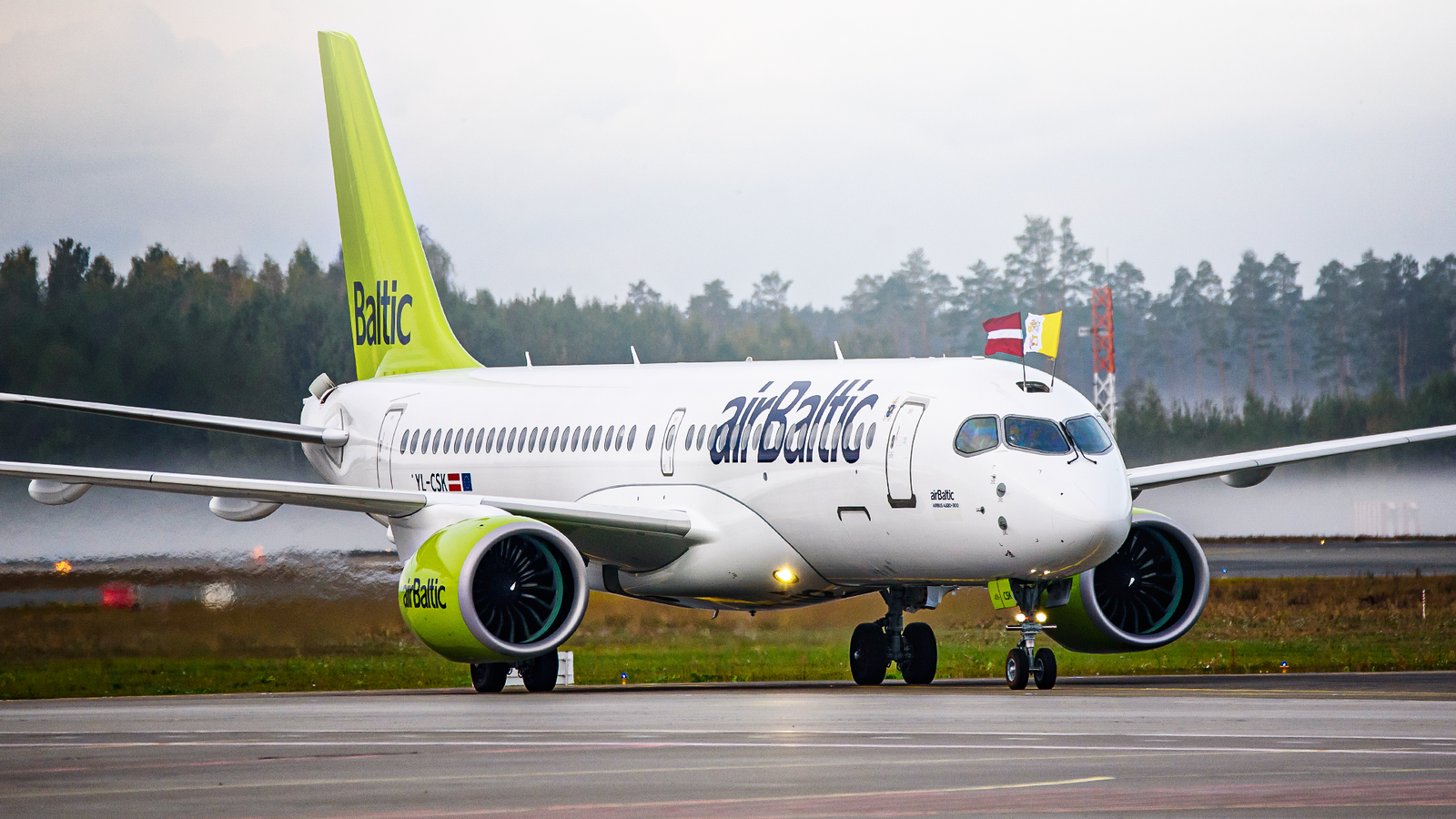
Credit: Gints Ivuskans | Shutterstock, Simple Flying Published Oct 16, 2026, 1:00 AM EDT Based in the UK, Josh is a keen writer with a degree in Military History. Having worked previously as a financial journalist, he has covered the aviation industry extensively, reporting on airlines' results and monthly passenger statistics in the aftermath of the pandemic, alongside the likes of regulation around sustainable fuels, and the prospects for hydrogen-powered commercial flight. He joins Simple Flying with a lifelong love of all things aviation. Sign in to your Simple Flying account The Airbus A220 family may not immediately stand out as a competitor in the longer-haul end of the market. Encompassing two narrowbody variants capable of carrying up to a maximum of just 160 passengers at a time, the jets are more aligned in size with those that typically cover regional hops. But impressive range capabilities mean the A220 family is far from confined to just linking nearby cities. Where huge multi-aisle airliners historically opened the door to accessible intercontinental travel, the two variants of the A220 have emerged among a string of narrowbodies capable of making some similar, lengthy journeys. In the case of the Airbus A220-300 in particular, few tap into the model’s versatility as much as Latvian carrier airBaltic. The Airbus A220-300 Credit: Airbus Alongside the smaller Airbus A220-100, the A220-300 makes up what Airbus historically dubbed the only family of aircraft “purpose-built for the 100 to 150 seat market.” Airbus did not develop the jets itself, though, with Bombardier having introduced the family through the CSeries program in 2008 before seeing its commercial jetliner program bought out by Airbus in 2018. The CSeries, first delivered throughout 2016 as the CS100 and CS300, was rebranded as the A220 soon after. Today, approximately 538 A220s are in airlines’ fleets, according to data from Airbus’ website. A total of 542 have been delivered, out of 1,100 orders. While that is a far cry from the 20,400-plus orders for variants of the Airbus A320 family, the A220 has proven popular as a means of plugging the gap between smaller regional jets and larger narrowbodies. Select Airbus A220 family specifications, as advertised by Airbus: Specification/Aircraft Airbus A220-100 Airbus A220-300 Typical capacity (two-class) 100-120 passengers 120-150 passengers Max capacity 135 passengers 160 passengers Max range 3,600 nautical miles (6,667 km) 3,400 nautical miles (6,297 km) That is, without sacrificing range, but also thanks to superior efficiency against aging models like the Boeing 737-700 and older Airbus A319s. Of course, competition has since emerged through the likes of the Boeing 737 MAX 7 — which does have the edge over the A220-300 in range and capacity — but delayed certification that only came this year means deliveries are in their infancy, placing Airbus’ A220 variants as far more established options. airBaltic’s own operations offer arguably the clearest insight as to where this has been the case. airBaltic Exclusively Flies A220-300 While it is not uncommon for airlines to run a common fleet in the interest of simplifying operations, airBaltic is among the few to exclusively operate the A220. Breeze Airways joined it last month upon fully retiring the Embraer 190, mirroring airBaltic in solely running the A220-300 and larger variant from the family. Having shifted to an all-A220-300 fleet earlier than its US-based counterpart in 2020, airBaltic, in particular, has come to be part and parcel of some of the longest scheduled routes featuring the model. According to its website, the carrier’s fleet currently includes 54 of the models. airBaltic Airbus A220-300 specifications, as advertised by the airline: Specification Value Capacity 148 passengers MTOW 149,032 lbs (67.6 tonnes) Max payload 36,817 lbs (16.7 tonnes) Length 127 feet (38.7 meters) Wingspan 115 feet, 1 inch (35.1 meters) Cruising speed 541 mph (871 km/h) Commercial range 2,471 nautical miles/2,843 miles (4,575 km) Fuel consumption 581 US gallons an hour (2,200 L/h) Engine Pratt & Whitney PW1521G Each is configured to carry 148 passengers in the A220’s standard 2-3 seating layout. airBaltic also places its A220-300s’ commercial range at 2,471 nautical miles (4,575 km), off Airbus’ advertised figure of 3,400 nautical miles (6,297 km). This is unsurprising, given the gap between real-world operations and the theoretical maximum range that requires near-ideal conditions. That said, the Latvian flag carrier has been known to push the A220-300’s capabilities on its most ambitious routes. airBaltic’s Flights Scheduled In Excess Of Seven Hours On block time — from the moment a flight pushes back to when it parks at its destination gate — airBaltic’s longest A220-300 flight has historically connected Riga International Airport (RIX) and Dubai International Airport (DXB). At a maximum of seven hours and 30 minutes, it is also among the longest journeys ever scheduled on the A220-300. But airBaltic also holds the crown for the longest A220-300 routes on sheer distance. Linking Tampere–Pirkkala Airport (TMP) in Finland to Tenerife South–Reina Sofía Airport (TFS), the seasonal route ran over the winter of 2023 and covered 2,562 nautical miles (2,948 miles; 4,745 km). That is longer than the commercial range the carrier lists online for its A220-300s. Where the Tampere-Tenerife trip boasted a still impressive seven hours on average, disruption to routing across the Middle East often pushed the flight times, leaving the shorter journey by great circle distance often taking longer due to the likes of delays and airspace detours. Such disruption has also gone a step further in regard to airBaltic’s scheduling to and from Dubai most recently. airBaltic Dubai Service Currently Suspended One caveat is that airBaltic does not currently fly to Dubai as of the time of writing in early October. That is not down to the A220-300’s capabilities, though, or even airBaltic's own choice. Rather, the carrier has found itself somewhat forced into dropping the route for the time being due to geopolitical issues across the Middle East. Indeed, airBaltic historically flew from its primary base at Riga to Dubai using the A220-300 up to five times weekly, and did so up until the start of this year. However, following the outbreak of the conflict in Iran, the service was suspended, and airBaltic most recently confirmed it would continue through the upcoming winter season. “The decision has been made following a comprehensive assessment of several factors,” the carrier wrote in late September, “including the current situation in the region, as well as potential operational restrictions affecting the routings normally used for flights to and from Dubai”. Nonetheless, the single-aisle Airbus jet had previously been central to its strategy connecting Northern Europe and the Middle East. Alongside other ambitious routes like that between Tampere and Tenerife, it was, in many ways, a testament to the versatility of the A220-300 itself, as a result. In airBaltic’s case, these same aircraft also cover some incredibly short hops. airBaltic’s A220-300s Also Used For Regional Hops On the other end, the airline’s shortest route today links the Latvian capital, Riga, and Palanga International Airport (PLQ), and is by definition the epitome of regional flight. Lasting just 40 to 45 minutes, per the airline’s advertised flight time, the connection covers only 111 nautical miles (206 km). Again, the A220-300 is used in the same configuration as it is for airBaltic's long-haul journeys. The reasoning is simple: a standardized fleet is far easier to maintain than one that includes a wide array of aircraft. Not only is there commonality in spare parts, but pilots only need training on one type and can move more easily between flights, for example. Thanks to the A220-300 itself, airBaltic has found a single model capable of serving either a 111-nautical mile (206 km) or 2,562-nautical mile (4,745 km) journey, and everything in between. Were it not for factors outside its control, the airline may well still be using the jet to take passengers deep into the Middle East now. Even so, airBaltic’s plans for this winter mean its A220-300s will still be put through their paces on a variety of flights. Reshuffle At airBaltic Ahead AeroRoutes data shows airBaltic has earmarked 12 new links for the coming months. These will connect Gran Canaria Airport (LPA), Finland's Kuusamo Airport (KAO), and Tenerife South to destinations across Europe, including through a new seasonal base at the latter. New airBaltic routes for winter 2026 season, from AeroRoutes: Origin Destination Distance Frequency Gran Canaria (LPA) Katowice (KTW) 2,067 nautical miles (3,828 km) 2x weekly Liège (LGG) 1,660 nautical miles (3,073 km) 2x weekly Poznan (POZ) 2,053 nautical miles (3,803 km) 2x weekly Warsaw (WAW) 2,177 nautical miles (4,031 km) 2x weekly Kuusamo (KAO) Berlin (BER) 945 nautical miles (1,749 km) 1x weekly Hamburg (HAM) 935 nautical miles (1,731 km) 1x weekly London Gatwick (LGW) 1,259 nautical miles (2,332 km) 1x weekly Manchester (MAN) 1,197 nautical miles (2,218 km) 1x weekly Riga (RIX) 565 nautical miles (1,046 km) 1x weekly Tenerife South (TFS) Liège (LGG) 1,685 nautical miles (3,120 km) 2× weekly Ljubljana (LJU) 1,824 nautical miles (3,378 km) 2× weekly Palanga (PLQ) 2,323 nautical miles (4,302 km) 1× weekly Longer term, however, airBaltic is set to trim back its summer operations next year and cut its fleet for the period. Some 78 destinations will be served from Riga, Estonia's Lennart Meri Tallinn Airport (TLL), and Vilnius Airport (VNO) in Lithuania, against 112 during the summer just gone. In tandem, its fleet will fall to 36 aircraft before being rebuilt over the remainder of the decade as the airline navigates financial difficulties, with the versatile A220-300 remaining central.
Why airBaltic Is Sending A 'Regional' Airbus A220 On Nearly 3,000-Mile Flights To Tenerife & Dubai
Full Article
Original Source
Read the full article at Simpleflying →KhanList aggregates and links to publicly available news content. We do not host full articles from third-party sources. Always verify important information with original sources.