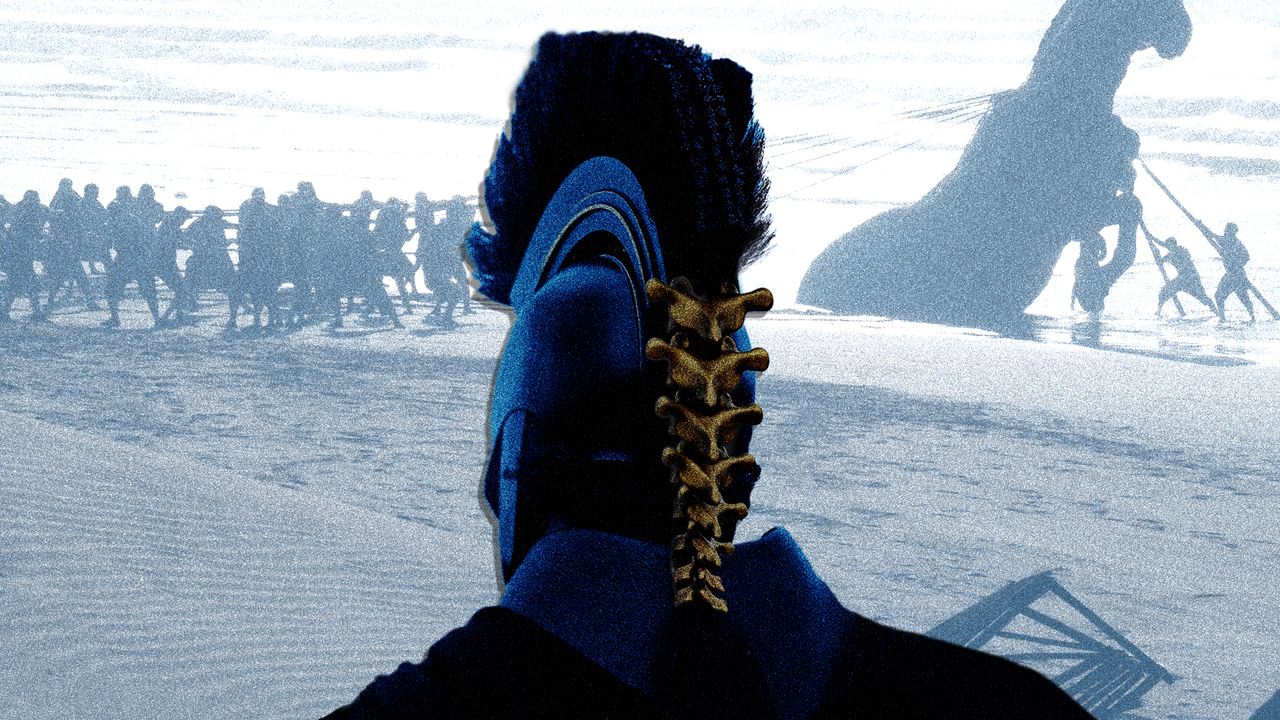
The following article contains major spoilers for The Odyssey.In classic Christopher Nolan fashion, The Odyssey revolves around a terrifying event that is frequently glimpsed through hazy flashbacks, but never fully revealed until its climax: the barbaric invasion of Troy, reimagined as a ruthless genocide that haunts Odysseus (Matt Damon), chief architect of the slaughter—being the guy behind the Trojan Horse. (Hence why he spends most of the movie moping around like an emo kid, minus the bangs.) As the doors finally cave in, and hordes of bloodthirsty swordsmen flood the streets like a murderous plague, they are led by a figure clad from head-to-toe in jet-black armor, a demon seemingly sent from Hades itself: Agamemnon (Benny Safdie).It’s a little like the scene when Darth Vader turns up in Rogue One. Agamemnon is like The Odyssey’s final boss, his very presence signaling one thing: Oh, you’re all fucked. He towers over the men around him, almost to the scale of the armored giants that decimated Odysseus’s men earlier in the movie; the implication has to be that he is just as much of a nuclear-grade threat. This is a monster, or a Bronze Age machine, whose solitary motivation is to destroy, to pillage, to wreak terror upon the world. And there’s a crucial detail that serves this more than a killer set of armor ever could: you pretty much never see his face.In Nolan’s interpretation, The Odyssey is basically a movie about war trauma, and how Odysseus feels extremely bad about his part in the destruction of, you know, an entire civilization. (Many online have drawn comparisons to how Oppenheimer, Nolan’s last film, is about a similarly morose figure haunted by his own invention: the atomic bomb.) The film is riddled with manifestations of his grief. For one example, we’re led to believe that he is frequently visited by the goddess Athena (Zendaya), but it’s revealed in the Troy sequence that the woman he sees in those visions was one of many civilians put to the slaughter by his men, beheaded before his very eyes. She is no beautiful figure of myth, then—more a hallucinated trauma response, a product of his struggle to reconcile his morality with the fact that his actions led to the deaths of hundreds, if not thousands, of innocents. (Ready the world’s smallest violin.)To this end, Agamemnon is another symbol. In Odysseus’s minds eye, he represents the terror of the war itself; its unceasing charge, its unrelenting desire for blood. It makes sense, then, that Odysseus would remember him to be so cartoonishly, terrifyingly evil, stripping away whatever, in reality, made him a man. To see his face would remind us, and Odysseus, of his humanity. (On a much more basic level, it also triples his aura, undeniably making him appear all the more badass.) Perhaps this is why we only get a glimpse of Safdie’s face in one scene. Midway through the film, Odysseus’s son Telemachus (Tom Holland) is told the story of Agamemnon’s death, murdered by his wife Clytemnestra (Lupia Nyong’o) upon his return from war in revenge for the sacrifice of their daughter. Odysseus might’ve thought of him as a armor-clad nightmare. But in others’s memories, he was just a naked man murdered in the bath.This article originally appeared in British GQ.
Why Agamemnon (Almost) Never Shows His Face in ‘The Odyssey’
Full Article
Original Source
Read the full article at Gq →KhanList aggregates and links to publicly available news content. We do not host full articles from third-party sources. Always verify important information with original sources.