
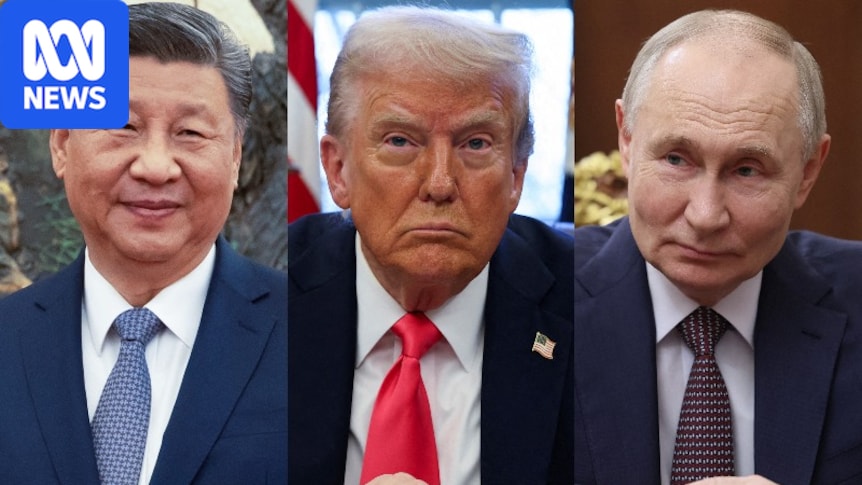
In 1945, in the bombed-out resort city of Yalta on the Black Sea, three global superpowers — America, Britain and the Soviet Union — met to decide the fate of Europe after World War II.The three wartime leaders, Winston Churchill, Franklin D Roosevelt and Joseph Stalin, had a common goal to defeat Nazi Germany.The Yalta Conference became shorthand for "sphere of influence" politics and synonymous with the betrayal of Eastern Europe — a region that felt it was traded into Soviet hands to achieve postwar cooperation.Fast forward 81 years and world leaders are again meeting at a time of searing global tension and seismic shifts in the global order.In the modern metropolis of Shenzhen, which links Hong Kong to China's mainland, the Chinese president Xi Jinping will host the American and Russian heads of state on the sidelines of the Asia-Pacific Economic Cooperation (APEC) summit.The meeting is unprecedented, undeniably historic and increasingly talked about as the most anticipated leaders' summit of the year.Donald Trump, Xi Jinping and Vladimir Putin will meet on the sidelines of the APEC summit at Shenzhen. (Reuters: Ekaterina Shtukina/Evelyn Hockstein/Mikhail Metzel)While many observers and analysts have jumped to suggest this is Yalta 2.0, there are a few differences, and it's probably more about optics than substance.China has replaced the UK at the table, and Russia is no longer the Soviet Union power it was, nor is it emerging victorious on the world stage with half of Europe under its control.It has a GDP similar to the size of Italy or Spain, and it remains entrenched in a deadlocked land battle for control of Ukraine's eastern Donbas region."Putin's Russia is weaker in all regards — it's not a global economic power," senior fellow at Carnegie Europe, Thomas de Waal, puts it."The way Putin tries to project it as a big power like the Soviet Union and have this big role in Africa and the Middle East, it's all a bit of a mirage, and it doesn't really have allies in the way the Soviet Union did," he said.All that said, Vladimir Putin has managed to elbow his way into a meeting with Donald Trump and Xi Jinping, the presidents of the world's two global superpowers.Nuclear proliferation a key concernIt has long been rumoured that Putin desires to recreate a Yalta-like moment when his wartime leadership is compared to Joseph Stalin's."Putin aspires to be Stalin 2.0, sitting down, carving up the world with other great leaders," de Waal said."That's the world they'd [Russia] like to return to in which there are the great powers that make the decisions about the world and the little countries as they see them fall in line."So, I think that's the psychology of Putin and why he looks back nostalgically to that meeting."The most likely reason Putin got a seat at the table is Russia's nuclear agenda.Moscow is increasing its sabre-rattling with nuclear threats, and Beijing is arming at a rapid pace.The treaty that limited the size of Russian and American nuclear arsenals expired in February and China has so far resisted calls to engage in non-proliferation talks on the basis that its nuclear forces are considerably smaller.Experts don't expect much to be decided at Shenzhen, but the symbolism of the meeting is almost more important. (Reuters: Alexey Pavlishak)Experts don't expect much to be decided when it comes to nuclear arsenals, but the symbolism of the meeting is almost more important.It offers a photo opportunity for Putin alongside the world's two most powerful leaders. It also places America, historically viewed as the global policeman, in the room with the world's largest authoritarian regimes.Russian expert Orysia Lutsevych from London think tank Chatham House described the concept of Yalta 2.0 as "Putin's sick fantasy"."It reflects the vision of these three strongmen on how the world should be run and especially Putin, who is in an active war of aggression, an unprovoked aggression against Ukraine, is sitting at the table with the two world superpowers," Lutsevych said."These three heads of state are sharing a certain vision of quite unilateral, personalistic regimes. They crave personal veneration, popularity and unilateral power."I think it's more done for the domestic propaganda uses, and each of them will spin it in a different way for their audiences."To understand the optics in global diplomacy, it helps to also look at who isn't on the guest list — the adage being if you don't have a seat at the table, you're on the menu or about to be carved up.Europe nervousUkraine hasn't scored an invite. Nor have much of Eastern Europe, the Baltic States, Taiwan and Iran.Lutsevych said there was a real fear among smaller countries and Europe that their fate was again at the whim of the major powers."There is this ambition to renew the sphere of influence logic. It's especially disturbing for many to see America embarking on this approach," she said."Europe feels fundamentally betrayed by the United States not actually being an alliance for an outcome on the war in Ukraine, for backing some of Russia's demands and for pressuring Ukraine on the battlefield by decreasing the speed of the Starshield," she said.America, in some respects, has enabled and emboldened Moscow's actions in Ukraine rather than constrained them and by standing shoulder-to-shoulder with Putin, some experts say Washington is legitimising his actions."Putin will use this meeting as a massive propaganda campaign inside Russia to justify to Russians all this death and destruction," Lutsevych said."This actually gives a legitimacy to this war and a boost of recognition that Putin was right all along by invading a sovereign country; he has achieved a respect and a seat at the top table."The war in Iran will also be on the agenda, but Ukraine is unlikely to feature heavily despite concerns Trump could use the meeting to discuss an end to the war without Kyiv in the room.Ukrainian President Volodymyr Zelenskyy has long complained of being cut out of the negotiating process on his country's own future and has fought hard to maintain a voice.The leaders' meeting comes hot on the heels of the first serious US-brokered peace talks between Russia and Ukraine in nine months.Made public by Zelenskyy, American negotiators Steve Witkoff and Jared Kushner floated the idea of a deal in which Ukraine gives up the Russian-occupied Donbas region in exchange for North Atlantic Treaty Organization (NATO) membership.Ukraine has sought to join since Russia's full-scale invasion in February 2022, but Europe and the US have been wary of inflaming tensions further with Moscow.NATO's eastward expansion towards Russia's borders over the past two decades was one of the main reasons Putin gave for invading Ukraine in the first place.Analysts, however, don't believe the deal will hold, nor does the US have the power to unilaterally allow entry to a new member."We are talking about Ukraine exchanging some of its sovereignty for an agreement that is coming from a country like the United States that consistently breaks rules of international order inside the UN, against the International Criminal Court, talks about violating the sovereignty of Canada, Iceland and others," Lutsevych said."It is a deal that is unlikely to hold coming from the current American administration that has no respect for any multilateral institutions."Each superpower will have their own priorities at the meeting, but it may prove to be little more than geopolitical theatre that Putin can market domestically to show he still plays with the big boys despite having much less power.
Why a Trump-Xi-Putin summit is no Yalta 2.0, but is 'Putin's sick fantasy'
Full Article
Original Source
Read the full article at Abc →KhanList aggregates and links to publicly available news content. We do not host full articles from third-party sources. Always verify important information with original sources.