
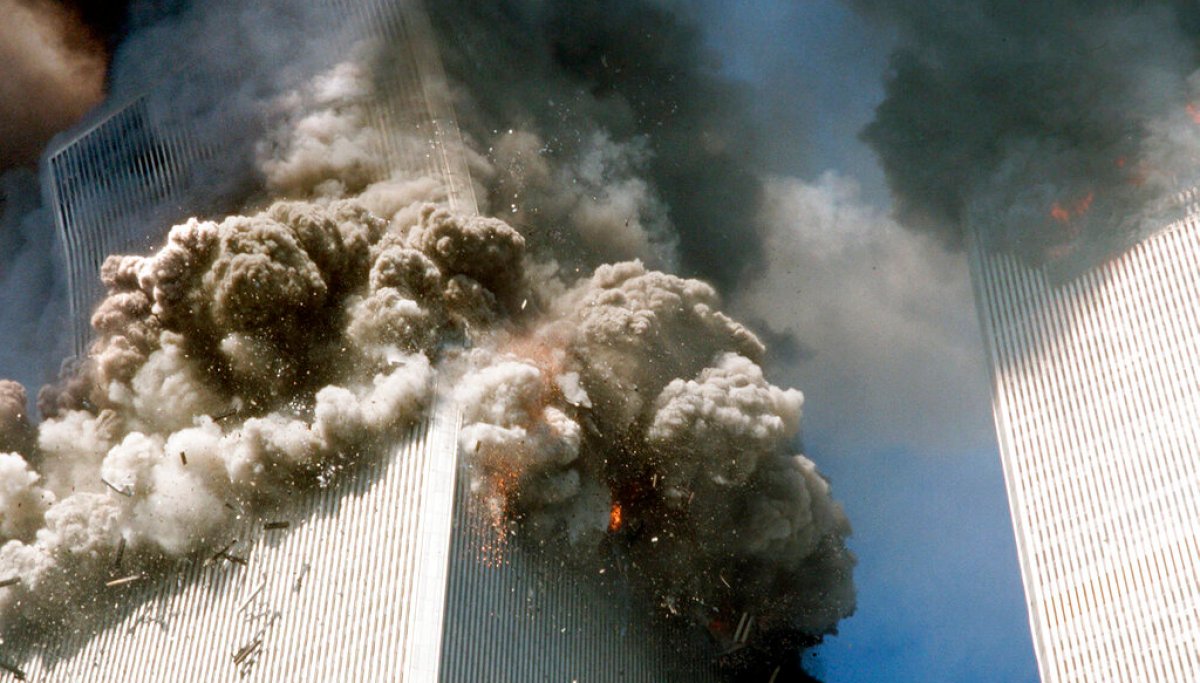
The tragic events of 9/11 were caused when 19 Islamic terrorists boarded four commercial aircraft and flew them toward targets in New York City and Washington, D.C. Two planes hit the World Trade Center’s Twin Towers, causing the towers and three surrounding buildings to collapse, one plane struck the Pentagon, and the fourth was driven by the hijackers into a rural Pennsylvania field after its passengers fought back.Twenty-five years later, however, thousands of Americans still don’t believe that’s the whole story.Conspiracy theories about 9/11 “began almost as soon as the Twin Towers came down,” said James Lindsay, Mary and David Boies distinguished senior fellow in U.S. foreign policy at the Council on Foreign Relations, and they have persisted despite exhaustive investigations into every aspect of the attack. Those theories range from the routine — that U.S. intelligence agencies knew more about the plot before Sept. 11, 2001, than they have ever acknowledged publicly, for example, to the elaborate — that a missile fired by the U.S. military struck the Pentagon rather than American Airlines Flight 77, for instance. But time has not resolved all the questions that many Americans had in the aftermath of the deadliest terrorist attack in history. In fact, in some ways, it has amplified the conspiracies.“You get new generations that all of a sudden stumble on an article, a web link, a TikTok, that purports to tell them the real story about what happened, and that can be quite powerful,” Lindsay told the Washington Examiner. America is now home to millions of people who weren’t alive on 9/11 and who have learned about the attack primarily from the internet, which can be a strange and scary place even when the topic of discussion is not the murder of 2,977 people. Warped narratives can metastasize easily: In the aftermath of the Oct. 7, 2023, Hamas attack on Israel, videos casting Osama bin Laden’s 2002 manifesto about 9/11 in a favorable light exploded in popularity on TikTok. Young users cited bin Laden’s “Letter to America,” in which the al Qaeda leader listed his justifications for the attack, as a source of enlightenment about America’s shameful past in clips that racked up millions of views. But conspiracy theories about 9/11 long predate the doom scroll. And they have withstood a barrage of facts from years of bipartisan investigations.Released in 2004, the 9/11 Commission Report provided 585 pages of details about the attack. It resulted from interviews with more than 1,200 people and a review of more than 2.5 million pages of documents. The commission held 19 days of public hearings. The National Institute of Standards and Technology conducted a nearly three-year investigation of the World Trade Center tower collapses that involved physically examining pieces of steel salvaged from Ground Zero and analyzing precisely how and why the skyscrapers fell.An entire online community still believes jet fuel couldn’t possibly have melted the steel.Supply & demand The earliest theories about 9/11 spread before social media existed because people were desperate to make sense of a tragedy that defied understanding. “People are trying to explain a horrific event. You have people with a preset agenda that see an event as an opportunity to spread their message,” Lindsay said. “You have people who see major events as a way to make money — that speaks to the supply issue. And on the other hand, there’s a big demand issue. People want to know why something happened, and people like simple answers, particularly answers that might confirm their worldview.”In 2001, the internet was still a fledgling medium for news and information. Most Americans alive on 9/11 recount their experience of the event in terms of where they were when they turned on their televisions, which provided a shared set of initial facts about what had happened. But people quickly set out to answer questions that the broadcasts didn’t seem to settle, and many turned to nascent online platforms.“It all unfolded in anarchic, disorganized fashion because 2001’s Internet was a wild place,” Jeff Melnick, professor of American studies at UMass Boston, wrote in 2021. “Professional web designers competed with do-it-yourself homepage makers and a huge amount of traffic about 9/11 was carried over email, through instant message and on emerging platforms like LiveJournal.”Email provided particularly fertile ground for one of the earliest and most easily debunkable conspiracy theories: That 4,000 Jews had called in sick to their jobs at the World Trade Center on 9/11 because they had been warned by Israel of the coming attack.Facebook and Twitter were three and five years, respectively, from invention on 9/11, and so what might have spread as AI-laden posts from boomers in today’s world instead bounced from inbox to inbox.“One conspiracy allegation that did achieve early prominence was the rumor widely circulated by e-mail and on the Web that not a single Jew had been killed in the attack and therefore that the attacks must have been the work not of Islamic terrorists but of Mossad,” Peter Knight, a professor at the University of Manchester, wrote in the New German Critique in 2008. “This conspiracy-minded urban myth with its anti-Semitic overtones rapidly spread through cyberspace, and although the rumor was soon rejected in the United States and Europe (in part because it was shown to have originated from an anti-Zionist Web site in Lebanon), it soon became widely accepted as fact in the Arab world.”The “missing Jews” theory was ultimately debunked by the fact that hundreds of Jews did, in fact, die on 9/11.Scars of the War on Terror Brilliant minds can debate precisely when the sense of national unity that followed 9/11 began to fade. By circa 2004, however, it had all but disappeared, thanks in no small part to revelations that the Bush administration had not been entirely forthcoming about its reasons for invading Iraq.While the 2003 invasion of Iraq was not directly related to 9/11, the Bush administration had tied it heavily to the broader War on Terror, which began with the October 2001 airstrikes in Afghanistan.Former President George W. Bush’s top officials had exaggerated intelligence suggesting Iraq’s Saddam Hussein was harboring weapons of mass destruction and that Hussein’s regime had links to the al Qaeda network that planned 9/11, and those deceptions deepened skepticism of an intelligence apparatus that had already raised suspicions in the aftermath of the attack.The “relationship between government secrecy, leaked or released documents, and public revelations of government malfeasance has proven to be a powerful acid of institutional trust,” wrote Jon Askonas, professor of politics at Catholic University of America, in a 2023 essay for the New Atlantis. “[T]he FBI and CIA knew a lot about the 9/11 attackers very quickly, because some of the attackers had come across the radars of U.S. agents or informants in prior years and because they were funded by Saudi and Pakistani networks the CIA was investigating,” Askonas said. “If you have an intelligence agency with a global reach, and it is involved in monitoring shadowy groups behind all kinds of sinister activity, it does not make it a puppet master. It means it is doing its job.”“But this secret activity does come at an epistemic cost,” Askonas added. “Societies with lots of conspiracies and secrecy generate cynicism and a distrust of the ‘official narrative.’”A pervading conspiracy theory regarding 9/11 holds that the U.S. intelligence community knew about the hijackers’ plot in advance and deliberately declined to intervene in order to provide the justification for the military action that followed. While subsequent investigations faulted a fragmented and siloed national security apparatus for failing to connect the dots, mistrust of the intelligence community persisted and fed into other 9/11 conspiracies that linger to this day.One of the most prominent involves Building 7, a 47-story building in the World Trade Center complex that collapsed hours after the Twin Towers fell. NIST later determined that debris from the collapse of the north tower earlier that morning damaged the building’s structure and sparked uncontrolled fires that weakened interior columns until the entire building crumbled.But conspiracy theorists have long maintained that a controlled demolition brought down Building 7. An infamous journalistic error gave birth to that theory: BBC reporter Jane Standley reported that Building 7 had collapsed at 4:54 pm on Sept. 11, but the structure did not actually come down until 5:20 pm.The revelation, weeks later, that the CIA had secretly been among Building 7’s tenants proved irresistible to the skeptics and cemented suspicion of the collapse narrative as an enduring conspiracy theory. In fact, the 9/11 conspiracy theories that have lived the longest, such as the theory that the U.S. military shot down United Airlines Flight 93 over a field in Shanksville, Pennsylvania to prevent it from striking an intended target in Washington, D.C., all point back to alleged cover-ups by American intelligence agencies.By 2004, nearly half of New York City residents believed the U.S. government knew in advance of the 9/11 attacks and declined to stop them.THE 10 SENATE SEATS MOST LIKELY TO FLIP IN 2026Trust in institutions has only eroded further since then. The share of Americans who say they have very little or no confidence in the U.S. military doubled from 2001 to 2026, according to Gallup. Overall trust in government information has cratered, and few have faith in legacy media to sort out the truth.That all means conspiracy theories about 9/11 are likely to persist for the next 25 years. And the next generation may be even less likely to buy the official story.
Why 9/11 conspiracy theories survived 25 years
Full Article
Original Source
Read the full article at Washingtonexaminer →KhanList aggregates and links to publicly available news content. We do not host full articles from third-party sources. Always verify important information with original sources.