
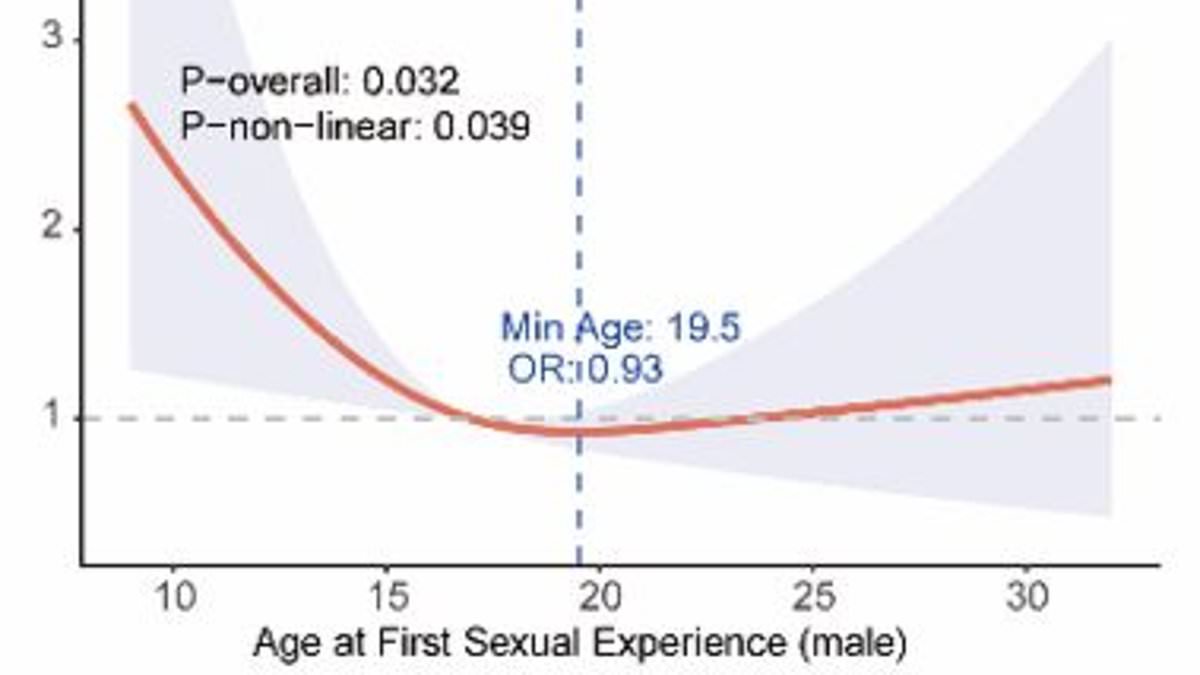
Scientists have revealed the best age to lose your virginity, and it may be older than many anxious teens believe.According to a new study, 19 years old is the ideal age for someone's first time.That is three years older than the current UK average of 16, while a third of people report having had sex before reaching the legal age of consent.However, while young people might worry about losing their virginity later than their peers, researchers found that people who waited longer were at lower risk of developing depression as adults.This effect was true for both genders, but the impact was even more pronounced for women than for men.The researchers discovered the risk of depression later in life decreased as the age of a person’s first sexual encounter grew, up to 17. After this point, the depression scores levelled off until around the age of 19 and a half, after which the risk rose slightly for people who waited longer.The authors, led by Dr Kaifa Tang of the Guizhou University of Traditional Chinese Medicine, said: 'Early sexual initiation has been associated with elevated risk of depression in adulthood, potentially through effects on educational attainment, economic stability, health-related behaviours, and social relationships.' Scientists have revealed that the best age to lose your virginity is 19, and warn that people who have sex earlier could be at risk of depression Previous research has noted that there is a strong connection between early sexual encounters and a risk of poor mental health later in life.However, both age of sexual debut and mental health are strongly affected by a range of other factors including wealth, education, employment and social relationships.That has made it extremely hard to pin down the exact connection but researchers believe the increased risk could be explained by a chain of cause and effect.In their paper, published in The Journal of Sexual Medicine, Dr Tang and her co-authors attempt to clarify this connection using two methods.First, they analysed data collected by the American National Health and Nutrition Examination Survey, which combines medical examinations with questionnaires.They looked at records from 4,907 participants surveyed between 2013 and 2016, looking at when they had first had sex and whether they reported symptoms of depression.This revealed that people who had sex for the first time later in life generally reported fewer symptoms of depression as adults.However, when the researchers accounted for differences in income, education, and health behaviours such as smoking, the connection dramatically diminished. While young people might worry about losing their virginity later than their peers, researchers found that people who waited longer were at lower risk of developing depression as adults (top row). However, this effect was much smaller in men once education and income were taken into account (bottom row)Once wealth was taken into account, the link between depression and early sexual experiences essentially vanished for men but persisted for women.To investigate further, the researchers then used a technique that focused on genetic information called Mendelian randomisation.The idea is that, since genes are assigned at birth, you should be able to find connections between genes linked to specific behaviours and health risks.The researchers searched through massive datasets of genetic information to find genes that were associated with age of first sexual intercourse and then looked to see if these same genes were linked to depression risk.Initially, they found that genes linked with someone losing their virginity later were also linked to a lower risk of general and severe depression.However, once the researchers accounted for genetically predicted household income, that connection disappeared for both men and women.As the researchers point out, there are also significant limitations to this technique.First of all, it’s not clear whether individual genes really determine complex behaviour like age of first sexual encounter. In the UK, the average age of first intercourse has fallen over the last few decades, reaching 16 in both men and womenIt might be the case that these genes really connect to factors like risk-taking behaviour or caution, rather than just when someone first has sex.The researchers also note that these genetic connections are really just picking up on broader behavioural or socioeconomic tendencies.Most importantly, this study found that 'household income significantly mediated the association between AFSI [age at first sexual intercourse] and severe depression in both sexes'.Additionally, number of years spent in education was found to be a strong mitigating factor in the connection between age at first sexual intercourse and depression in women.Both education and income are well known to strongly influence the risk of depression, and the age at which people lose their virginity.That means the connection could be a lot more complex than simple cause and effect.The researchers conclude: 'These bidirectional findings highlight intertwined socioeconomic and behavioural influences on sexual initiation and depression.'
Why 19 is the best age to lose your virginity, according to science
Full Article
Original Source
Read the full article at Dailymail →KhanList aggregates and links to publicly available news content. We do not host full articles from third-party sources. Always verify important information with original sources.