
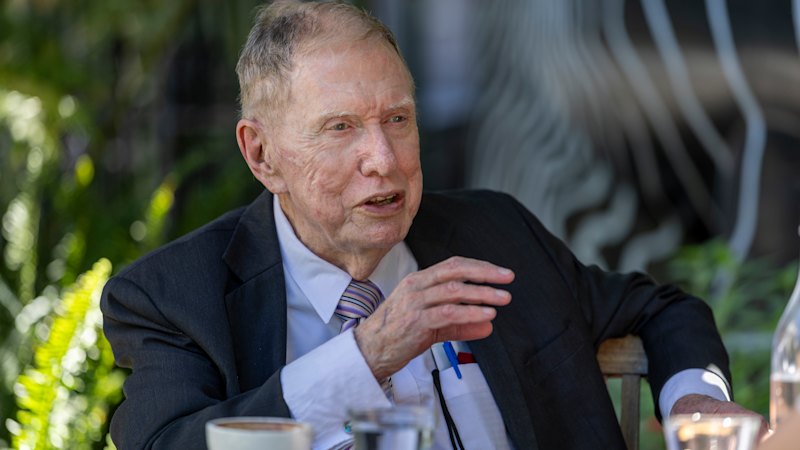
He was the High Court’s first “celebrity judge” and still has students and legal practitioners coming up to him to tell him his judgments are their favourites.Former High Court justice Michael Kirby retired from the bench in 2009 but continues to be in demand as an arbitrator and speaker around the country.Former High Court judge Michael Kirby over lunch at Streat cafe in Collingwood. Jason SouthThe 87-year-old lives in Sydney but is in Melbourne ahead of delivering the Brotherhood of St. Laurence’s annual Sambell Oration.Kirby arrives straight from the airport to meet me for lunch at Streat cafe in Collingwood.In a quiet backstreet, the cafe has a rare luxury in the inner-city suburb – a sun-filled grassy courtyard with tables and chairs where we can sit and talk.I tell Kirby he was my favourite High Court judge when I studied law because his judgments were always interesting and easy to read.It’s not the first time Kirby has heard this.“Everywhere I go, they want to go up and tell me they learned their law through my opinions,” he says.It’s a nice legacy to have, I say.“It is, but I don’t get carried away with it,” Kirby says.Such is his popularity that a production of a musical based on his life is currently under way.“I sort of vetoed it and said I wouldn’t co-operate,” Kirby says. “But then I wrote back and said if they really want to, they should go ahead.”He says he’ll go along when it is staged, as long as the musical numbers are decent.“You’ve got to have some good tunes,” he says.Kirby’s popularity is partly due to his judgments written in plain legal English rather than the convoluted and more confusing style favoured by some of his contemporaries.Lunch with Michael Kirby, comprising a spinach and ricotta roll and an Anzac biscuit at Streat cafe.Jason South“You can make things easier to understand if you write in short sentences,” he says. “So that’s what I did.”Kirby served on the High Court from 1996 to 2009, and during this time he was known for his incisive judgments and for dissenting from the judgment of his colleagues, particularly on matters of civil liberties and human rights.I ask him if it was lonely dissenting so much, but Kirby says he only really broke ranks when he joined the High Court in response to pressure from parliament “to rein these judges in”, to just apply the law rather than try to address fundamental values.His rulings, including finding that WorkChoices legislation distorted the constitution, that prisoners deserved the right to vote and that indefinite detention of a stateless migrant was unlawful, attracted the ire of then-prime minister John Howard.Receipt from lunch at Streat with Michael Kirby. Cara WatersHoward was often critical of “judicial activism”, and Kirby returned serve by giving speeches defending the right of judges to interpret laws in light of changing social values.Even when he was in the majority, Kirby often wrote his own separate judgment – a record he’s proud of.“Chief Justice Mason once gave a big compliment to me,” Kirby says. “He said ‘If you want to know what the case is really about, start with the Kirby judgment’.”A talent for writing runs in Kirby’s family – he tells me his grandfather, William Spotswood Knowles, was a journalist for The Sydney Morning Herald.Sadly, Knowles was a little before my time, so we turn to the menu and Kirby confesses he has already eaten on the plane, so isn’t particularly hungry.A committed pescetarian, he says Qantas’ catering now finally embraces his dietary preferences.Instead, Kirby orders a mocha and biscuit, which he carefully nibbles on during the course of our discussion, while I order the spinach and ricotta roll with a carafe of sparkling water.The pastry is buttery and flaky and the creamy ricotta has a salty tang to it.It’s good, but Kirby chose Streat more for the cafe’s social impact than the quality of its food.Kirby pictured in his chambers in 2005. Chris LaneIt’s a social enterprise which provides vocational training and support programs for disadvantaged and homeless youth.He’s been concerned with social justice since he was given a copy of the Universal Declaration of Human Rights by his teacher as a student at Fort Street Boys’ High School, in Petersham, in Sydney’s inner west.Kirby studied law at the University of Sydney and practised as a solicitor and a barrister before his appointment in 1974 as the deputy president of the Australian Conciliation and Arbitration Commission. In 1983, he was appointed to the Federal Court, and then the High Court in 1996.During his time at the bar and as a judge, Kirby was known for his formidable work ethic, often beginning his day at 5am.“The Melbourne bar is a late bar, and the Sydney bar is an early bar,” Kirby explains.“In the old days, before the internet and emails, you could get a few good hours of total silence. You could focus on the problems of your day, clear your head, get across the issues, and how you will express the issues in your head.”It’s a habit Kirby continues to this day.Ralph Heiman’s Radical Restraint, featuring former High Court judge Michael Kirby, is one of the most popular pieces at Canberra’s National Portrait Gallery.Heath MissenHe still walks into chambers each day, proudly showing me his watch that shows he has already clocked up more than 6000 steps for the day.He asks to compare with my watch and is put out that I have eclipsed him with 9000 steps thanks to an early morning run with friends.“Don’t worry, you’d have me on a normal day,” I tell him.Since retiring from the High Court, Kirby has not eased up, working with the United Nations and is still in demand as a speaker at universities and for events like the Sambell Oration where he called for a new national approach recognising poverty as a human rights issue.“The reason I took this topic was because every day when I walk to work, I see people who are seriously poor, sitting on the pavement,” Kirby says. “Sometimes asleep in borrowed bedding, or sometimes with bedding which is handed out to them.”Kirby says it seems like homelessness is becoming more prevalent and in a wealthy country like Australia, 14.2 per cent of the population shouldn’t live below the poverty line.“Remember when Bob Hawke promised that no child will live in poverty?” Kirby asks. “The words came back to bite him. But most people would think 14 per cent is quite high for a country like us.”Kirby warns about the impact of worsening inequality on society pointing to the recent protests and looting in France.“And having regard to what we’re seeing in the world at the moment, deep unrest of violence, destruction of public property, it’s a warning to us in this way to keep on top of this” he says.Still sharp as a tack, Kirby is comfortable discussing jurisprudence from 40 years ago as well as the latest decisions from the High Court where he says, “I keep an eye on areas I’m interested in.”As well as his public speaking duties, Kirby is presiding over a billion-dollar arbitration in India, which involves occasional travel there.He has agreed with his spouse, Johan van Vloten, that once the arbitration concludes in about three years he will finally actually retire – at the age of 90.“I’ve done a deal, it’s a Trumpian deal that I will retire when I finish it,” Kirby says. “He says he will believe it when he sees it.”Van Vloten and Kirby have been together for 57 years and were vocal advocates for the marriage equality vote.I ask Kirby what it was like coming out as gay in such a high-profile role, and he says for much of his career he was not open about his sexuality.“The deal was: if you don’t make us think about diversity, we’ll leave you alone,” Kirby says. “And so that’s what I did, and I continued doing that for quite a while.”Michael Kirby married his partner Johan van Vloten on the 50th anniversary of when they first met in 1969. Hadden Motion PicturesIt was van Vloten who convinced him to help blaze a trail for the next generation as he is from the Netherlands where “they call a spade a shovel” and so told Kirby it was time to stand up for himself.“What can they do to you?” van Vloten told Kirby. “You are on the highest court on the land.”Kirby says in the end, van Vloten proved to be correct.His secret to a long and successful relationship is compromise and mutual interests.“You’ve got to have one partner who will always give in,” Kirby says. “That’s me. You’ve also got to have mutual interests. Ours is history basically.”Kirby says he sometimes wonders if he should have been a history professor rather than a lawyer.When he retires he plans to spend time talking to van Vloten about the history books van Vloten is reading, while Kirby will spend his time reading the London Review of Books.“That is a wonderful journal, all about a lot of books I will never read,” he says.I ask whether it is cheating to read the London Review of Books rather than the books themselves. Kirby laughs.“Who’s going to dob me in?” he says.Our lunch is over and Kirby carefully places the remainder of his biscuit in a paper napkin to take away for later.He has some parting advice for me as I attempt to digest our expansive lunch conversation into this article.“Short sentences. Full stops.”Noted.Read more great conversations over lunchBen Cubby discovers why Richard Glover is the happiest man in the roomAnn Peacock gives Stephen Brook the inside track on political feuds, family and a dark momentNetflix’s ‘queen of screens’ Bela Bajaria hid a secret about her past. She tells Michael Lallo that when it came to light, she frozeOur best minds in science are being driven away. Sam Berkovic explains why to Michael Bachelard
‘Who’s going to dob me in?’ Michael Kirby’s literary secret, his great love and a stark national warning
Full Article
Original Source
Read the full article at Smh →KhanList aggregates and links to publicly available news content. We do not host full articles from third-party sources. Always verify important information with original sources.