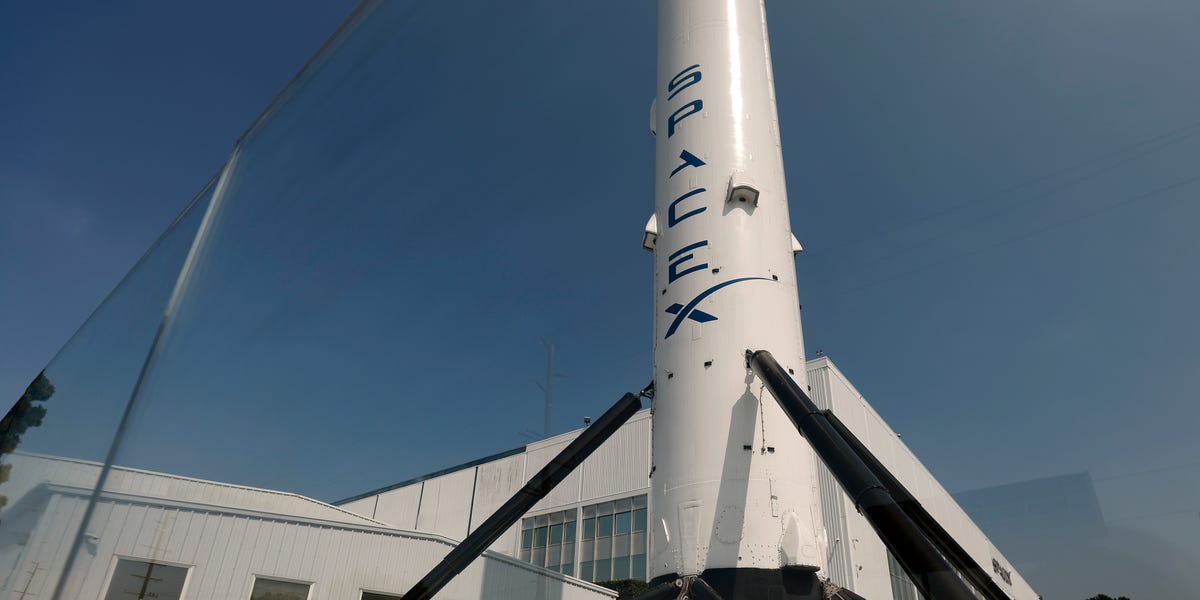
3 min readHere’s what you’ll learn when you read this story:A piece from one of SpaceX’s Falcon 9 rockets crashed into the moon in the early morning of August 5, 2026, a result that wasn’t anticipated when the rocket was launched back in 2025.Scientists learned back in April that the five-story-tall, 400-ton second stage was destined for lunar impact and even calculated the date, time, and location of the inevitable crash.Astronomers hoped the impact would produce a lunar plume that could be analyzed for scientific purposes, but initial observations detected no noticeable flash or plume.Earth has a space junk problem.The European Space Agency (ESA) estimates that there are 1.2 million pieces of debris in Earth’s near orbit, including discarded rocket stages, dead satellites, and even little bits of shrapnel around 10 centimeters or larger. At around 2:35 a.m. Eastern time on August 5th, 2026, humanity officially exported its untidiness to another celestial body when a five-story-tall, four-ton upper stage of a SpaceX Falcon 9 rocket smashed into the surface of the Moon traveling at roughly 5,400 miles per hour.The journey toward this unplanned collision began when a Falcon 9 rocket lifted off toward the Moon early in the morning on January 15, 2025. Onboard were two commercial landers belonging to U.S.-based Firefly Aerospace and a Japanese company named ispace. The first lander, known as the Blue Ghost, successfully touched down on the Moon on March 2 at Mare Crisium near Mons Latreille, while the Japanese lander regretfully lost contact seconds before landing and crashed into Mare Frigoris, or the Sea of Cold.However, that wouldn’t be the only crash associated with this particular mission. Because the lunar mission required more thrust than other SpaceX launches closer to Earth, the second stage didn’t burn up in Earth’s atmosphere or plunge into the ocean. Typically, the second stage would remain in orbit as a piece of space junk to be avoided by future satellites, but in late April 2026, astronomer Bill Gray predicted the precise date, time, and location that this second stage—now completely uncontrollable since it had dumped its fuel—would crash into the lunar surface.“What has happened is essentially a mixture of solar activity and gravity forces have put it on a path toward the Moon,” Julianna Scheiman, SpaceX’s director of NASA science and Dragon spacecraft programs, told reporters on Monday.This isn’t the first time a rocket stage has crashed into the Moon. In 2009, for example, NASA intentionally crashed a rocket stage into the lunar South Pole to study the dust kicked up from the impact. The experiment proved fruitful as observations detected water in the resulting plume. This time around, not wanting to waste an opportunity, scientists trained their gaze near Einstein Crater on the far western edge of the Moon’s near side using the Lowell Discovery Telescope in Arizona and the Very Large Telescope in Chile, among others.The results were remarkably muted, but that wasn’t necessarily a surprise. According to The New York Times, simulations of the rocket stage creating an observable dust cloud relied on the piece of rocket maintaining a vertical orientation, but it’s possible the stage sort of “belly-flopped” into the Moon. Initial observations saw no noticeable flash or change in the lunar surface, but operators at the Paranal Observatory reported a change in emissions lines, possible evidence of an impact and “an encouraging preliminary result.” South Korea’s Danuri lunar orbiter will also gather before-and-after shots of the area while NASA’s Lunar Reconnaissance Orbiter will pass over the site in less than a week.While the Moon is no stranger to humans leaving behind space trash, the unplanned nature of this collision once again illustrates how space debris is a growing problem—in both Earth and lunar orbits.“This may be of some—probably minor—scientific interest, and we may learn some things from it,” Gray told The Guardian. “It doesn’t present any danger to anyone, though it does highlight a certain carelessness about how leftover space hardware [space junk] is disposed of.”Darren lives in Portland, has a cat, and writes/edits about sci-fi and how our world works. You can find his previous stuff at Gizmodo and Paste if you look hard enough.
Whoopsie! A SpaceX Rocket Accidentally Crashed Into the Moon.
Full Article
Original Source
Read the full article at Popularmechanics →KhanList aggregates and links to publicly available news content. We do not host full articles from third-party sources. Always verify important information with original sources.