
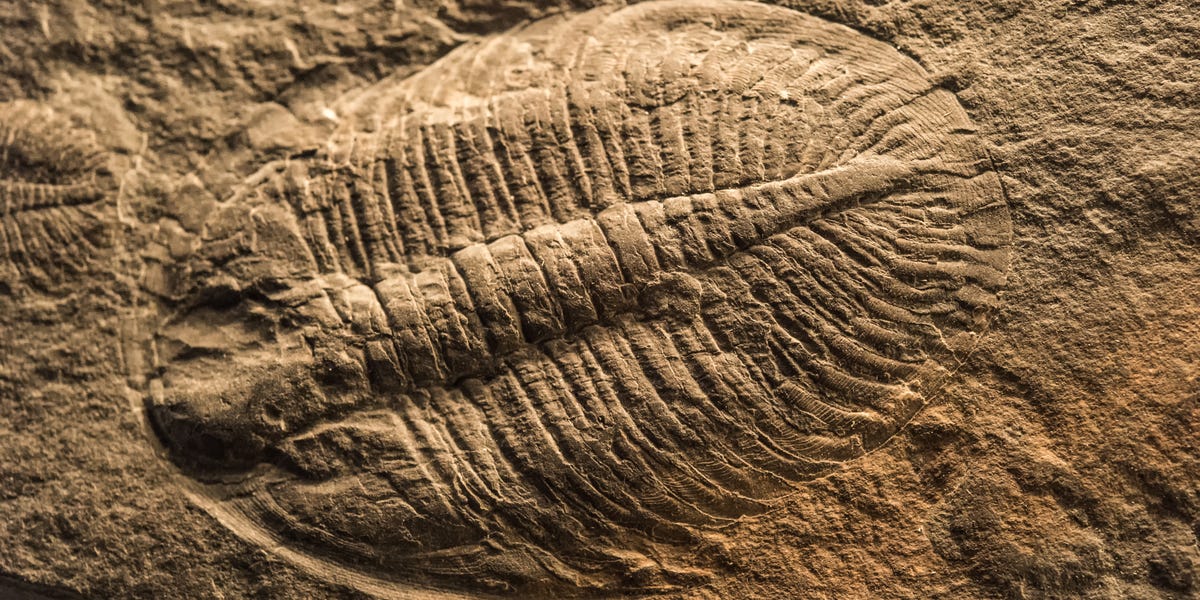
3 min readHere’s what you’ll learn when you read this story:The oldest known animal fossils are about 574 million years old, but the fossil record is too sparse to reveal when Earth’s first animals actually evolved.A new study challenges the use of animal-free deposits as evidence of animal absence, showing that one such deposit formed when animals are known to have existed.A molecular clock analysis puts the origin of animals between 700 and 800 million years ago, during or before the global glaciations of Snowball Earth.Cyclomedusa. Dickinsonia. Tribrachidium. These are only some of the strange, soft-bodied creatures that drifted and sprawled across Earth’s seafloors during the Ediacaran Period, which began 635 million years ago and produced the oldest known animal fossils some 574 million years ago. Although these fossils are conventionally treated as the first animals, the timing of animal origins remains unresolved. No animal fossils are known from before the Ediacaran, when the oceans appear to have held little more than protozoans and algae. That gap, however, may reflect the limits of preservation rather than the limits of life itself, and a growing number of researchers suspect animals evolved hundreds of millions of years earlier.The strongest hint comes not from fossils but from chemistry. Ancient rocks that were once seafloor sediment hold lipid biomarkers—molecular residues of sponges, or Porifera—laid down at least 75 million years before the oldest animal fossils. Sponges are the simplest animals we know of, lacking nerves, muscles, and organs, yet their cells and tissues carry features found nowhere outside the animal kingdom. That matters because sponges and humans descend from a shared ancestor that molecular evidence says must have existed, but that no one has ever found preserved in fossil form.Not everyone is convinced. Some scientists have argued that animals did not exist before 590 million years ago, pointing to China’s Weng’an Biota—the youngest known fossil deposit with no animals in it. If animals were around, the reasoning goes, this remarkably well-preserved assemblage should have captured them.Led by paleobiologist Ross Anderson of Oxford University and the Natural History Museum in London, a team of researchers used scanning electron microscopy to analyze microfossils from the Kheseen Biota in Mongolia. Kheseen is 40 million years younger than Weng’an but also contains no animal fossils—even though animals from this period turn up in other deposits. None of its impeccably preserved microfossils can be confirmed as animals, though some contain internal cells resembling an animal embryo. That, Anderson argues, is the point: a deposit can fail to record animals even when they were there, which undermines Weng’an as evidence that animals had not yet evolved.“These two biotas have similar preservation and microfossil assemblages, containing no definitive animals,” Anderson said in a study recently published in Science Advances. “The Kheseen Biota, deposited at a time when animals were undoubtedly present, questions the validity of the Weng’an [interpretation].”Preservation itself can decide whether animals appear in the rock. The animal fossils that do exist from Kheseen’s age survive only because conditions there were exceptional. Invertebrates had no bones, and soft bodies could easily have decayed without leaving impressions. It’s also possible the region was simply barren or hostile. The team therefore examined three older deposits with near-ideal fossilization conditions—Arizona’s Chuar Group, Australia’s Bitter Springs Formation, and Svalbard’s Svanbergfjellet Formation, dating from 730 to 850 million years ago—and found no animals in any of them, which by their own argument settles nothing.Anderson and his team then turned to molecular clock analysis for an idea of when animals might have evolved. Using dates from the fossil record for reference, they measured the rate of genetic mutations that accumulated in living species as they evolved to figure out when they diverged from a common ancestor. Their analysis showed that animals must have appeared sometime between 700 and 800 million years ago. In other words, animals had already evolved and begun to diversify by the Cryogenian Period, also known as Snowball Earth, or even further back during the Tonian Period. Complex multicellularity may itself be a Tonian innovation, according to some researchers, which would mean the building blocks of animal bodies were in place hundreds of millions of years before the first animal fossil.“The possibility of a pre-Ediacaran origin and diversification of animals means we cannot discount hypotheses that link the timing of animal diversification to Cryogenian Snowball Earth glaciations,” said the researchers. “The causes and trajectory of animal evolution will remain uncertain until paleontological and geochemical data provide sufficient confidence…to ensure a reliable timescale.”Elizabeth Rayne is a creature who writes. Her work has appeared in Popular Mechanics, Ars Technica, SYFY WIRE, Space.com, Live Science, Den of Geek, Forbidden Futures and Collective Tales. She lurks right outside New York City with her parrot, Lestat. When not writing, she can be found drawing, playing the piano or shapeshifting.
Whoops! Scientists Might Have Had the Origin of Animals All Wrong.
Full Article
Original Source
Read the full article at Popularmechanics →KhanList aggregates and links to publicly available news content. We do not host full articles from third-party sources. Always verify important information with original sources.