
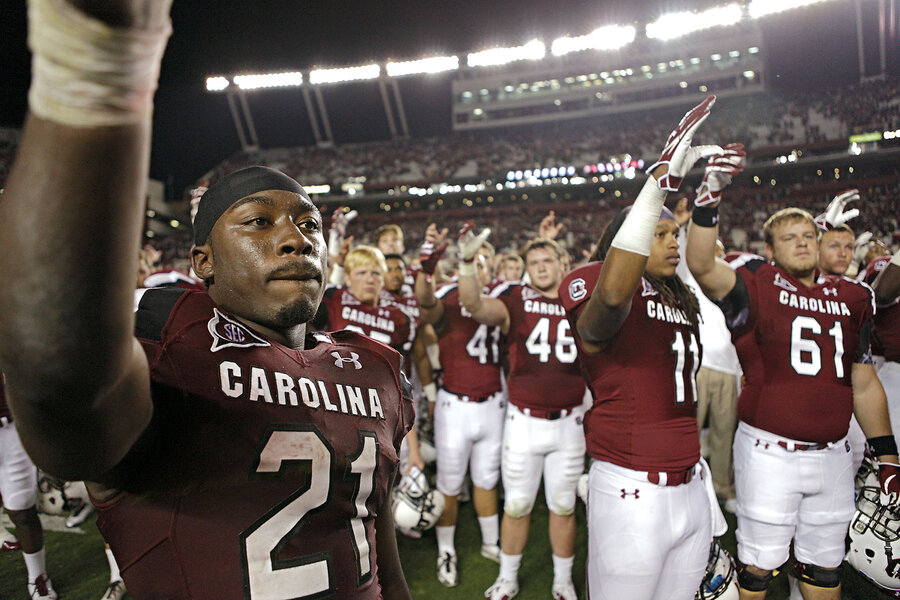
Marcus Lattimore, a former elite running back from the University of South Carolina, has a unique understanding of the trappings of fame within the realm of college athletics.He uses a single word – “terrified” – to describe his concerns for current players, whom he considers his “little brothers.”The college sports landscape has changed in the nearly 15 years since Mr. Lattimore played at South Carolina – and now Congress is weighing in. Currently, legislators are considering the Protect College Sports Act, which aspires to place federal guardrails on what is perceived by many as the “wild west” of modern revenue-generating college sports. Why We Wrote This Through the Protect College Sports Act, lawmakers are weighing in on the new era of revenue-generating college sports. Athletes are wondering who will represent them. At the center of the bipartisan legislation is NIL, short for name, image and likeness, which corresponds to a student athlete’s ability to use their personal brand to make money. The bill would establish uniform requirements – presently, rules vary by state – for NIL agreements for college athletes and provide a limited antitrust exemption for schools and conferences to pool and sell certain college sports media rights. It also allows student athletes one penalty-free transfer through the “transfer portal,” which lets players change institutions for increased playing time or more money and has drawn criticism for its overuse.“There’s a kinship that I share with a high-profile recruit or someone playing college football at a high level because I’ve sat in their shoes,” says Mr. Lattimore, who went on to play for the San Francisco 49ers. “I’m terrified for what will be if there is no psychological or wellness practice – if they don’t have a centering device.”The act failed to reach a vote during a pre-recess session in the Senate over the past weekend. It is now slated for September, after the chamber returns from summer break.Mr. Lattimore notes that the current legislation “seems confusing to me,” because of the sport’s controversial history when it comes to player compensation. Some college boosters and coaches had long found ways to pay choice recruits or their families. “They were paying players before it was legal to pay players,” he says. Julia Demaree Nikhinson/AP From left, President Donald Trump, Secretary of State Marco Rubio, White House Chief of Staff Susie Wiles, and former Alabama football coach Nick Saban attend a roundtable discussion on college sports, at the White House, March 6, 2026. Now that payments are aboveboard and Congress is getting involved, the former running back agrees with those who have suggested college football players have a union to negotiate on their behalf. “Someone that they can trust has their best interests at heart.”Advocates for passing the bill include President Donald Trump, who held a college sports roundtable in March that was noticeably devoid of current players, and former Alabama football coach Nick Saban, who attended the gathering.Critics have asked whether players’ interests are properly represented in the act, if at all. The NAACP, which in May called for a boycott by athletes in Southern states where Black voting rights were being eroded by redistricting, reiterated its call in the face of the current bill.“The Protect College Sports Act is not simply an NIL bill. Public institutions cannot depend upon Black athletes to fill their stadiums, secure television contracts, attract donations, and build nationally recognized brands, then claim neutrality when the political rights of those athletes, their families, and their communities are under attack,” wrote NAACP President and CEO Derrick Johnson.Ezinne Ofoegbu, an assistant professor in the educational leadership program at Santa Clara University who studies social justice commitments and initiatives in college athletics, believes previous NCAA stances inform this current legislative push.“The NCAA has a long history of looking to Congress and looking at universities as a means of restoring control over college athletics and college athletes and the way that they behave,” Dr. Ofoegbu says. “The NCAA argued against the implementation of Title IX [the law barring sex discrimination in schools receiving federal funds] back in the 1970s. ... Control was taken from [the NCAA] by the Supreme Court, indirectly, when NIL became legalized.”She adds: “I see the Protect College Sports Act and any attempt that the NCAA makes to get Congress to intervene as their attempt to restore control.” The commissioners of the NCAA's Power Four conferences – from second from left, Greg Sankey of the Southeastern Conference, Jim Phillips of the Atlantic Coast Conference, Brett Yormark of the Big 12, and Tony Petitti of the Big Ten – speak with ESPN college football reporters Roddy Jones, left, and Dana Boyle, right, in Washington, April 9, 2025. Discussing potential caps to what athletes can earn while coaches face no such limits is also imbalanced, Dr. Ofoegbu adds, as evidenced by recent buyouts for coaches that have drawn displeasure from many. Louisiana State University paid a $54 million buyout to former football coach Brian Kelly.“LSU will be paying Brian Kelly $800,000 a month until December of 2031. That’s almost around $25,000 a day, but you have Congress and the NCAA who are saying, ‘Oh, we need a cap on how much schools can pay athletes,’” Dr. Ofoegbu says.Athletes can be taught more about brand deals and endorsements, to ensure that money flows to them and schools, but that wasn’t what universities and the NCAA intended, she says.Even the term “student-athlete,” which was created in the 1950s by NCAA Executive Director Walter Byers, who sought a way to avoid paying workers’ compensation to players, is hotly debated.Dr. Ofoegbu also challenges college sports viewers such as herself to be “critical consumers.”“Especially in the American context, sports are inseparable from politics, and this bill is the perfect example,” she says. “I think sports are a great site for understanding politics related to gender, race, nationalism, everything. So, if we can have these conversations about American pastimes, imagine how those conversations might leak into the ways that we think about education and other American social institutions.”Bruce Johnson Jr., a former defensive lineman at South Carolina State University and currently a high school defensive line coach in South Carolina, has been on both sides of the proverbial line. Hailing from humble beginnings in Greenwood, South Carolina, his experiences with football have always been centered around doing the impossible – dreams his father put in his head at an early age.While college athletics remain a great meritocracy, he explains, there are “pros and cons” in the current landscape.“NIL is a good thing. It gives players financial stability, and they can take care of their families at a young age,” Mr. Johnson says. “I’m not against it, but I still feel like it has to be earned, not given. ... You have players who come in and are expecting money, but don’t live up to expectations.“When it comes to making laws, that can be good and bad,” he says. “One of the bad things is the control over the players. You don’t want someone controlling all of your rights, or as they used to say, feeling like you signed your life over.”
Who wins when Congress calls the plays in college sports?
Full Article
Original Source
Read the full article at Csmonitor →KhanList aggregates and links to publicly available news content. We do not host full articles from third-party sources. Always verify important information with original sources.