
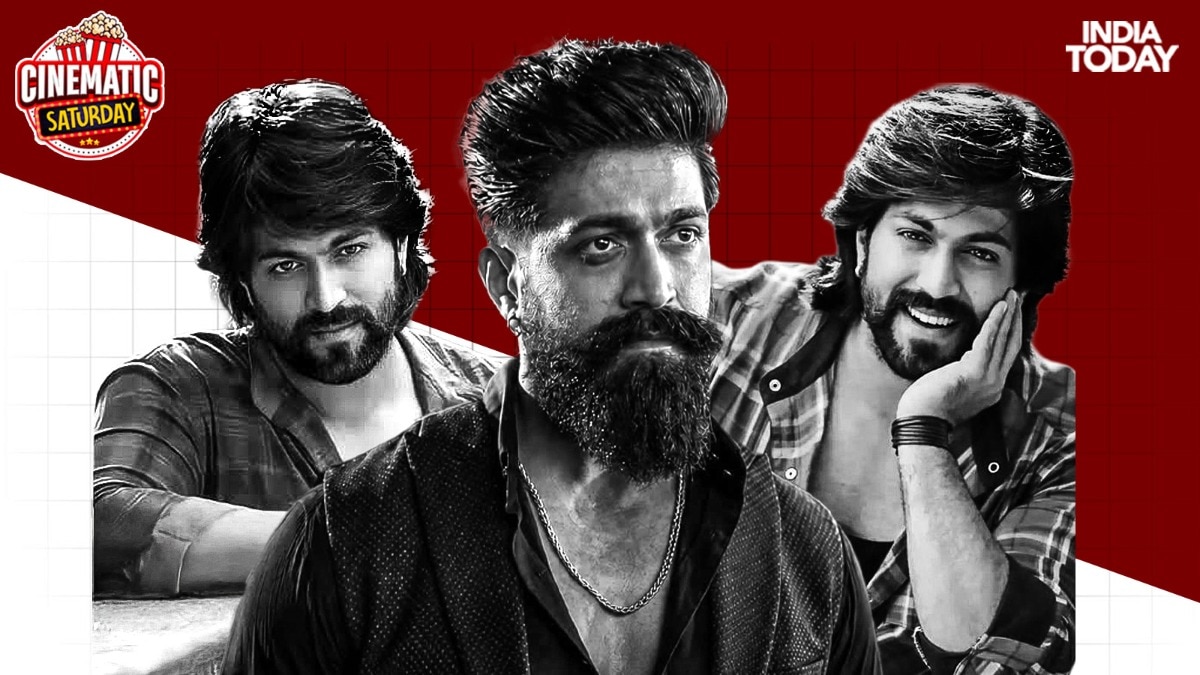
"Illi yaaru hero galanna huttu haakalla namige naave hero aagbeku.”Nobody is going to make a hero out of you here; you have to become one yourself.You just read a line from the 2013 hit Kannada drama Raja Huli that, years later, feels less like dialogue and more like an accidental prophecy. Yash says it to a friend who is trying to impress a girl, telling him that nobody else can hand him the status of a hero; he has to earn it himself. At the time, it was simply another mass-friendly line in a Kannada film. Today, it reads almost like a neat summary of Yash's career.So when Telugu producer Allu Aravind asked in 2023, "Who was Yash before KGF?", the question struck a nerve. It was provocative because, for a large part of India, there really was a before and after KGF.In 2018, Yash arrived as Rocky Bhai – bearded, brooding and swaggering through Prashanth Neel's Kolar Gold Fields in a cloud of dust and gunfire – and suddenly an actor who had been a major Kannada star became a name the rest of the country knew. Fans were quick to point to the films that had already made him a force in Karnataka, while Yash himself later acknowledged that KGF had changed his visibility, even as he stressed that cinema is never the work of one person alone. But there is a danger in looking at a career backwards from its biggest success. Once KGF becomes the defining image, everything before it can begin to look like a prologue: the television years become trivia, the early films become stepping stones to Rocky Bhai, and a decade-long rise starts resembling an overnight transformation. That version of Yash's story may be convenient, particularly for audiences who discovered him only after KGF, but it does very little justice to the career Kannada cinema had already spent years building.To understand what KGF actually did for Yash, perhaps the better question is not who was Yash before KGF, but what had Yash already become by the time KGF came along? After speaking to people who knew him at different points of that journey – from his earliest days in television and theatre to his rise as one of Kannada cinema's biggest stars – the answer is remarkably consistent. He was already a star, but more importantly, he had already been building himself like one.Before the hero, there was an actorThe Yash story does not begin on a film set. It begins much earlier, with theatre, television and a young Naveen Kumar Gowda trying to find his way into an industry that had no obvious reason to make room for him.Actor and very dear friend of the star, Girish Shivanna, first saw Yash in 2002, when the latter had come to Bengaluru from Mysuru and was working in theatre. That detail matters because Yash's early years are often compressed into a convenient television-to-cinema narrative, when the reality was considerably more layered.“He was a pure theatre person,” Girish recalls while exclusively speaking to India Today, listing productions such as Jokumaraswamy, Gokula Nirgamana, Saptavarna and Devadana. Television came later, and films came after that. Theatre was where he learnt the first, most basic lesson of performance: how to hold attention before anybody decided if he was worth watching. There was no star treatment attached to those years. He was simply another young performer learning the machinery of the craft, and that willingness to learn would become one of the recurring themes in conversations about Yash decades later.Director Shashank, who cast him in Moggina Manasu (big screen debut for both Yash and his wife Radhika Pandit) in 2008, first noticed him on television. Yash appeared in the 2006 serial Preeti Illada Mele, playing a character who was almost the opposite of the soft, romantic role Shashank had written for his film. “I got impressed with his talent,” Shashank says, during an exclusive conversation with us, adding, “Basically, he was acting very well. He was carrying that character very well.”Moggina Manasu gave him that opportunity. He was not the film's conventional male lead – it was a women-centric story – but his performance was noticed, earning him the Filmfare Award for Best Supporting Actor. The industry had begun to look at him differently, and yet there was still a long way to go before anyone outside Karnataka would know his name.The climb was slower than the mythThe temptation, when writing about successful actors, is to make their early career look like an uninterrupted march towards greatness. Yash's wasn't. After Moggina Manasu, there were films that worked and films that did not, and he moved through leading roles while slowly figuring out what kind of performer – and eventually what kind of star – he wanted to be.Rocky (2008) did not immediately turn him into a box-office force. Kallara Santhe (2009), Gokula (2009) and other early films were part of the process. There were years when he was working without the certainty that the next film would change everything, which is precisely why Googly in 2013 mattered so much. Shashank, who remained in touch with Yash after Moggina Manasu, remembers that transition clearly. Yash had gone from being a talented young actor to someone who was beginning to look like a genuine star. Yash as Sharath and Kriti Kharbanda as Swathi in a still from Googly. “Through Googly, he became a household name,” Shashank tells us, "It became a huge blockbuster as a solo hero.” That distinction is important because KGF was not the first time Yash had experienced the feeling of being the reason audiences turned up.Googly gave him the breakthrough, Raja Huli reinforced it, and then came Mr. and Mrs. Ramachari (2014), which became one of the defining successes of his career and firmly established him among Kannada cinema's biggest commercial stars. Masterpiece (2015) and Santhu Straight Forward (2016) followed, further strengthening that position.By the time KGF went into production, Yash was not an unknown actor being handed an enormous canvas. He was a Kannada superstar being given an unusually enormous canvas, and that distinction changes the entire story.What the rest of India missed“He was someone who would definitely be very beneficial to Indian cinema,” Yash's Raja Huli co-actor Meghana Sarja recalls her father saying while speaking to India Today. What is striking is not merely the prediction, but what Meghana says she saw herself while working with Yash. “He is himself a student of cinema,“ she claims.That phrase comes up repeatedly in conversations about him. Yash, Meghana says, was never somebody who simply arrived on set, performed his scenes and went home. He wanted to understand how the film was being made.During Raja Huli, she remembers him being involved in almost every part of the process. That involvement can sometimes be mistaken for interference, particularly when an actor begins offering opinions beyond his own performance, but the people I spoke to make an important distinction: Yash does not appear to want to be the director. He wants to understand why something works. Yash as Raja Huli and Meghana as Kaveri in Raja Huli poster. Girish Shivanna puts it more practically. If a director tells Yash to walk into a scene, he might suggest another way of entering because he is thinking about what the audience will feel when they see it. “Those are things the actor should discuss with the director. You cannot act without improvisation,” he says. The director gives the actor the script and broad direction, but the actor has to bring something of his own to it, and Yash has always understood that distinction.He wasn't chasing other stars but an audienceYash, Shashank says, felt that frustration too. He wanted Kannada cinema to compete – not merely survive, not merely find its niche, but compete with the industries whose films were routinely occupying screens in Karnataka. That ambition eventually became bigger than his own career.According to Shashank, Yash understood that if Kannada cinema was going to travel beyond Karnataka, the films had to be made at a level that could compete with productions from anywhere else in the country. That meant better scale, stronger storytelling, greater technical ambition and, crucially, an understanding of what mass audiences wanted. It is difficult not to see the beginnings of KGF in that thinking.Because yes, KGF changed everything. Its scale changed the conversation around Kannada cinema, its dubbed versions travelled, Rocky Bhai became a cultural phenomenon and Yash became a pan-India star. But the ambition to reach that audience did not suddenly appear in 2018. The opportunity did. The preparation had been going on for years. Yash as Rocky in KGF: Chapter 1 poster. The decision to make KGF itself was a gamble. Shashank points out that Yash spent around three years on the film when, in that same period, he could have made several other movies. He chose one project and bet on its ability to take him somewhere nobody knew was possible. That decision tells us something about the actor long before we consider the result: he was willing to wait for the right film rather than simply chase the next release.So, did KGF create Yash?The honest answer is both yes and no. It would be disingenuous to pretend KGF did not transform his career. It did. The film gave Yash an audience far beyond Karnataka, altered the commercial possibilities around him and made him one of the most recognisable faces in Indian cinema. But saying KGF created Yash is different from saying KGF made Yash visible, and the latter is much closer to the truth.Before Rocky Bhai, there was the theatre actor who was willing to do whatever was required to learn the craft; there was the television actor Shashank noticed almost by accident; there was the supporting actor who won an award for Moggina Manasu; and there was the young leading man who endured films that did not work before finding his rhythm with Googly and Raja Huli. There was also the star who reached the top of Kannada cinema through Mr. and Mrs. Ramachari, Masterpiece and Santhu Straight Forward, while simultaneously developing an unusually deep understanding of how films are made and how audiences respond to them.And through all of it, according to those who knew him, there was the same restless student of cinema. Girish describes him as a horse with blinders on: he does not spend his time looking sideways at other actors or worrying about who is ahead of him; he simply keeps moving forward. Meghana remembers someone who knew what he wanted and worked towards it with unusual diligence. Shashank calls the eventual success a “well-achieved target”, rather than a sudden transformation. Now that the world is once again prepared for a similar storm with Geetu Mohandas' Toxic: A Fairytale for Grown-Ups, that may be the most useful way to look at Yash's career.KGF did not manufacture the ambition, the discipline or the instinct for mass cinema that audiences associate with him today. It took qualities that had been developing quietly for years and placed them on a canvas large enough for the rest of India to see.The world met Yash in 2018. Kannada cinema had been watching him for a decade and a half. And perhaps that is what was missing from the question, “Who was Yash before KGF?” He was not waiting to become Rocky Bhai. He was already becoming Yash.- EndsPublished On: Aug 22, 2026 10:00 IST
Who was Yash before KGF? The question that misses the bigger story
Full Article
Original Source
Read the full article at Indiatoday →KhanList aggregates and links to publicly available news content. We do not host full articles from third-party sources. Always verify important information with original sources.