
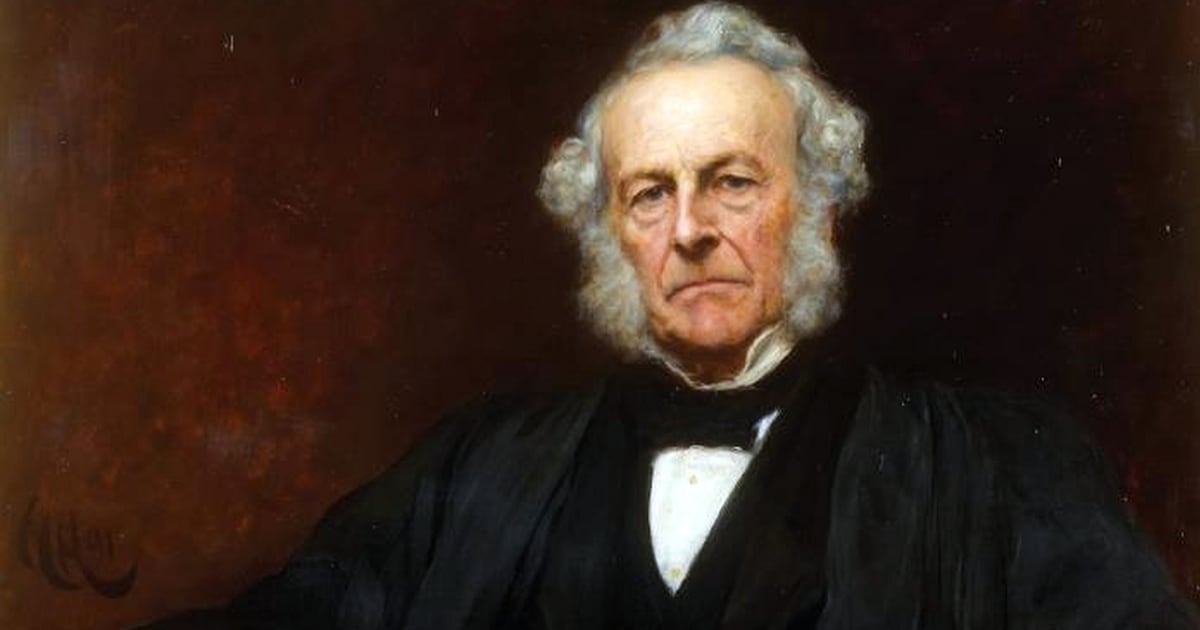
OpenAI claims to have found proof of Sligo scientist’s equations but tech rivals are less than impressedGeorge Gabriel Stokes made profound contributions to hydrodynamics and devised and performed many ingenious experiments in optical science. Portrait: The Royal Society A mathematical problem is making big news, with AI companies clashing over claims by one tech giant to have found the solution to the Navier-Stokes equations. Regarded as one of trickiest puzzles of mathematics, it has Irish connection.Who was George Gabriel Stokes?George Gabriel Stokes was born in Skreen, Co Sligo, in August 1819, the son of the local Protestant minister. After schooling at home, in Dublin, and in Bristol, Stokes entered the University of Cambridge in 1837 to study mathematics.He held many of the most significant roles in 19th century science, including Lucasian Professor of Mathematics – a position previously held by Isaac Newton and later held by Stephen Hawking – and Member of Parliament for Cambridge University. While his research interests were wide-ranging, his most significant contributions were to hydrodynamics, and he is best known for the Navier-Stokes equations (French physicist Claude-Louis Navier also did work on them). READ MOREMuch of Stokes’s work on this topic was inspired by the Irish coastline. Stokes said it was a childhood experience of almost being carried away by a large wave off the Sligo coast that first made him interested in studying waves, and later measurements for his research that lead to these equations were taken at or near the Armagh coast, his wife’s homeplace and the family’s annual holiday destination. What are the Navier-Stokes equations?The Navier-Stokes equations – which were published in 1845 – are the fundamental basis of fluid mechanics. They can predict how fluids will behave under certain conditions, and have been used in scenarios as varied as weather forecasting, vehicle aerodynamics and aviation, blood flow in the body – and to explain why the bubbles in a pint of Guinness sink rather than rise. However, despite the fact that these equations are used in practice every day, the theoretical understanding of how the equations work is far from complete. The primary unanswered question is whether – under certain, specific conditions – solutions to the equation always exist and whether these solutions are smooth (a word mathematicians use to convey a certain type of consistency).The importance of these equations means they were chosen by Clay Mathematics Institute in 2000 to represent a Millennium Prize Problem, the solving of which carries a $1 million prize (€890,000). Aoife Kearins is a history of maths PhD student at the University of Oxford, researching 19th century mathematical physics and particularly George Gabriel Stokes How was the Navier-Stokes problem solved?Well, it remains to be seen if the problem was truly solved. In early September, OpenAI announced that it had found a solution to the problem and posted a proof totalling 166 pages. In order for the Navier-Stokes equations to be considered solved, one of two things has to happen: either the equations have to be shown to exist and be smooth in all scenarios (under the specific conditions outlined), or a counter-example has to be found that therefore proves the equations don’t hold in all scenarios. OpenAI’s solution presents the latter. It shows how the equations can sometimes fall apart, finding scenarios known as “blow-ups” where the speed of part of the moving fluid becomes infinite – a situation that can’t happen in real life.Approximately 10,000 OpenAI LLM (large language model) agents spent 88 hours constructing a blow-up collectively, which showed that the equations do not, in fact, always hold. Why are AI companies at war over the solution?There has been no shortage of contention since the solution was announced last month, with mathematicians still unable to agree on whether the equation was solved, how exactly it was solved if that’s the case, whether the process amounts to plagiarism, and what exactly all this means for the future of mathematics research.Leading experts in the field of fluid dynamics have found the OpenAI proof difficult to read. Several research groups are now working through the paper and its accompanying programming code to see what’s really going on with the maths in the equation.In a further twist, it has emerged that OpenAI’s rival Anthropic had also been working on the problem in collaboration with academic mathematicians, and there are allegations that information was passed on to OpenAI – something OpenAI denies.The row over the equations has become another front in the acrimonious rivalry between OpenAI and Anthropic, which was founded in 2021 by former OpenAI employees who believed OpenAI was putting profits ahead of safety in developing artificial intelligence.[ Tech leaders outline AI dangers and opportunities at Dublin summitOpens in new window ]Another competitor Google DeepMind AI has criticised Open AI’s approach to the Navier-Stokes problem. Its co-founder and chair Demis Hassabis told this week’s AI summit in Dublin – an event hosted by Ireland as part of the EU presidency – that his company was examining similar maths problems. But, unlike OpenAI, he said his company believed in “working with the maths community to understand maybe how the answer was arrived at, not just come up with the answer out of the blue”.OpenAI is undeterred, however, and last week it announced hundreds of new findings, amounting to tens of thousands of pages, claiming to have solved questions across numerous subfields of mathematics and theoretical computer science. The quantity and scale of these solutions has left the mathematical community at a loss, with no clear answer on what the approach should be for verifying and understanding this new mathematics or what it means for the future of the field.Aoife Kearins is a history of maths PhD student at the University of Oxford, researching 19th century mathematical physics and particularly George Gabriel StokesIN THIS SECTION
Who was George Gabriel Stokes? The Irish mathematician whose 180-year-old puzzle has AI giants at war
Full Article
Original Source
Read the full article at Irishtimes →KhanList aggregates and links to publicly available news content. We do not host full articles from third-party sources. Always verify important information with original sources.