
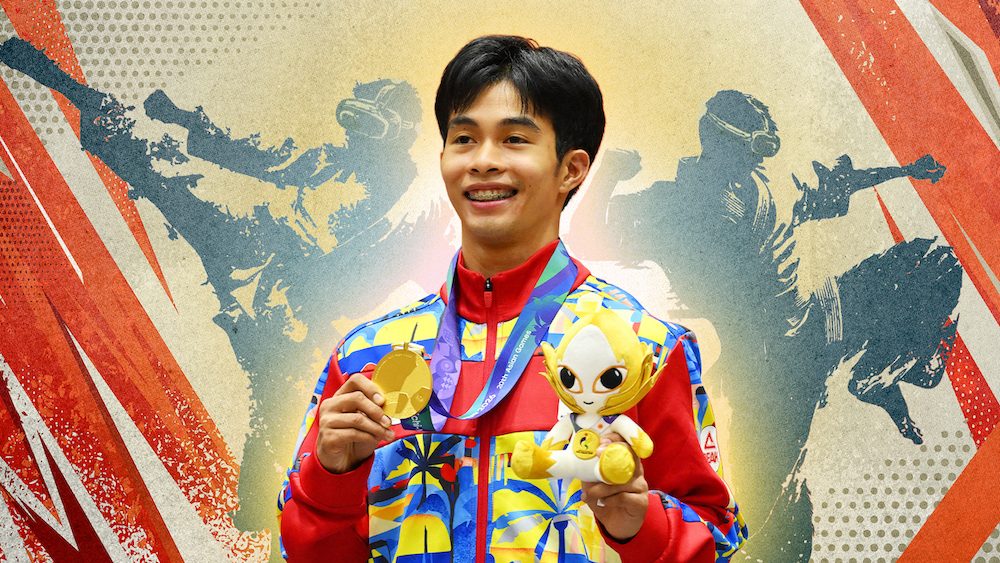
CHAMPION. Jeus Yape of the Philippines wins the gold medal in mixed individual virtual taekwondo in the 2026 Asian Games. Andy Chua/Reuters Reaping the fruits of nearly two decades spent honing his craft in taekwondo, Jeus Yape becomes the first Filipino to win a gold medal in the sport in the Asian Games Jeus Yape, a 22-year-old taekwondo athlete, became the first Filipino to win a gold medal in virtual taekwondo at the Asian Games, contributing to the Philippines' total of four golds. Yape comes from a taekwondo family and has been training in the sport since he was four years old, transitioning from kyorugi to poomsae due to his size. His victory in virtual taekwondo has elevated him to the status of a national star, alongside established athletes Carlos Yulo and EJ Obiena, while he continues his studies in fitness and sports management. This is AI-generated. Read the article for full context. Report any errors. Few knew Jeus Yape before the Asian Games. But that changed overnight as the 22-year-old became the first Filipino to win a taekwondo gold medal in the quadrennial showpiece following his triumph in the mixed individual virtual taekwondo. Yape helped the Philippines equal its four-gold tally in the 2018 and 2023 stagings as he delivered the last mint after Carlos Yulo claimed the floor exercise and vault titles in men’s artistic gymnastics and EJ Obiena defended his crown in men’s pole vault. On top of his gold, Yape also bagged bronze in the men’s individual poomsae, joining Yulo as the only Filipino athletes to win multiple medals in the 20th edition held in Nagoya, Japan. The medals are the fruits of nearly two decades Yape spent honing his craft in the sport. Runs in the blood Hailing from Kananga, Leyte, Yape comes from a taekwondo family, with both his father, Roderick, and mother, Joyce, holding black belts and serving as taekwondo instructors. His older sister, Stella Nicole, has also represented the country in the sport. He first took up taekwondo at just four years old and has not looked back since. “Back then, I just tagged along whenever my father taught classes and I spent my time playing. Eventually, he started having me join sparring sessions, and over time, I grew to like the sport,” Yape said in Filipino. Yape started as a kyorugi (full-contact sparring) athlete before switching to poomsae (non-contact form) when he reached high school. “I was quite small back then, so I was moved to poomsae because my size was a disadvantage in kyorugi. From then on, I became more focused on poomsae,” Yape said. That shift paid dividends as Yape earned a taekwondo scholarship from the University of Sto. Tomas and became a member of the national team, representing the country in the 2024 World Poomsae Championships and 2025 Southeast Asian Games, where he both won bronzes as part of the mixed team. Little did Yape know that perhaps the biggest achievement of his career would come in virtual taekwondo, an event that debuted in the Asian Games. What is virtual taekwondo? Yape likens virtual taekwondo or VTKD to Tekken, the popular fighting game where players aim to deplete their opponents’ health bars through a combination of attacks and strategic moves. But instead of controllers, VTKD competitors wear virtual reality headsets to enter a digital arena, while motion-tracking nodes attached to their backs, thighs, and shins capture their movements in real time. Attacks are measured by acceleration, with faster kicks inflicting greater damage. Competitors, though, can negate damage with successful blocks. VTKD also borrows elements from video games, including a stun meter that renders opponents temporarily defenseless once filled. While punches do not deal damage, they help charge the stun bar. Although VTKD requires no physical contact, Yape said the sport presents its own challenges. “It’s difficult because you’re not hitting anything, so there’s more strain on the hamstrings since nothing absorbs the impact of your kick, especially when you kick with full force,” he said. VTKD also demands stamina, with players delivering a steady stream of kicks in each fast-paced, one-minute round. “I can say it’s hard because there’s luck involved. It’s anybody’s game,” Yape said. New star Yape’s landmark Asian Games victory has thrust him into the same spotlight as Yulo and Obiena, two established stars he only once looked up to from afar. For Yape, being mentioned in the same breath as the two Olympians is a tremendous honor. “We watched kuya EJ compete in the Tokyo Olympics on TV at home. I never expected that I’d get to talk to him and be here with him,” Yape said during the heroes’ welcome for Asian Games medalists. “I also really admire kuya Caloy. Our sport, freestyle taekwondo, has some similarities to gymnastics, so I’m really amazed by what kuya Caloy can do. He’s so good at sticking his landings and that’s one of the things I want to learn too. I’m inspired by him.” While still riding high on his breakthrough triumph, Yape has returned to the familiar demands of student life as he continues his studies in fitness and sports management at UST’s Institute of Physical Education and Athletics. “Things are back to normal now. I still have to catch up on the assignments and works I missed,” Yape said. – Rappler.com How does this make you feel? Loading
Who is Jeus Yape and what is virtual taekwondo?
Full Article
Original Source
Read the full article at Rappler →KhanList aggregates and links to publicly available news content. We do not host full articles from third-party sources. Always verify important information with original sources.