
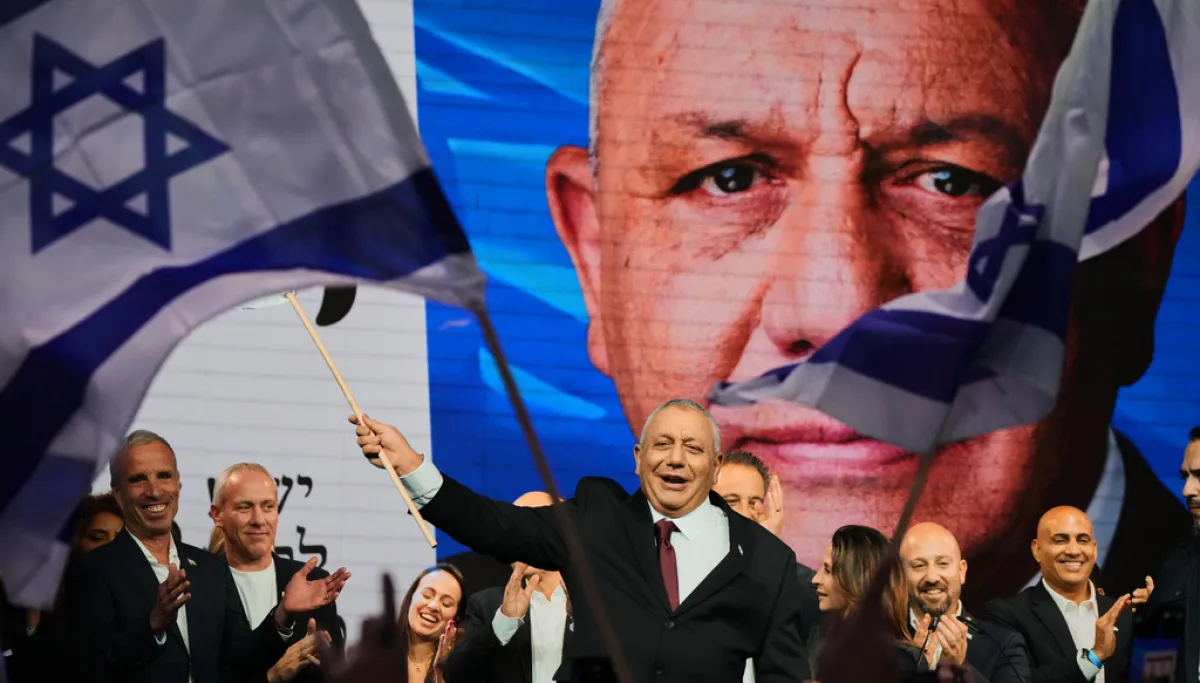
Former Israel Defense Forces Chief of the General Staff Gadi Eisenkot has positioned himself as the top contender against Prime Minister Benjamin Netanyahu for Israel’s premiership, using his respected credentials to unite a swathe of differing parties.Eisenkot’s position as head of the opposition best displays Netanyahu’s domination of Israeli politics. His coalition spans the entire political spectrum, all united solely behind the desire to oust the prime minister. Analysts have noted that the two are remarkably similar on most issues, particularly security and defense matters. But the former Israeli military chief helped turn the election into a referendum on Israel’s most polarizing political figure, campaigning on taking Netanyahu down, drafting ultra-Orthodox Jews, and opening a state inquiry into the Oct. 7, 2023, surprise attack by Hamas.Eisenkot was born in 1960 to Moroccan Mizrahi Jewish immigrants. If he wins the premiership, Eisenkot would be the first non-Ashkenazi Jewish prime minister since independence in 1948, though less than a third of Israelis are Ashkenazi today. His ethnicity and working-class background underscore the tension within Israeli society between the Ashkenazi descendants of the Zionist pioneers of the early 20th century and the non-Ashkenazi immigrants who fled to Israel from across the Middle East. The future military leader was drafted into the IDF in 1978 and chose to remain on as a career officer. By the time Israel invaded Lebanon in 1982, he was a company commander in the Golani Brigade, one of the most highly decorated and prestigious units in the military. He gradually climbed through the ranks until his future rival, Netanyahu, appointed him chief of the general staff after the 2014 war in Gaza. He retired in 2019.His tenure as chief of the general staff saw an escalation of attacks against Israel’s adversaries, including thousands of strikes against Iranian targets in Syria. On the issue of Palestinians, however, he was noted as a relative moderate. He pursued a policy of restraint during the so-called “knife intifada” in 2015-2016 in the West Bank, pushing back against calls for more radical action such as curfews or shoot-to-kill orders.Eisenkot made a name for himself as a military theorist, being closely linked with Israel’s Dahiyeh Doctrine, where the Jewish state responds to aggression with greater destruction as a method of deterrence. He’s also been credited with the development of Israel’s Campaign Between the Wars doctrine, Jerusalem’s method of degrading adversaries’ capabilities through unconventional operations and grey zone warfare.The former military chief joined politics in 2022 and was elected to the Knesset as a center-right hawk. After the Oct. 7 attack, he joined the government as a minister without portfolio, though he left the government with his party in June 2024. He formed his own center-right party, Yashar, in September 2025.The war in Gaza would come to define Eisenkot in voters’ eyes due to the personal suffering he has endured: his son, Master Sgt. Gal Meir Eisenkot, 25, was killed by an improvised explosive device in Gaza in December 2023; his nephew, Sgt. Maor Cohen Eisenkot, was killed a day after his son; and then a second nephew was killed in November 2024. He’s framed their deaths as the defining moment of his career.“Over Gal’s grave, I swore that the price he paid, he and his friends, those he knew and those he didn’t, would not be in vain,” Eisenkot wrote in the newspaper Yedioth Ahronoth in April 2026, calling the promise central to his mission.His party’s name, which translates to “straight,” comes from a quote from freed Israeli hostage Eli Sharabi: “It’s not right, it’s not left, it’s straight.”The 2026 parliamentary campaigns have taken on a particularly personal and bitter character, featuring fierce attacks against Netanyahu and Eisenkot. Netanyahu’s camp aired a highly controversial artificially generated ad that showed Eisenkot running past a boy who looked like his dead son to embrace the leader of an Arab Israeli party.Despite the fiery campaign, the two’s positions on major issues are broadly similar. Eisenkot supported both wars against Iran, believes Iran is Israel’s foremost threat, doesn’t support a two-state solution with the Palestinians, and hasn’t spoken against alleged abuses by Israeli forces in Gaza. The two critical issues they differ on are Eisenkot’s support for drafting ultra-Orthodox Jews and an investigation into the Oct. 7 attack, responsibility for which the opposition leader has pinned on the prime minister. His hesitance and refusal to work with Arab Israeli parties unless they meet a rigid criteria is another important commonality.One of Israel’s most respected journalists, Nahum Barnea, told the New Yorker in a July profile that Eisenkot’s two biggest appeals are his perceived ability to “stop the bleeding in two areas” — Israel’s standing in the world and domestic polarization.ISRAELI TOP ELECTION OFFICIAL ORDERS SHIN BET TO INVESTIGATE ALLEGATIONS OF FOREIGN INTERFERENCE WITH ARAB VOTE“The second was the country’s polarization, the bitterness of its political discourse. Eisenkot might embody a different kind of public figure,” Barnea said. “He’s misleading because people see an overweight guy, like a bear, very warm and informal. He doesn’t look like a general. But he is hardly mediocre. He is serious. And, yes, he lost his son in war. He knows that his bereavement is a political advantage, and not cynically. He represents a going back to public service.”Netanyahu and Eisenkot both face a tough battle for the top, as neither was able to seize a parliamentary majority due to Arab Israeli parties taking 19 seats with over 90% of the vote counted.
Who is Gadi Eisenkot?
Full Article
Original Source
Read the full article at Washingtonexaminer →KhanList aggregates and links to publicly available news content. We do not host full articles from third-party sources. Always verify important information with original sources.