
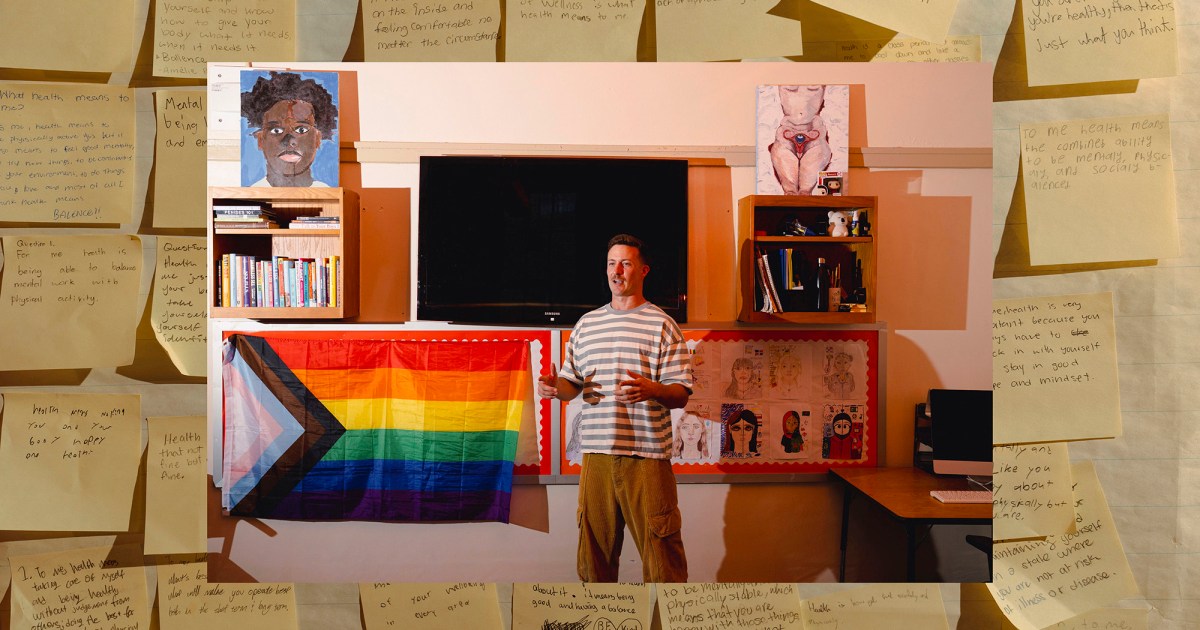
Get your news from a source that’s not owned and controlled by oligarchs. Sign up for the free Mother Jones Daily. For the first time in nearly 10 years, Alice* didn’t spend her fall welcoming a new class of students. After leaving her role as a high school English teacher last spring, she spent back-to-school season tending to her newly launched small business in the southwestern Ohio town where she lives with her wife. She left, in large part, because of her sexuality. Alice spent most of the last decade teaching at a public school in her area after leaving her previous role at a Catholic school when another teacher was fired for being gay in a targeted campaign by a student’s parent. When she started at her new school in 2015, she had an acute understanding of the stakes of being an openly gay teacher in her conservative district. But she expected that her sexual identity wouldn’t be as much of a liability in a public school. Post-Its from students in Drew Miller’s high school health and sex education class answering the question, “What does health mean to you?” Student answers to the question, “What does health mean to you?” Things took a turn for the worse around the 2024 election, when Alice was suspended over social media posts where she discussed teaching banned books in her classroom. Parents and community members in Facebook groups doxxed her, threatened her safety, and accused her of being a groomer because she was gay. When I talked to Alice on the phone in early August of this year, she told me how dehumanizing the whole ordeal was for both her and her wife. Coming back to school after the suspension, Alice scaled back how visibly queer she was at work and drastically censored her curriculum. She pulled down pictures of her wife in her classroom, removed its library, and cut Oscar Wilde’s The Importance of Being Earnest out of her lesson plan to avoid teaching a book by a gay author. She kept only a small pride flag up in the back of her classroom, a signal of both acceptance and defiance. Now, she and her wife are planning to start a family of their own—a driving force in Alice’s decision to leave. After weathering a grim political atmosphere for years, she finally decided to step back. “If it’s between their education and my safety, it’s time to choose my safety,” she told me. A scan of The Color Purple, banned in numerous states. A detail of male and female genitalia in Drew Miller’s classroom. Alice is not alone in feeling the current scrutiny around LGBTQ teachers weigh so heavily that it changes the way she approaches her career altogether. But for queer students, teachers like Alice can be a lifeline. A 2023 study by the Trevor Project shows that without queer teachers, students in the LGBTQ community are more likely to feel depressed or anxious, and more likely to consider or attempt suicide. Yet attacks on the LGBTQ community at the state and federal level continue to home in on schools in particular. Just last month, the Trump administration announced a return to the president’s 2020 interpretation of Title IX, one that rolls back protections for transgender students. The policy also makes it harder for women and girls to seek justice for sexual assault, undermining the very motivation the administration claims for the rule change. “While the administration is unlawfully eroding protections for trans students under the guise of ‘protecting women and girls,’ they are systematically weakening the very laws that keep students safe and schools accountable,” Shiwali Patel, senior director of education justice at the National Women’s Law Center, said to Politico. When it comes to degrading the rights of trans people, no casualty count seems too high for President Trump. A photo collage of a quote from Candice, who has taught high school English in Utah for 17 years. These actions put targets on the backs of anyone who is LGBTQ in schools—and as more schools adhere to or openly embrace Trump’s directives for discrimination, queer educators are increasingly likely to conceal their sexual identity at work, flee to more liberal districts, or leave the teaching profession altogether. Students in more conservative or rural areas across the nation are at risk of losing that lifeline and critical touchstone of queer representation as a result. President Trump’s Title IX policy change was nothing new: he’s targeted schools as a hotbed of leftist ideology since early in his first administration, attacks that have only intensified. In his second week back in office, Trump signed an executive order with the purpose of “Ending Radical Indoctrination in K-12 Schooling,” in which he accused schools of pushing left-wing propaganda that denigrated white. Notably, the order asserted that schools were “steering students toward surgical and chemical mutilation without parental consent”—an allegation he’s continued peddling throughout his second term. More recently, before releasing the Title IX revision, the president issued a statement supporting a House bill that would functionally require teachers to out queer students to their parents and claiming that educators have violated parents’ trust by supporting the wishes and privacy of LGBTQ students. Anatomical genitalia models that Drew Miller uses in his health and sex-ed classes. A student’s identity portrait assignment in Drew Miller’s high class, including the Pride and trans flags. The left: how the world sees you. The right: who you are on the inside. That agenda of sterilizing public education is not confined to the federal level. Lawmakers across the country have introduced hundreds of laws targeting transgender students in 2026 alone. Florida’s Parental Rights in Education Act, infamously known as the “Don’t Say Gay” bill, was signed into law by Gov. Ron DeSantis in 2022 and banned classroom discussion on gender and sexual orientation. Copycat laws have popped up in legislatures across the nation, forcing teachers to purge their classrooms and curriculums of anything deemed too progressive. Students are left with fewer opportunities for the open-minded and curious discussions schools are meant for. Ohio’s “Parents’ Bill of Rights” passed in 2023; similarly to this year’s House bill, it in effect required teachers to out students to their parents. I asked Alice if this law impacted how she was able to interact with queer students who came to her seeking support, especially ones who specifically sought her out because she is gay. She told me that she has had to stop students in their tracks if it seemed like they were getting into a territory she’d need to report. “The rules around students coming out to you have become very rigid,” she said. “And in order to protect my licensure, I kind of will stop students before they say anything that I need to report to admin, counselors, and parents because the rules are very, very specific now.” Where students used to have a trusted adult figure who would be accepting and understanding of their identity, they now have a teacher forced by the state to turn them away when they’re looking for help. A page from a book detailing a queer message to parents. A detail of Drew Miller’s classroom, featuring a number of objects that would be banned in several states across the country, including a Pride flag and an assignment where students create identity portraits. I got in touch with my ninth-grade English teacher, Caty DeWalt, to discuss what it’s been like for her navigating the political targeting of the LGBTQ community. Caty—who I knew previously only as Ms. DeWalt—retired in May after teaching English for 25 years in Upper St. Clair, a glossy suburb in Pittsburgh’s South Hills. I was her student a few years before the district predictably went for Trump in the 2016 election (before flipping for Biden in 2020). Even coming from a liberal family, Caty was one of the only gay adults I knew of as a kid. She told me how, even though she never taught material that was particularly precarious, there’s a fear that some conversation or lesson plan could be taken out of context, end up a story in the news, and inadvertently put a target on the school’s back—and how her identity might play into that conversation. “It’s something that always hovers in the background of your consciousness,” she said. “What’s going to be said across the table at home, and how is that potentially going to come back to me?” Thinking back on my experience as Ms. DeWalt’s student, I remember her class well. She provided a no-nonsense approach to classic American literature through a curriculum that was what you would expect from an English teacher, nothing provocative or out of the ordinary. Her class was never once about her sexual identity, but the mere fact that she was a known gay teacher allowed me to learn from someone with a different life experience. She gave my more conservative classmates a face and a name to their prejudices, which, I believe, were diminished in the process. For students who hold conservative and homophobic views, queer teachers humanize the LGBTQ community in a way that can offset the animosity they would otherwise bring toward other students. As the saying goes, hatred cannot survive proximity. I spoke with Candice, an English teacher in Utah, who talked to me about how she has connected with students who enter her classroom with views diametrically opposed to her beliefs and queer identity. One student who would protest Planned Parenthood clinics with her parents started the school year skeptical of Candice as a teacher and ended it by requesting to be placed in her AP class the following year. “Even my conservative kids, I know, leave my classroom having more respect for queer people,” she said. A detail of books in Drew’s classroom. Many would be banned in multiple states, including This Book Is Gay and The Bluest Eye. The most damaging rhetoric about teachers that’s taken hold in the Trump era are the accusations that gay teachers are groomers, and are forcing a gay agenda on the nation’s kids. But overwhelmingly, the teachers I talked to want to show their kids how exceedingly normal and joyful a queer person’s life can be, living proof of the “it gets better” mantra for kids who may not otherwise have reason to believe it. The biggest concerns of the teachers I spoke with were protecting their immigrant students from ICE, navigating education in the era of AI, keeping kids engaged with the course material, and getting a second job to pay the bills. They don’t have lesson plans brimming with radical leftist ideology. They have normal curricula aimed at keeping kids engaged. Even if a teacher did want to implement a gay agenda, when would they find the time? More than anything, it seems the people most obsessed with talking about LGBTQ issues in schools are the proponents of the legislation bowdlerizing classrooms across the country. The political climate the Republican party is stoking around schools in the Trump era causes more than a chilling effect on what kids can read and learn about: It signals to educators the specific identity they must conform to. Given the option to work at a school where you can’t authentically be yourself, or at a school that embraces your identity, it’s reasonable to expect teachers to choose the latter if their circumstances allow. Some teachers who don’t have the option to work in a more progressive district may choose to leave education altogether. Bard High School Early College health and sex-ed teacher Drew Miller. I talked to Drew Miller, a gay man and sex-ed teacher in New York City, about being openly queer in a progressive district. He’d previously worked at a more conservative school in Pennsylvania as a sexual education and PE teacher, and was not open about his identity for fear of being labelled a creep or, worse, a predator. Hostility bolstered by the Trump administration pushed him to leave for a school in Manhattan. Drew told me that, while he would like to think he could teach in a more conservative school where queer representation is lacking, he would never move to a red district where he’d feel like he had to hide his identity for safety or acceptance. Being a public school teacher in the United States is among the most difficult jobs that I can imagine, and the data reflects it. According to research by the Learning Policy Institute, one in eight teaching positions nationally were either unfilled or filled by teachers not certified for the role in 2025, up from previous years, with attrition a primary driver for the shortage. Yet at a time when teachers are needed and lacking, the Trump administration and its allies are dedicating a large portion of their time and our tax dollars to policies that make it harder for teachers to teach and less welcoming for students to go to school. As I was finishing up my conversation with Alice, I asked her why she thinks it’s important for students to have queer teachers. She made it clear that she wasn’t trying to challenge the status quo when she chose her career path: she just loved teaching, and carried on the family tradition of her mom and grandmother, who were also educators. But the political hostility got to a point where she was making a statement by the very fact of being a lesbian educator in a conservative town, a statement that carried a cost higher than she can bear to pay anymore. Drew Miller’s high school health and sex-ed classroom, featuring students’ identity portraits and models of genitalia. It was clear from our conversation that leaving her students broke Alice’s heart. But it was equally clear how much she doesn’t feel she has a choice anymore. “I do view being openly queer in the classroom as not only a political stance, but a really important one for my students’ interactions in the world,” she said. Every student deserves the most expansive and diverse education that we as a society can offer. Queer teachers are a critical part of that equation, and will be lost if Trump’s vision for our schools comes to pass. *Pseudonym used for safety purposes.
Who Has the Most to Lose if Trump Pushes Teachers Back Into the Closet? Your Child.
Full Article
Original Source
Read the full article at Motherjones →KhanList aggregates and links to publicly available news content. We do not host full articles from third-party sources. Always verify important information with original sources.