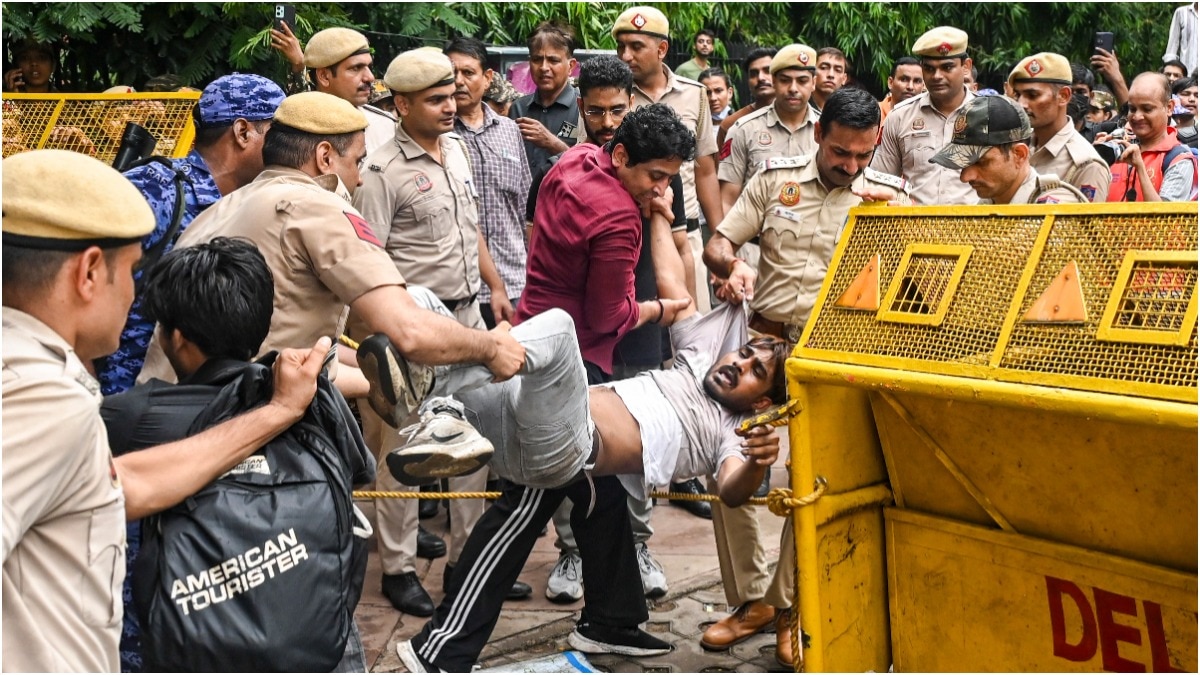
Indian law gives the police significant powers to control unlawful assemblies and restore public order, but those powers are far from unrestricted.Police detain protesters during a demonstration at Jantar Mantar demanding the resignation of Union Education Minister Dharmendra Pradhan over alleged irregularities in the NEET examination. (PTI)Can police use force simply because a protest has turned unlawful? Does the imposition of prohibitory orders automatically permit a lathicharge or the use of tear gas? And who ultimately decides when force becomes lawful?The answers to these questions lie in a combination of statutory provisions, court rulings and police regulations.While the Bharatiya Nagarik Suraksha Sanhita (BNSS) empowers authorities to disperse unlawful assemblies, it also prescribes when force may be used, who can authorise it and the procedural safeguards that must be followed.Judicial precedents have consistently held that force is a measure of last resort and must remain proportionate to the threat faced. WHO CAN ORDER THE USE OF FORCE?The primary authority rests with an Executive Magistrate, the officer in charge of a police station, or any police officer not below the rank of a sub-inspector.Section 148 of the BNSS empowers these officers to order an unlawful assembly, or an assembly of five or more persons likely to disturb public peace, to disperse. If the assembly refuses to comply or clearly shows that it will not disperse, they may use civil force to disperse it.This is substantially the same framework that existed under Sections 129 to 131 of the CrPC.DOES SECTION 163 AUTOMATICALLY ALLOW POLICE ACTION?No. Section 163 of the BNSS allows Executive Magistrates to issue preventive orders restricting assemblies or activities.However, merely imposing prohibitory orders does not automatically authorise the police to use physical force.Force becomes legally permissible only after a lawful order to disperse has been issued and disobeyed.WHAT DOES 'USE OF FORCE' MEAN?The law distinguishes between different levels of force.Initially, authorities may use civil force – reasonable, non-lethal physical force – to disperse an unlawful assembly.Only where the civil force proves inadequate and public security faces a serious threat can stronger measures be considered.Under the earlier CrPC, the armed forces could be requisitioned by an Executive Magistrate in exceptional circumstances, with independent deployment by military officers permitted only when public security was in "manifest danger" and no magistrate could be contacted. The BNSS retains this approach.FORCE MUST BE THE LAST RESORTIndian policing rules consistently emphasise that persuasion should come before coercion.The Ministry of Home Affairs' Code of Conduct for the Police in India states that police should first rely on persuasion, advice and warnings. Force should be used only when unavoidable, and even then only the minimum necessary.The same principle appears in the United Nations Code of Conduct for Law Enforcement Officials, which permits force only when strictly necessary and only to the extent required to perform official duties.WHAT HAS THE SUPREME COURT SAID?The judiciary has repeatedly narrowed the circumstances in which force may be used.Anuradha Bhasin case (2020)The Supreme Court held that prohibitory orders must respond to a genuine emergency, record material facts and satisfy the test of proportionality.Authorities cannot rely on vague or speculative apprehensions.Ramlila Maidan case (2012)While examining the midnight police action against Baba Ramdev's supporters, the Supreme Court stressed that procedural safeguards are not mere formalities.Police should issue repeated warnings, make public announcements, videograph the proceedings, prepare medical arrangements and ensure safe dispersal before resorting to force.The Court noted that Delhi Police Standing Orders also require banners announcing prohibitory orders and repeated requests asking demonstrators to disperse peacefully or submit to peaceful arrest.Significantly, the Court observed that the police had failed to use water cannons before escalating to other measures.CAN POLICE FIRE ON PROTESTORS?In the 1982 PV Kapur judgment, the Delhi High Court held that the mere existence of an unlawful assembly — or even refusal to disperse — does not automatically justify the use of firearms.If warnings are sufficient to disperse the crowd, force is unnecessary.The Court also held that authorities must always choose the least harmful effective method and that the objective is to restore public order, not punish protesters.WHAT DO POLICE RULES SAY ABOUT TEAR GAS AND FORCE?Police Standing Orders require officers to carefully assess factors such as crowd size, temperament and wind direction before deploying tear smoke.Tear gas should generally not be used in enclosed spaces, and shells should be fired away from rather than directly into crowds.Rule 14.56 of the Punjab Police Rules, applicable in Delhi, also requires that force remain proportionate and be confined to quelling disturbances or dispersing assemblies that refuse lawful orders to disperse.THE BOTTOM LINETaken together, the BNSS, police regulations and judicial precedents establish a clear legal principle: police cannot use force simply because a protest is taking place or because prohibitory orders have been imposed.Force may be used only after lawful procedures have been followed, protesters have been directed to disperse, warnings have been issued and non-coercive measures have proved ineffective.Even then, the force employed must remain proportionate, strictly necessary and limited to the minimum required to restore public order.- EndsPublished By: Aprameya RaoPublished On: Jul 29, 2026 23:45 IST
Who can authorise police to use force against protesters? What the law says
Full Article
Original Source
Read the full article at Indiatoday →KhanList aggregates and links to publicly available news content. We do not host full articles from third-party sources. Always verify important information with original sources.