
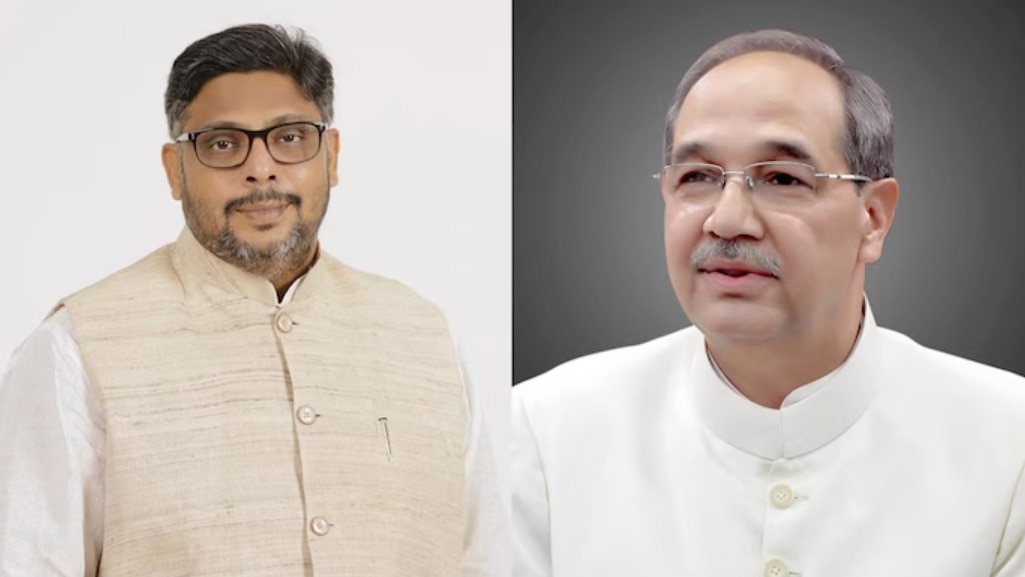
The BJP has retained Tariq Mansoor as national vice-president and appointed Kunwar Basit Ali as Minority Morcha chief in its new national team. Both are from Uttar Pradesh and associated with the party's Pasmanda outreach. Their elevation comes ahead of the 2027 Assembly elections, signalling the BJP's continued focus on Muslim outreach.Kunwar Basit Ali (L), Tariq Mansoor (R)In the BJP's organisational reshuffle announced on Monday, all eyes are on two Muslim faces from poll-bound Uttar Pradesh who have made it to party chief Nitin Nabin's national team. Nabin retained former Aligarh Muslim University (AMU) vice-chancellor Professor Tariq Mansoor as a national vice-president and appointed Meerut-based organisational worker Kunwar Basit Ali as the national president of the BJP Minority Morcha.The appointments are part of a broader organisational overhaul ahead of the crucial 2027 Uttar Pradesh Assembly elections. They are being viewed as part of the BJP's continued efforts to expand its outreach among Muslims, particularly the Pasmanda, or backward, sections of the community.Uttar Pradesh is the only state to have Muslim representation at this level in Nabin's new team.TARIQ MANSOOR: FROM AMU CAMPUS TO BJP'S NATIONAL LEADERSHIPProfessor Tariq Mansoor, born on September 20, 1956, in Aligarh, has been reappointed as one of the BJP's national vice-presidents under Nitin Nabin. His reappointment marks continuity in a senior organisational role after he served in the same position under former party president JP Nadda. A surgeon by profession, Mansoor obtained his MBBS from AMU's Jawaharlal Nehru Medical College in 1978 and an MS in Surgery in 1982.He subsequently served as principal and chief medical superintendent of the college, as well as head of its Department of Surgery, before becoming AMU vice-chancellor in May 2017. He held the post until April 2023. His tenure as vice-chancellor coincided with the anti-CAA-NRC protests. According to party sources and accounts of his tenure, Mansoor worked with the police to maintain law and order on the campus when troublemakers allegedly entered the university, while also directing that students should not be harmed. His supporters credit this approach with sending a positive message.During his tenure, Uttar Pradesh Chief Minister Yogi Adityanath's helicopter landed at AMU, an episode that reportedly strengthened Mansoor's ties with the BJP. The presence of RSS joint general secretary Krishna Gopal at his son's wedding was also seen as a sign of his growing proximity to the Sangh Parivar.After stepping down as vice-chancellor, Mansoor was nominated as a member of the Uttar Pradesh Legislative Council in 2023.Despite holding senior positions in the BJP, including national vice-president, Mansoor had for a long time not been seen as a conventional grassroots party worker. His continued elevation to senior organisational positions has been viewed as a reflection of his political standing and influence.As AMU vice-chancellor, Mansoor occupied a particularly influential position. The university's alumni network spans around 120 countries, while the vice-chancellor is regarded as an important public face of the Muslim community in Aligarh and beyond.BJP leaders credit Mansoor with conveying the message to sections of the Muslim community, through a relatively diplomatic approach, that maintaining good relations with the government can bring tangible benefits. His calm and understated demeanour is often highlighted.Mansoor belongs to the Qureshi community and is regarded as a Pasmanda Muslim.One notable moment during the Covid-19 pandemic came when he facilitated a virtual interaction between Prime Minister Narendra Modi and AMU to mark the university's 125th anniversary. The episode is believed to have impressed the BJP's central leadership.His supporters point to his handling of a campus known for recurring protests as evidence of his ability to prevent agitations from escalating into more confrontational movements.KUNWAR BASIT ALI: BJP'S FACE OF MINORITY OUTREACH IN WESTERN UPKunwar Basit Ali, a resident of Kayastha Badda village in the Kithore Assembly constituency of Meerut, has been appointed national president of the BJP Minority Morcha.The 40-year-old leader, born on August 1, 1986, joined the BJP around 2008 and has steadily risen through the party's organisational ranks.According to his official profile and party details, Ali entered active politics after joining the BJP. In 2010, he was appointed district media co-in-charge in Meerut and became district media in-charge in 2012. In 2013, he was appointed district president of the BJP Minority Morcha in Meerut. He has also served as a regional coordinator of the Muslim Rashtriya Manch.On June 20, 2021, he was appointed president of the Uttar Pradesh BJP Minority Morcha. In that role, his primary focus was to expand the party's base among Muslims, particularly Pasmanda and socially backward sections.He organised membership drives, chaupals (village-level interactions), dialogue programmes and yoga camps at madrasas in Muslim-dominated areas of western Uttar Pradesh. Campaigns highlighting welfare schemes of the Narendra Modi government at the Centre and the Yogi Adityanath government in Uttar Pradesh formed a key part of his outreach.In 2025, under his leadership, the Minority Morcha also held discussions among Pasmanda communities on issues of identity and rights.Ali's elevation to the national Minority Morcha presidency highlights the BJP's reliance on organisational workers who have built networks from the district level upwards. Party observers consider him one of the prominent Muslim leaders in western Uttar Pradesh, with the Minority Morcha serving as an important channel for engaging with the community.He has publicly credited senior organisational leaders in Uttar Pradesh for their guidance and pledged to work with full commitment.STRATEGIC SIGNIFICANCE AHEAD OF 2027Political analysts view the two appointments as more than symbolic representation. Both leaders are associated with the Pasmanda spectrum -- Mansoor belongs to the Qureshi community, while Ali is deeply rooted in the social and organisational landscape of western Uttar Pradesh.For several years, the BJP has sought to expand its reach among non-Ashraf Muslims by focusing on welfare delivery, education and development rather than relying solely on traditional identity-based politics.With the Uttar Pradesh Assembly elections scheduled for early 2027, the presence of these two leaders is expected to help the party take its message to Muslim communities, particularly in western Uttar Pradesh and Aligarh.Whether the appointments translate into measurable electoral gains remains to be seen. But the organisational signal is clear: under Nitin Nabin, the BJP continues to invest in visible Muslim leadership from Uttar Pradesh at the national level.- EndsPublished By: Sayan GangulyPublished On: Aug 18, 2026 22:48 IST
Who are the two Muslim faces in Nitin Nabin's team?
Full Article
Original Source
Read the full article at Indiatoday →KhanList aggregates and links to publicly available news content. We do not host full articles from third-party sources. Always verify important information with original sources.