
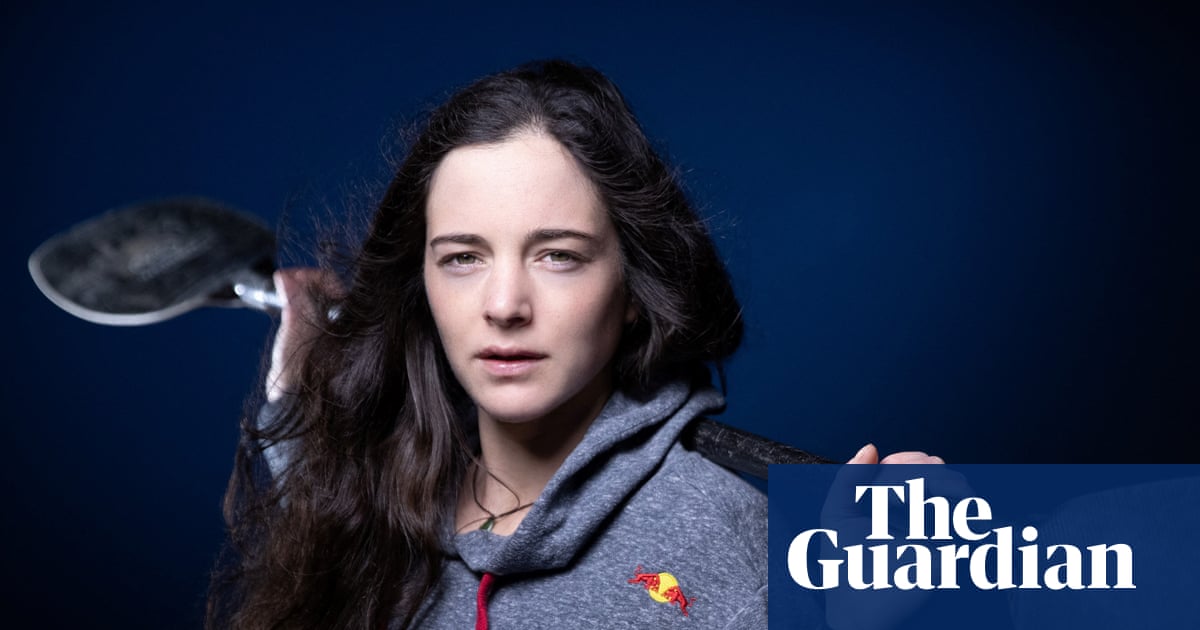
Just hours before Nouria Newman planned to put in on the Klinaklini River in north-western British Columbia, she checked the water gauge at the mouth of the river. The levels had looked good. Then it started raining.Water flows doubled overnight, turning the Class V lower gorge into a death trap. Even in good conditions, the Klinaklini is one of the most elusive rivers in the world. Of the three groups that had attempted before her to paddle the full 125 miles to the Pacific, only one was successful. Newman, a French professional kayaker, was hoping to be the second.After waiting for flows to recede, Newman and her paddling partner, Sandy MacEwan, launched on to the river. By the time they reached the 12-mile crux, the river had returned to its normal volume, around 10,000 cubic feet per second. Carefully scouting the six canyons that make up the lower gorge, they completed the second full descent.“Rivers like this are exciting, scary and unknown,” Newman said. “Whitewater is ephemeral, that’s why we keep chasing it. A lot of people see happiness as a whole – family, job, house, money – but I see whitewater as these super, super happy moments, and then I move on to the next thing.”The 35-year-old is one of the most accomplished kayakers in the world, largely because of her ability to see a river for what it is: an ever-changing canvas that oscillates quickly between ecstasy and catastrophe. Newman’s early career was defined by competitions, both slalom and freestyle. In 2013 she won the Ottawa XL, one of the biggest freestyle events in the world, and took second at the ICF Canoe Slalom World Championships. In 2014 she won gold at the world championships in the team category. She has been named an extreme kayaking world champion five times. Yet, despite her success paddling gates and doing tricks in controlled environments, Newman was drawn to wild rivers.The seed was planted on an impromptu trip to the Stikine River, where she became the first woman to run Site Zed, one of the most dangerous rapids in the world. “I bought a ticket the day before and didn’t go thinking I was going to run Site Zed,” Newman said, “but when we scouted it, I felt good about the line. I’ve learned to trust that feeling.”Running the Stikine, which flows from northern British Columbia to southern Alaska, brought a lot of attention, something that helped Newman pivot further towards remote rivers around the world. Over the last decade she’s paddled in dozens of countries including solo expeditions in India and Madagascar and first descents in Colombia and China. She set the world record for the largest waterfall drop by a woman at 104ft, and was the first woman to run the Rondu Gorge in Pakistan in 2023.With these accolades it’s easy to assume Newman is nearly fearless. The truth is more complex.Growing up in Le Villaret du Nial, a village in the French Alps, Newman had access to rivers, mountains, and the outdoors. At the age of five, she took her first kayaking class with a local club, which pushed her towards competitions because they relied on results for funding.Nouria Newman rides down a waterfall in March 2022. Photograph: Red BullAt six, she paddled her first wild river, the Chéran, which includes a particularly steep access where the boats and gear had to be lowered down with ropes. “I loved that feeling of adventure,” Newman said, “but I was too slow so my dad clipped me on to his boat and towed me fast, so I flipped upside down. I was hitting rocks, scared, cold, crying and angry at my dad. Then we stopped and had a picnic, and I was happy again. I learned you can’t kayak without being cold at some point.”She won her first race when she was eight, and was recruited by the national federation training center at 15, but decided to stay with her club. During high school she would paddle every day before or after class, and even sometimes at lunchtime. After graduating she moved to Toulouse in southern France to study at Sciences Po, a prestigious university.At the same time she earned one of three spots on the French slalom team, but only one athlete could go to the Olympics. “Everyone was fighting for the spot,” she said. “Mentors who had been nice to me since I was young suddenly changed how they treated me. The atmosphere was really bad.”Tensions between Newman and the federation grew, largely because of politics outside paddling. “I was raised in a way where I didn’t assume all adults are right,” said Newman. “The federation told me to study sports science, but I wasn’t interested. I wanted something outside of sports, so I wasn’t focused on it all the time. That created some issues.” On weekends she took trips to paddle whitewater, a rarity in a slalom world defined by precision and predictability – another decision the federation disliked.Although Sciences Po was just 20 minutes from the training facility, Newman often had to miss training sessions because of class. When the federation scheduled a training camp the week before her exams, she skipped it so she wouldn’t fail. School remained her priority. In 2018 she graduated with a master’s degree in journalism and political science and a focus on sociology. Her thesis was on social constructs and fear – specifically how women are conditioned from a young age to be more fearful than men.At the end of 2017, after shoulder surgery and two seasons of up-and-down results, Newman was kicked off the federation team. Feeling lost, she flew to India for a solo expedition on the Tsarap, Zanskar and Indus Rivers, sometimes called the Grand Canyon of Asia. With her mind in a fog, she underestimated a line and her boat was pinned on a rock above a siphon, one of the most dangerous features in a river.After four minutes of trying to free her boat with her head barely above water, Newman pulled her skirt and tried to climb up the rocks, but the water sucked her into the siphon. Fortunately, she flushed through safely. In shock but without options, Newman paddled for five more days to reach the river’s end. Such close calls have taught her about risk, the unknown and decision making.Over the last decade, Nouria Newman has paddled in rivers across the world, from France and Colombia to Canada and Pakistan. Photograph: Red Bull“In the prep, risk is rational, it’s a calculation. On the river it has to be more intuitive,” said Newman, who admits that her calculations aren’t always right. “If you do this long enough, you see the contradiction. You want to bring the risk lower, but you’re willing to test it. It’s like having little demons that try to push it too far. We’re humans, so we will make mistakes at some point.”Most people, Newman believes, don’t understand the difference between risk and consequence. “Risk is the odds you’re going to miss the line. Consequence is what happens if you do. Alex Honnold is a great example. What he does has extremely high consequences, but the risk that he falls is very, very low.”One of the most difficult tasks is explaining decisions to her parents. Newman used to lie to her mother about waterfalls, but doesn’t any more. “They now know more than they sometimes want to, even if they don’t always understand why I do it,” Newman said. “My why is always changing. Whitewater pulls you toward a river, but what you remember is the people you were with, not the whitewater.”Like most paddlers on the sharp end of the sport, Newman has had her fair share of close calls. On the Clearwater River in Canada she lost focus and was pushed into a recirculating water trap. “I was arrogant and not respecting the river, and got beat down,” she said.Newman believes that most of kayaking, at least at her level, is in your own head, balancing fear, goals and ego. These lessons translate well to the rest of life. “In my exams at university I sat next to this girl who was so stressed. Worst case she fails and takes the class again, so why feel that bad?” Still, there are a few everyday things in everyday life that give Newman anxiety, like doing taxes, driving in traffic, or parallel parking in a tight spot, because she hasn’t pushed the limits on them.Despite being a writer, expedition planner and entrepreneur, Newman wants only to be known as a whitewater kayaker. “Everyone these days calls themselves an adventurer or influencer or explorer. I don’t know what that means any more,” said Newman. “Climbing an 8,000m peak with fixed ropes is not a real adventure, there is no unknown. You’re not even an alpinist. If you run the Grand Canyon with an outfitter, it’s not whitewater. These words are so common they mean nothing, so I don’t use them.”This directness is what makes Newman stand out. She’s never been afraid to share what’s on her mind, to the French kayaking federation, the media or anyone else. She learned how to be direct on river trips, which remain the most important thing in her life.“I would buy a plane ticket for tomorrow to try a new river. My business model is to put kayaking first, and then everything else,” said Newman. “I don’t want YouTube or Instagram to take too much time. I could make more if I followed the algorithm, but that would take away from me kayaking. Other people might get an agent or a sunscreen ad or be on a billboard, but I don’t care about that. I do it my way.”
‘Whitewater is ephemeral. That’s why we chase it’: Nouria Newman on the risk and thrill of extreme kayaking
Full Article
Original Source
Read the full article at Theguardian →KhanList aggregates and links to publicly available news content. We do not host full articles from third-party sources. Always verify important information with original sources.