
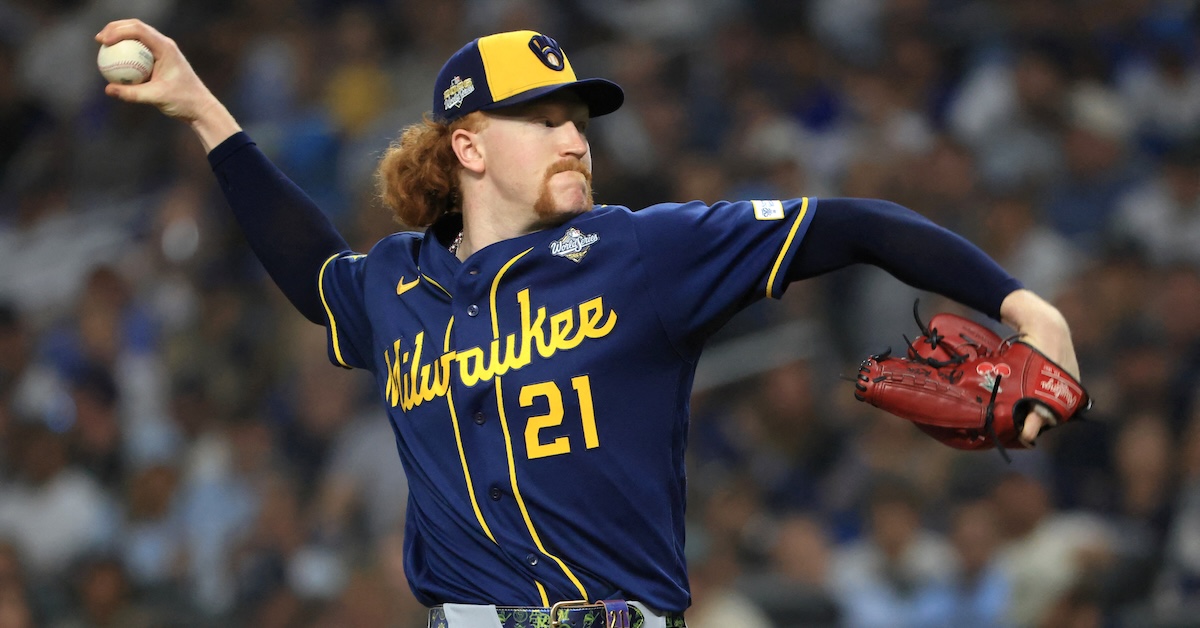
Kim Klement Neitzel-Imagn Images The White Sox were the breakout team of 2026. With the pope in their corner and years of misery in the rearview mirror, the South Siders improved by 24 games and captured a playoff spot. Then they kept things rolling by sweeping the Astros out of the Wild Card round, after which they took the Guardians to a decisive fifth game in the Divisional Series. With few offseason departures of note, the Sox came into the winter with plenty of good vibes. And while they seem unlikely to seriously compete in the Tarik Skubal sweepstakes, they nonetheless wasted no time in adding to their rotation. As Robert Murray first reported, the Sox and Dustin May have agreed to a three-year deal worth $52.5 million. May just finished one of the best seasons of his career. That might sound strange to say after he posted a 4.70 ERA with unexciting strikeout and walk numbers, but health has always been May’s biggest weakness, and he finally overcame that hurdle. He made a career-high 31 starts and pitched 145 2/3 innings, only the second time in his seven major league seasons that he’s eclipsed the 100-inning mark. And while the ERA might be ugly, the rest of his numbers were decidedly less so. His 3.63 FIP, 3.96 xFIP, 4.43 xERA, and 3.99 SIERA all suggest that May’s performance outstripped his ERA. May’s solid year didn’t go unnoticed at the time. He started the season with the Cardinals, but the Brewers traded for him at the deadline, and he made five appearances for them in the playoffs. His role in Milwaukee was a hybrid one, and one that the White Sox also utilized this postseason: multiple innings at a time, whether as a starter or reliever, without the expectation that he’d go five innings or face any batters a third time through. That new school approach feels perfectly tailored for May. It’s not just that he did it in 2026 – his entire career has straddled the starter-reliever line, for both health and pitch mix reasons. May debuted in 2019 in a swingman role, but the Dodgers always viewed him as a starter in the long run. Over the subsequent six years, he made 51 appearances with the team, 48 of them starts. But while Los Angeles gave him plenty of chances in the rotation, his health held him back. A torn UCL and subsequent Tommy John surgery cost him most of the 2021 and 2022 seasons. Nine starts into the 2023 season, elbow pain sent him back to the IL; he subsequently underwent two elbow procedures, a Tommy John revision and flexor tendon surgery. He wasn’t able to return to the field at all in 2024; the elbow surgeries delayed the start of his season, and then a freak accident cost him the balance of the year after a piece of lettuce tore his esophagus. That series of unfortunate events meant that May spent roughly six years in a perpetual cycle of rehabbing, building up strength, and then going back on the shelf. And even when he was healthy, his sinker-dominant arsenal never played particularly well against opposite-handed batters. He’s faced more than 1,000 lefties in his career, and they’ve posted a batting line 22% better than he’s allowed against righties, which is an enormous split. His managers have shied away from letting him face tough lefties multiple times in an outing, understandably so given the numbers; his walk rate triples against them, and he allows more hard contact and more line drives. That’s a quick recapitulation of the reasons that May never turned his enviable potential into a regular starting role in Los Angeles, or subsequently in Boston after the Dodgers traded him at the deadline in 2025. Still, the Cardinals gave him a pillow contract and installed him atop their rotation to start 2026, and he showed intermittent signs of tapping into the form that made him a top prospect all those years ago. After a few short outings to get his feet under him, he ripped off a 12-start stretch where he averaged more than six innings per start, struck out four times as many batters as he walked, and notched a 2.54 ERA and 2.68 FIP. But that incandescent form didn’t last; after he masterfully shut out the Padres in the best outing of his career on June 15, he came undone for a month, averaging fewer than four innings per start en route to a 6.26 ERA in the remainder of his time with the Red Birds. All told, May averaged around five innings a start in St. Louis, and he pitched even fewer innings per time out in Milwaukee. It’s just a part of May’s game; he doesn’t miss many bats or garner many strikeouts, so he’s prone to getting BABIP’ed out of the game or simply running up a high pitch count due to a few long at-bats. That didn’t stop the Brewers from turning to him in key spots throughout the playoffs – it just meant that they treated him as something in between a starter and a reliever rather than as a fixed part of the rotation. So far, I’ve mentioned a lot of unflattering parts of May’s statistical record. But here’s another way of looking at it: May has been absolutely snakebitten when it comes to his health, and despite that, playoff teams keep acquiring him and he keeps pitching meaningful innings for them. The Dodgers gave him a ton of chances even when he was struggling. The Red Sox gave up a good prospect for him. The Brewers acquired him as a rental and used him in key spots throughout a dominant playoff run. Why? Because May’s sinker/sweeper combination is just that good. Though he has diversified his pitch mix substantially, he still goes to that pairing two thirds of the time against righties, and they still have basically no solution. Both pitches are outliers in pretty much every way. His sinker gets more run and more total downward break than a pitch traveling 97 mph has any right to. His sweeper breaks 35 inches in the opposite horizontal direction, and drops like a stone to boot. Baseball Savant measures pitch movement relative to similar-velocity offerings from the rest of the league; May’s sweeper gets 4.9 inches more vertical drop and 3.2 inches more horizontal run than his peers. He’s phenomenal at generating spin; his less-frequently-used curveball also generates far more movement than average. In 2026, May turned to a cutter more frequently than ever before. It’s a logical move given how he works the zone horizontally, and how much movement he’s able to generate on the rest of his pitches. Everything he throws pairs better with a cutter than with just about everything else he throws: You can’t see his curveball because it has so much downward movement that it doesn’t fit on that chart. But you get the idea; the cutter is a nice bridge pitch against righties, and he used it as his primary offering against lefties, working a cutter/four-seam game on the inner half of the plate and then mixing in back-foot sweepers and changeups away. In theory, that gave May the tools to attack lefties. In practice, while they struggled to do any damage against his cutter, the plan didn’t quite work anyway. That’s because his four-seamer hardly missed any bats and his changeup was downright flammable. He did a decent job of getting ahead in the count through judicious cutter usage, but putaways were hard to come by, and lefties teed off on every other pitch that he tried against them. The White Sox will surely continue to work with May to tinker with his pitch mix. He’s displayed an aptitude for making adjustments and changing pitch shapes, and in modern baseball, no pitcher is a finished product. I think that’s a meaningful part of May’s appeal, in fact. He’s still young, having just turned 29 two months ago. And he’s even younger than that in terms of major league experience; he might have a ton of service time, but he still hasn’t hit 500 innings pitched in the big leagues. It’s entirely believable that he’ll continue to improve as he hones his craft. But the Sox didn’t sign him because he might get better. They signed him because he might get better and because he’s already good. Sure, he’s relatively weak against left-handed hitters, but that’s relative to how dominant he is against righties. He’s been a roughly average starter in the aggregate, even with the injury interruptions, short starts, and platoon struggles. Are the White Sox hoping for more length out of May than he’s displayed so far in his career? Surely. But they’re clearly comfortable building a rotation out of pitchers who aren’t locks to deliver length in their starts. Sean Burke, the presumptive ace, is the only pitcher who I’d expect to work deep into games. Grant Taylor will be switching from his fireman role to a starting job next year, and I expect him to get plenty of short outings as he builds up his strength. Davis Martin is a five-and-dive type. Anthony Kay, who we currently project as their fifth starter, turned in almost exactly five innings per start last year. The Sox made that work by stocking their bullpen with multi-inning types. Indeed, no team pitched more innings in relief in 2026. They frequently used openers and had the guys we think of as starters work bulk roles afterwards, a useful tactic for frustrating opponents who want to platoon heavily. They employed a ton of multi-inning relievers; sure, Taylor is going to be starting next year and Sean Newcomb is a free agent, but that still leaves top draft pick Hagen Smith and a bevy of other arms who can get you four-plus outs at a clip. In May, the Sox are adding a starter who they think can give them plenty of quality, even if the quantity is in question. There’s nothing wrong with throwing five innings at a time if those five innings are excellent, particularly if the rest of your team is designed with shorter starts in mind. There’s little reason to doubt May’s effectiveness when he’s available; sure, he might work long innings and give up traffic, but he’s very good at keeping the ball on the ground and limiting damage. The stuff plays, and there’s no reason to think that he’s going to give up more runs than the various peripheral estimators would suggest; in his career, he has a 4.12 ERA, 4.04 FIP, and 4.08 xFIP. The price tag of three years and $52.5 million is more than I predicted, which is often the case with the earliest deals signed in free agency. The third year is the surprising part here, and it makes sense to me that the Sox added it to entice May to choose them over any two-year deals he might have had on offer. A $17.5 million AAV places May squarely in number three starter territory based on recent free agent contracts, but few of those deals have extended three years; they’re generally of the one- or two-year variety. That says to me that the White Sox wanted May specifically, not just a good starter in this price range. There are a bevy of free agent pitchers who project around league average next year. I expect several of them to sign deals that have a similar AAV but fewer years than May’s. But none of them offer quite the same mixture of talent and potential. We don’t know what a third straight healthy year might mean for May’s development. We don’t know if he’ll stay healthy, either, of course – it’s been a challenge for him throughout his career. But the range of outcomes here includes some very good seasons. There’s little question that May has that form in him somewhere; he’s displayed it in short bursts throughout his career. And he’s one of the youngest free agents on the market, which means that third year isn’t as onerous as you’d think. Will he be a 200-inning frontline starter? Almost certainly not. Will he strike out the world? Probably not happening. But will he frustrate the opposition for five or so innings at a time as often as he’s healthy enough to take the ball? I bet so. And given the team’s overall youth, signing a younger free agent to sync up timelines is a good move as well. I was surprised to see this deal, but the more I think about it, the more I think it makes sense. It’s a good fit of player and team, and at a salary and term broadly in keeping with market trends. I’m excited to see how May’s evident talent meshes with Chicago’s modern allocation of innings, and to see whether he continues to tinker with his approach with another healthy year under his belt.
White Sox Sign Dustin May To Bolster Rotation
Full Article
Original Source
Read the full article at Blogs →KhanList aggregates and links to publicly available news content. We do not host full articles from third-party sources. Always verify important information with original sources.