
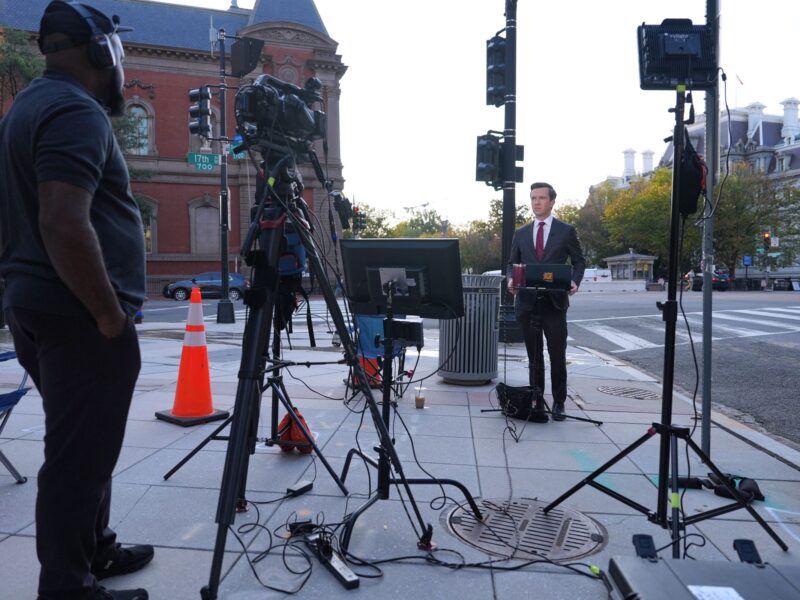
A Trump-appointed judge said he was skeptical the government was motivated by national security concerns.WASHINGTON (CN) — The White House on Thursday refused to restore access to journalists from CNN, Politico and MS Now, failing to comply with a federal judge’s early-morning order after President Donald Trump banned the outlets from the White House on Friday.U.S. District Judge Timothy Kelly, a Trump appointee, approved a temporary restraining order requiring the White House to restore press credentials to the outlets and their journalists as the case continued. He noted the clear lack of process in the revocation and rejected the government’s national security claims.In an eight-page order, Kelly acknowledged national security is a “weighty interest” for the executive branch and judicial review should be “highly deferential,” but he found little evidence to justify the White House’s reliance on those concerns.“The court is skeptical — at least on this record — that defendants’ interest in safeguarding national security is the actual motivation for, or is even advanced by, the revocation of plaintiffs’ hard passes,” Kelly wrote.However, when journalists from the outlets arrived at the White House Thursday morning, they were still denied access.According to Politico, a Secret Service agent told one of its reporters he was not cleared to enter but could use a temporary day pass — meant for journalists without a permanent “hard pass.”Speaking from the Oval Office Friday, Trump said he ordered the ban because of “one-sided” and “never good” reporting over the last two years and threatened to ban other outlets. The ban stripped journalists of hard passes to the White House, expressly barring them from the entire grounds.The outlets were also removed from the White House press pool — a rotating group of reporters who share responsibility for video, audio, photography and print coverage of the president — leading other broadcasters in the pool to yank their own coverage of the president in solidarity.“For one thing, nothing in the record that predates this suit suggests that the revocation of plaintiffs’ hard passes was motivated by national security concerns,” Kelly wrote. “Certainly, that is not what President Trump said when he announced that he was ‘banning’ plaintiffs from the White House — instead, he focused on the alleged lack of truthfulness and negativity of plaintiffs’ reporting."Kelly further rejected the government’s reliance on letters to the news outlets explaining the bans were due, in part, to their use of anonymous quotes from a “senior administration official.” Reporting has shown the quotes were from a press call hosted by the White House. The government argues the quotes raise national security concerns so there was no requirement for full process.“But the circumstances here are not so ‘extraordinary’ as to permit deviation from the ‘essential principle of due process’ that a deprivation of liberty ‘be preceded by notice and opportunity for hearing,’” Kelly wrote. “The sorts of stories defendants identify in the letters to plaintiffs are routine.”“Defendants offer no declarations or other support — classified or unclassified — explaining how any of the reporting they identified in their letters damages the national security,” Kelly added. ”The declarations they do provide include general background about classified information, but the declarants are senior officials in the Department of Defense who have no direct knowledge of how reporters operate in the White House, or about any of the facts at issue here."Kelly highlighted that CNN reporter Betsey Klein’s credentials were revoked months after reporting cited by the government, “undercutting any argument that she or her employer, for example, had the requisite notice that the conduct at issue violated a relevant standard."Kelly found the journalists were likely to succeed on their claims for two reasons. First, Kelly said he was bound by D.C. Circuit precedent in *Sherrill v. Knight*and *Karem v. Trump,*which require journalists receive due process in disputes over their White House press passes.Second, the journalists will likely be able to show their credentials were revoked without constitutional due process, as they White House provided neither notice nor an opportunity to be heard before the journalists were stripped of access.Kelly noted that, under *Karem,*the government can only revoke a White House-issued hard pass if it promulgates a set of rules or standards governing the conduct that would lead to a revocation.The White House’s arguments that the two D.C. Circuit cases were wrongly decided fail, since until they have been overturned Kelly said he must still follow their rulings.The news outlets have asked Kelly to schedule an emergency hearing immediately to address the White House’s clear non-compliance. Kelly first ordered the government to explain itself by 12:30 p.m. EST.Subscribe to our free newslettersOur weekly newsletter Closing Arguments offers the latest about ongoing trials, major litigation and rulings in courthouses around the U.S. and the world, while the monthly Under the Lights dishes the legal dirt from Hollywood, sports, Big Tech and the arts.Additional Reads
White House ignores court order to restore access to CNN, Politico, MS Now
Full Article
Original Source
Read the full article at Courthousenews →KhanList aggregates and links to publicly available news content. We do not host full articles from third-party sources. Always verify important information with original sources.