
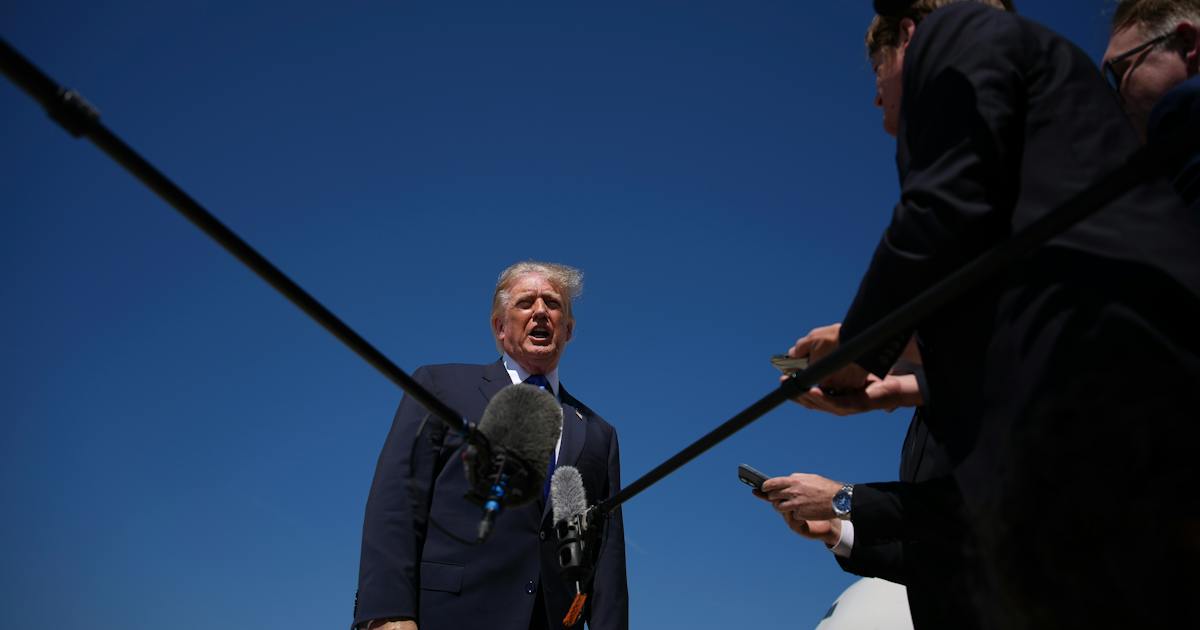
The White House on Thursday continued denying CNN, MS NOW, and Politico access to the White House, even after Trump-appointed District Court Judge Timothy Kelly struck down the president’s sweeping ban late Wednesday night. All three outlets said they had reporters who were denied entry to the White House premise, and no reason was given for the refusal.Kelly’s temporary restraining order gives access back to Politico, MS NOW, and CNN after they filed a lawsuit on Monday against the Trump administration. While the administration’s lawyers tried to justify the ban on national security grounds, Kelly wasn’t buying it.“The Court is skeptical—at least on this record—that Defendants’ interest in safeguarding national security is the actual motivation for, or is even advanced by, the revocation of Plaintiffs’ hard passes.... Nothing in the record that predates this suit suggests that the revocation of Plaintiffs’ hard passes was motivated by national security concerns,” he wrote in his decision. “Certainly, that is not what President Trump said when he announced that he was ‘banning’ Plaintiffs from the White House—instead, he focused on the alleged lack of truthfulness and negativity of Plaintiffs’ reporting.” Trump apparently saw this decision coming, opining about Kelly’s commitment to judicial ethics on Truth Social and promising to appeal the decision the day the lawsuit was filed.“As expected, Fake News CNN, Politico… and MSNOW (formerly known as MSDNC!), have brought suit to gain access to the White House, and your President, ME! They have drawn a great Judge, for them… The Judge’s name is Tim Kelly, and he was, sadly, appointed by ‘TRUMP,’” the president wrote. “In other words, almost without question and, as usual, we’ll go for appeal because Fake News people and publications that only write negatively, and who violate our National Security by writing false and defamatory stories with unknown ‘sources,’ shouldn’t be allowed access to the most important Office anywhere in the World.”This story has been updated.Executives from America’s leading artificial intelligence firms are urging the United Nations to set global regulations for their burgeoning tech.Both Anthropic CEO Dario Amodei and OpenAI CEO Sam Altman testified before the U.N. Security Council Wednesday, imploring the international conference to police the industry before it grows out of control.“If managed poorly, I even believe AI could be a risk to humanity as a whole,” said Amodei.Altman explained that he believed there were two ways that AI progress could go “very badly” for humanity.“First, we could lose control of the future to AI,” said the ChatGPT creator. “The risk is that it moves so fast that people can no longer follow what’s happening or intervene when needed.”The other risk, Altman said, was that AI could unjustly concentrate power within a small cadre of people.“No one person, or company, or country should be able to use the most powerful AI models to impose their worldview on everyone else,” he continued. “A company or country that believes only it can be trusted with this technology, can use that belief to justify almost anything else. We have to eject that logic even when it’s convenient.”Yet that’s not how the U.S. president has approached the issue. Donald Trump has insisted that the U.S. dominate the technology, convinced that it will be the “Greatest Economic Development Engine in History,” and has been dismissive of Silicon Valley’s myriad warnings.Trump has a lot to politically—and personally—gain from championing AI. Days into his second term, the president unveiled a $500 billion public-private venture to support AI development. The project was dubbed Stargate and backed by OpenAI, SoftBank, Oracle, and MGX, an AI investment firm owned by the United Arab Emirates.Trump’s 2026 financial disclosures also revealed that he’s invested a sizable sum in tech companies pursuing AI projects, spending millions of dollars on stock purchases for Oracle, Microsoft, Nvidia, Meta, Amazon, Apple, and Alphabet.But Trump’s opinion on the matter is seriously at odds with that of the American public. Recent polling indicates that the vast majority of Americans, including Republicans, have no interest in permitting the tech industry to build AI facilities in their backyards. An August survey published by Heatmap revealed that 75 percent of the public opposes data center development in their communities.And the rumors of AI’s deadly potential have some bite to them: Tech experts and European leaders are treating the concept of “killer robots” as more fact than fiction.A woman had her microphone turned off and was dragged away mid-sentence while speaking out against Flock cameras at a City Council meeting in Springfield, Missouri. Dozens of residents attended the Monday meeting regarding a resolution to review the city’s use of automatic license plate reader, or ALPR, cameras—the majority of which are operated by the controversial Flock surveillance company. The city council voted 5–3 to advance the legislation, and the citizens present were asked to leave without having the chance to publicly comment, leading many of them to boo and protest as they were ushered out. One man was arrested.Springfield resident Mia Heider later attempted to voice her opposition to Flock to Springfield Mayor Jeff Schrag at a different point in the council meeting.“Hello, my name is Mia Heider. I’m a Springfield, Missouri, constituent, and I’m here to oppose the usage of ALPR cameras, most commonly made by Flock Safety,” she said. “These cameras are not just surveillance—”“I’m sorry, ma’am,” Schrag said, interrupting Heider. She held up two middle fingers at him and continued while a law enforcement officer approached her.“They are an invasion of our privacy,” she said. The officer then grabbed her and placed her under arrest. Schrag concluded the council meeting immediately after. — Joseph Cox (@josephfcox) September 23, 2026 The other Springfield resident arrested at the meeting was freelance photographer Noah Powell.“Well I said: ‘Jeff Schrag is a cuck.’ I said: ‘Fuck you Jeff.’ I said: ‘Worthless’ and then, also, the final thing I said was: ‘Jeff Schrag has a tiny, stinky, cock,’” Powell told 404 Media. “I just let myself get handcuffed and let them do whatever power trip they wanted to do. Got my ticket and left.”There are currently 41 cameras being used by the Springfield Police Department to surveil residents. Last year, the city entered a five-year, $45,000-per-year contract with Flock for their ALPR cameras. This instance is one of many in the growing national resistance to Flock cameras, which have become prevalent in nearly every major U.S. city without any real kind of vote or democratic process. The “deflock” movement has seen multiple citizens tear down Flock cameras in their neighborhoods. Last week, hackers revealed that Flock cameras survey far more than just cars, intaking data on people walking, biking, and even zooming in on their bumper stickers, all without them knowing—giving even more cause to these protests. President Trump is preparing to ban diesel exports from the U.S. for 90 days against the advice of many in his Cabinet. Politico reports that the plan, which also faces opposition from some oil companies, is aimed at bringing down fuel prices surging as a result of the Iran war and Ukrainian attacks on Russian oil infrastructure. Oil companies are warning that the move will only have short-term benefits and would cause higher fuel prices in the future. That opinion is echoed by Energy Secretary Chris Wright, who said Wednesday that “the blunt tool of banning diesel exports definitely doesn’t work.” “If you can’t export the diesel that comes out of our refineries, you run out of places to store it, and you have to reduce U.S. refining, which would put upward pressure on gasoline prices and jet fuel prices,” Wright said at an event hosted by The Economist in New York. At another event the same day, Wright suggested that a “voluntary” plan was coming instead of a blanket ban.Wright called energy CEOs Tuesday night warning them that a ban was coming in the next few days. Almost immediately afterward, some of those executives started calling the White House voicing their concerns, an unnamed White House energy adviser told Politico, adding, “there’s a lot of swirl so it might change.”“It’s a terrible idea,” the adviser told the publication.Treasury Secretary Scott Bessent and Interior Secretary Doug Burgum also oppose a diesel ban. On Tuesday, Trump said that he supported stopping exports. “I’ve said, ‘Let’s not send out the diesel.’ We make a lot of diesel,” Trump said while speaking to the press with Ukrainian President Volodymyr Zelenskiy. “I’ve called for it within my people. I’ve been talking about it.” As of Wednesday, diesel fuel costs $6.52 per gallon on average, up from $3.69 only one year ago according to the American Automobile Association. If implemented, the ban would be the first such restriction on the U.S. fuel trade since President Obama lifted the country’s 40-year ban on oil exports in 2015. In the short term, the ban would lead to more diesel in the U.S. fuel system, but domestic refiners could react by slowing down production.Meanwhile, the real roots of the sky-high prices—the wars in Iran and Ukraine—show no signs of abating or ending. Publicly, Trump says he isn’t concerned about the Iran war affecting the midterm elections in November. But moves like a diesel ban, coupled with complaints from Republican candidates, suggest that times are getting desperate.The lone broadcaster that remained in the White House press pool has compromised Donald Trump’s safety.Real America’s Voice, a far-right streaming channel, aired footage of the president’s motorcade as it wound its way through Manhattan Tuesday evening. The clip captured the taillights of Trump’s NYPD entourage, tracking their movements through the city’s streets.Conservative influencer Nick Sortor thanked the channel for showcasing “RAW footage of how difficult it is to keep President Trump safe.”Yet the MAGA loyalists had only done the president a disservice by highlighting the route, and revealed their ignorance regarding the pool’s long-standing policy on the matter.“For decades, the [White House Correspondents’ Association] has advised poolers not to air video of taillights because it’s a potential risk to the security of the motorcade,” former WHCA president Weijia Jiang wrote on X, responding to Sortor’s post.Trump announced Friday that he was banning MS NOW, CNN, and Politico from the White House, writing on Truth Social that the prohibition was the result of “FAKE NEWS.”Other broadcasters considered the ban an assault on the First Amendment and an affront to news institutions across the country. By Monday, every reputable broadcaster in the White House press pool—including NBC, ABC, CBS, and Fox News—had joined together to suspend coverage of the president and his actions until he reversed course.MS NOW, CNN, and Politico also filed a lawsuit against the president and his administration Monday, describing the selective ban as a “a blatant violation” of the First Amendment.Just one other streaming service currently remains in the pool: Lindell TV, owned and operated by 2020 election-denier MyPillow CEO Mike Lindell—though it too has aired sycophantic coverage of the president.“Access changes are nothing new,” the White House wrote in a press release Monday. “What is new, however, is the sudden claim that it becomes sacred only when the outlets are friendly to the Radical Left. The rule was never ‘every outlet gets in.’”“It was always ‘our side stays in,’” the statement read.On Wednesday, 49 media organizations signed an amicus brief in defense of MS NOW, CNN, and Politico, urging the courts to immediately suspend Trump’s ban.
White House Bans Reporters Despite Court Ruling Restoring Access
Full Article
Original Source
Read the full article at Newrepublic →KhanList aggregates and links to publicly available news content. We do not host full articles from third-party sources. Always verify important information with original sources.