
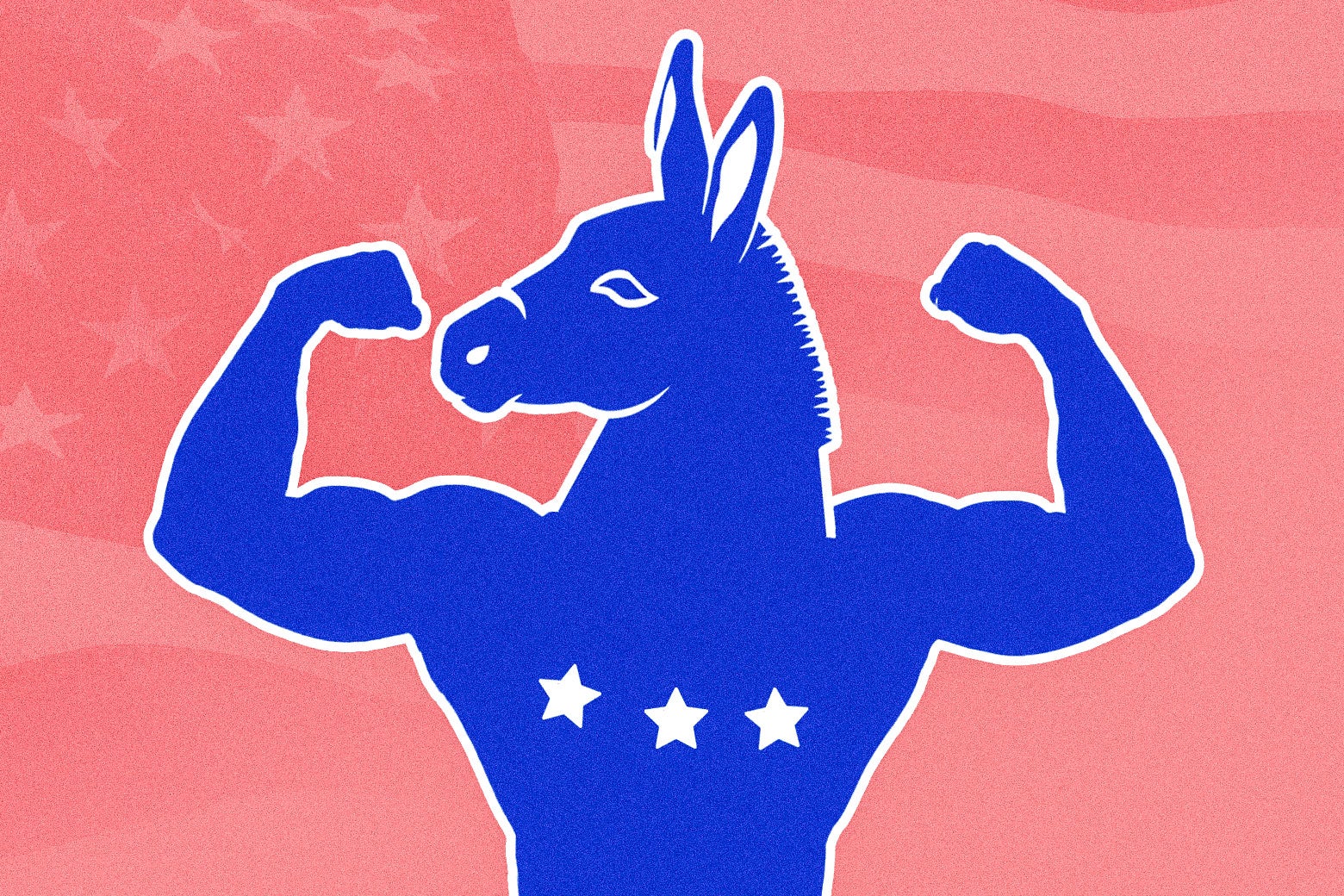
Politics Where Do Democrats Go to Get Their Apology? It wasn’t just Trump. Democrats just pulled off a political masterpiece. Photo illustration by Slate. Images by barbaraaaa/Getty Images Plus, Sofix/Adobe Stock, and Andrey Bandurenko/Adobe Stock. Sign up for the Slatest to get the most insightful analysis, criticism, and advice out there, delivered to your inbox daily. Making fun of the Democratic Party has long been a bipartisan pastime. “I don’t belong to any organized political faith. I am a Democrat,” the actor Will Rogers said in 1933. Nearly a century later, Donald Trump mocks the party as “Dumbocrats.” Democrats in disarray has become a cliché among beltway journalists. A screenshot from a 1994 episode of The Simpsons, which depicts a Democratic convention unfolding beneath slogans like “We cant govern!” and “We hate life and ourselves,” circulates on social media with dismal frequency. In an AP/NORC poll last year, voters described the party as “weak,” “ineffective,” and “generally bad.” And those voters were Democrats. A similar undercurrent of belittlement is already detectable after Tuesday’s midterms, which resoundingly swept Democrats back into power in Congress, governors’ mansions, and hundreds of other seats across the country. “Will Democrats Misread Their Victory?” the Wall Street Journal wonders. “Democrats, Don’t Mess This Up,” admonishes the Intercept. The skepticism is coming from inside the (literal) House, too. “I’m really worried that we’re going to misread victory as an endorsement of us or America falling in love with Democrats,” Rep. Jim Himes of Connecticut told Time magazine. “We need to remember that we have been asked to audition for a role in which the party has failed.” It’s as if the whole country can’t help but picture Democrats stepping on a rake at the earliest possible opportunity. Governing is harder than campaigning, so those concerns aren’t totally unjustified. Yet the midterm results highlight an important truth that has long gone underappreciated: Democrats really aren’t so bad at this whole politics thing. Derided on the left and right as unpopular, out-of-touch quislings, Democrats proved last night that they remain plenty adaptable, resilient, and effective at winning power. Unlike the GOP, which has been in thrall to Trumpism for a decade, and despite Americans’ growing disenchantment with political parties in general, Democrats still behave the way an effective political party should: recalibrating after defeats, adjusting messages as the political environment shifts, backing quality candidates, and tolerating a broad spectrum of ideologies and voices under one umbrella. Parties exist to win elections, and on that score this donkey remains alive and kicking. I can hear the objections already: Didn’t Democrats fumble two presidential races against Trump? And isn’t the chief architect of the party’s midterm victories actually the president himself, who spiked prices with tariffs and a war? Yes and yes. No point in sugarcoating it: Losing to Trump not once but twice has been hugely costly, not least for the Democrats’ brand. And both times, the party made major missteps. In 2016, Democrats ignored warning signs while clearing the field for Hillary Clinton, a candidate who was a poor match for the moment. In 2024, the party did the right thing by pushing Joe Biden out of the race over widespread concerns about his age, but they did so too late—and paid for it dearly. But the mark of a successful political party isn’t winning every election. In fact, adaptation after defeat is arguably the story of Democrats’ persistence. As the historian Michael Kazin writes in What It Took to Win, his 2022 history of the Democrats, “the party’s history is rife with missteps and outrages.” Yet as Kazin also notes, the party has consistently turned rejections at the ballot box into opportunities for reinvention. There’s a reason the Democrats are considered the longest continually active political party in the world; you don’t get to be 198 years old without knowing a few things about survival. Democrats have proved that repeatedly during the Trump era, but particularly over the past two years. In 2020, Biden ran on restoring “the soul of America” and barely beat Trump. Four years later, Kamala Harris repeatedly warned that Trump threatened both American democracy and Americans’ fundamental freedoms, calling him a “petty tyrant” and “wannabe dictator.” (I don’t have to remind you what happened next.) A less disciplined party might have stuck with the same message in 2026; Trump, after all, keeps trying to imprison his political opponents, restrict voting rights, and side with foreign dictators over democratic allies. But after losing to him a second time, Democrats pivoted. Democrats blaming Trump for Americans’ ongoing concerns about affordability was a no-brainer, but Harris also lost in part because she failed to draw meaningful contrasts with Biden over issues like immigration. This year, Democratic candidates including James Talarico in Texas, Annie Andrews in South Carolina, Paige Cognetti in Pennsylvania, and even the progressive Abdul El-Sayed in Michigan blasted the Biden administration for failing to secure the southern border. Each of those candidates won. Harris’ past criticisms of oil drilling and comments about transgender Americans also came back to bite her in 2024. This year, Talarico vowed to protect his state’s fossil fuel industry and Andrews cut an ad saying she opposed letting trans athletes compete in women’s sports—positions that, whether one agrees with them or not, reflected the places they were trying to win. On the GOP side, politicians who break from Trump get Truth Social screeds and their careers ended by a president who endorses their primary challengers. But because Democrats are a political party rather than a cult of personality, their leaders can brook disagreements in the interest of winning power. Biden reportedly called Cognetti this week to congratulate her on her victory. Those maneuvers may be the most dramatic examples of Democrats’ adaptability, but this week’s victories also built on wins the party notched even in years it lost the presidency. Since the Trump era began, Democrats have done a pretty good job of overcoming the Senate’s inherent bias toward Republicans, managing to net seats in traditionally red states like Georgia, Arizona, and Alabama and defend seats in purple states like Arizona, Michigan, and Nevada even as Trump won them. The party has now clinched resounding House majorities twice and held its losses to single digits in 2022, a midterm that took place under an unpopular, inflation-besieged president of their own party. When Trump was inaugurated in 2017, Democrats occupied just 16 governors’ mansions around the country. As of this week, they’re poised to control nearly twice that number. Not a bad record for a party that in the popular imagination can’t stop tripping over its own feet. And where did all those winning candidates come from? Wave elections can make almost anybody look like a political genius, but this wave started building more than a year ago thanks in part to Chuck Schumer, the Senate Democratic leader, and Hakeem Jeffries, his House counterpart. After Trump’s reelection, Schumer and Jeffries effectively became pain sponges for furious liberals, who derided them as strategically feckless, cringey, and out of touch. Yet their interventions helped set the conditions for Tuesday’s blue tsunami. Last year, according to the New York Times, Schumer wooed former Gov. Roy Cooper in North Carolina, former Rep. Mary Peltola in Alaska, and a Mississippi district attorney named Scott Colom to run for Senate, reportedly telling associates that he saw Mississippi in particular as a potential surprise pickup. Pundits and Republicans scoffed. “Democrats are delusional,” the leader of a GOP super PAC told the Times. On Tuesday, Cooper romped by 20 points, and both Peltola and Colom look likely to win. Unlike political movements dominated by a single, thin-skinned figure, successful political parties are elastic enough to accommodate dissent. Schumer and his deputies threw money at candidates in tough races who criticized his leadership, including El-Sayed and Maine’s Troy Jackson, placing party interests above ego. (Still, Schumer sounds confident that he’ll have the votes to become majority leader once more, and Jeffries will almost certainly become the country’s first Black speaker.) Democrats have done something similar over the past two years in terms of legislative strategy. Liberal voters, pundits, and even members of Congress dismissed former Bill Clinton adviser James Carville as a fuddy-duddy for suggesting Democrats “roll over and play dead” while Trump and the GOP inevitably bungled things. Yet that approach, whether it was a conscious choice or merely a result of being in the minority, largely worked. Trump’s governing mistakes—from tariffs and Iran to aggressive immigration enforcement—are arguably the biggest reasons the midterms became a rout, and Democrats capitalized on them by (mostly) getting out of the way. Elsewhere, the party picked its battles wisely. According to the Atlantic, Jeffries resisted pressure from inside his own caucus to make the 2025 government shutdown a proxy fight over Trump’s corruption and authoritarian impulses, instead focusing relentlessly on the issue of expiring healthcare tax credits. Even as Republicans let the credits expire, polls showed that Democrats won the debate. Now, Jeffries is reportedly eyeing legislation to revive those subsidies. There are plenty of caveats to this phoenix-like story of Democratic defeat followed by renewal. For one thing, the party’s brand remains tarnished, with approval ratings well below where they were even in Trump’s first term. Yet that may start to change now that the stink of loserdom is starting to lift, and the party now has a raft of new leaders to buff its image. For another, no leader bats a thousand. Schumer coaxed a reluctant Gov. Janet Mills to challenge Sen. Susan Collins in Maine and backed Michigan Rep. Haley Stevens for Senate after his preferred candidates passed. Those misfires didn’t end up costing Democrats this time, but the party has narrowly lost critical Senate races in other years, like Florida in 2018 and Pennsylvania in 2024. It’s also true that there really can be political advantages—at least temporary ones—to behaving less like a party, which demands consensus and mutual forbearance, and more like a cult of personality. Through force of will and threats of primary challenges, Trump has bent Republicans into shapes they never would have assumed a decade ago, from getting self-described Tea Partiers on board with two deficit-exploding tax laws to bullying most of his party into forgiving a coup attempt. Democratic voters have often been jealous of the hold Trump has over his party’s rank and file. Still, this week’s results suggest that those heavy-handed tactics can eventually backfire. (It remains to be seen whether Tuesday’s thumping will persuade enough Republicans to act less like foot soldiers in Trump’s movement and more like a political party that wants to get out from under an unpopular president.) Last, of course, is the question many voters, journalists, and elected Democrats are already asking: Can Democrats use the congressional majorities they just won to make life better for frustrated Americans? There are real risks that infighting over Israel, debates over how far to push on healthcare reform, and other issues will derail the bonhomie. And practically speaking, there’s probably not much the party will be able to achieve legislatively as long as Trump remains in the White House. Democrats are already disagreeing about whether to prioritize accountability for Trump officials or legislation aimed at lowering the cost of living. They’re also divided over which potential standard-bearers are best positioned to win back the White House in 2028. Yet the past may be instructive here, too. “As during the heydays of the New Deal and the Great Society,” Kazin writes in his book, the Democratic Party “can taste victory consistently only if its activists, candidates, and officeholders debate their differences without one side denouncing or seeking to purge another.” Despite the party’s many shortcomings, he argues, “the Democrats remain the only electoral institution in twenty-first-century America able to help solve the serious problems facing the United States and, to a lesser degree, the rest of humanity as well.” That’s a tall order. But this week, against all odds, Democrats really did snatch an opportunity to change the country for the better, and it would be wrong to count them out. After all, they have history on their side. Chuck Schumer Congress Democrats Donald Trump Elections 2026 Midterms
[Whispers] The Democratic Party Is Good at Politics
Full Article
Original Source
Read the full article at Slate →KhanList aggregates and links to publicly available news content. We do not host full articles from third-party sources. Always verify important information with original sources.