
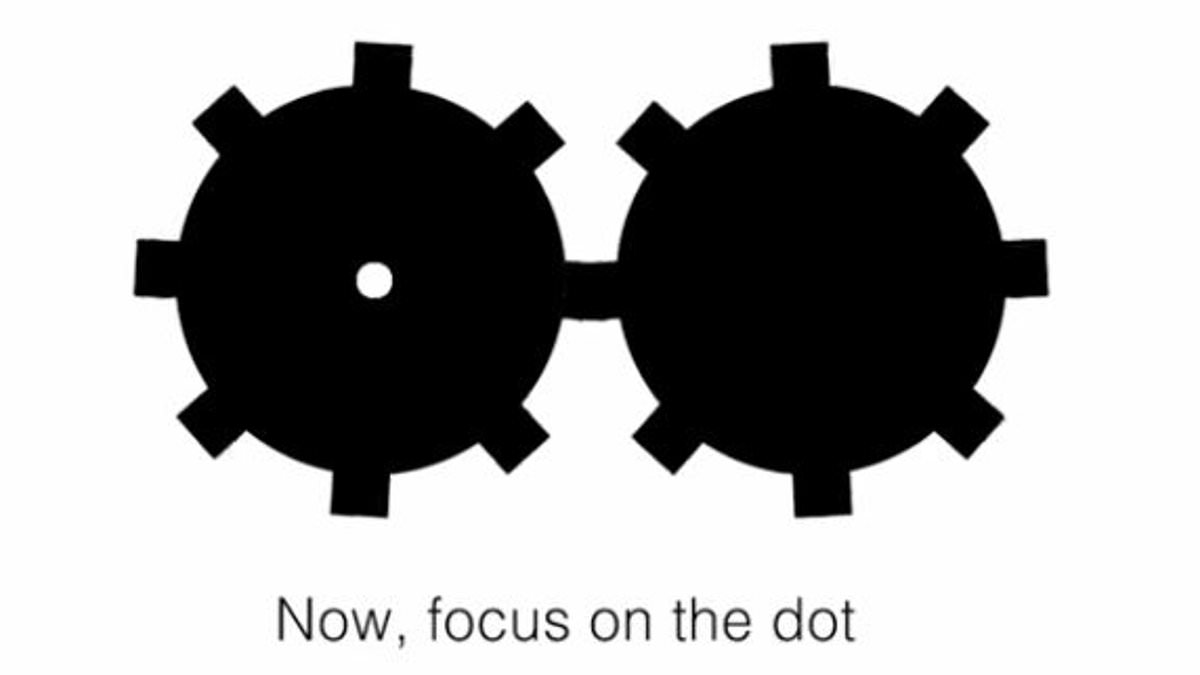
How fast are the cogs in this video spinning? While one looks like it's moving faster than the other, you might be surprised to learn that they're actually identical. The illusion – named Optical Illusion of the Year – features two cogs that are spinning side–by–side.They're moving at exactly the same speed, but when you focus on a point on the left–hand gear, you'll notice the one on the right unexpectedly speed up.However, the really strange part begins when one of the cogs is rotated so that the teeth appear to interlock.Making this small adjustment causes the illusion to become significantly stronger, as it seems the right–hand cog is now spinning even faster.According to the scientists who created this strange effect, that bizarre feature could help us understand the secrets of perception.Jacky Yueh, co–creator of the illusion and undergraduate student researcher at the University of British Columbia, told the Daily Mail: 'We think this illusion shows how our minds may be sensitive to when interlocking parts are working together, because this can guide how we ultimately move around the world and interact with each other.' The official optical illusion of the year tricks your brain into seeing completely different speeds for two identical spinning wheelsThe baffling illusion was chosen as the winner of the Best Illusion of the Year Contest by the Neural Correlate Society, a charity that promotes research into perception and cognition, snagging a $3,000 prize for its creators.Entries were judged on the counterintuitive quality, 'sheer beauty', and their contribution to the understanding of the human mind and brain.Although optical illusions are fun to look at, they are also an important tool in understanding how our brains create the world we experience.At the basic level, this illusion shows that there is a striking difference between how we process information at the centre of our visual field versus at the periphery.When we fixate on one gear, it is locked in the centre of our vision where the density of light–sensitive cells is highest, and we are exquisitely tuned to fine details.At the periphery, our vision is less tuned for detail but is excellent at processing motion, making the cog on the edge of our visual field appear to spin faster.These differing abilities may have evolved to help us navigate the world, and are actually extremely useful when we are dealing with high–speed environments such as driving on the highway.However, the fact that the illusion becomes stronger when it looks like the cogs are meshing suggests there is also a more complex process at play. Strangely, the researchers found that the effect is even stronger when the two cogs appear to be meshing together (pictured) Mr Yueh says: 'We think that when two gears are enmeshed, they are perceived as a working mechanical system.'Just as the motion of a living body grabs our attention, so too does a well–functioning machine.'The researchers suggest that our brains might be particularly well tuned to systems of cause and effect, or causality.When the gears are meshed, our brain assumes that one is acting on the other and jumps to the conclusion that the second cog should be spinning even faster.According to Mr Yueh, that illusion tells us something about where our minds draw the line between automatic visual processing and more complex higher–level thought.He says: 'We typically think that complex causal interactions belong more to the domains of reasoning and expertise; this illusion suggests that visual processing may be "smarter", extracting principles of causality that can then serve as building blocks for reasoning about more complex dynamics later on.'So this might reflect a way in which our minds are especially tuned to causality, especially to objects in the world that are continuously affecting change in each other.'From seeing a ball hit a wall to pushing a door with our hand, chains of cause and effect are all around us. Scientists say optical illusions like these work because the centre of our visual field is much clearer, while the brain often makes up details in the periphery. In these illusions, the edges are different from the centre, but if you stare at the middle the whole image will become more uniformLikewise, mechanisms, from the gears in a bike to the joints in our bodies, are 'continuously causal', meaning that they are always interacting with other parts.This makes it likely that our brains would have evolved a particularly good sense for these causal connections, which a finely crafted illusion can exploit.It is exactly these sorts of unexpected conclusions that make optical illusions so interesting to researchers.Dr Susana Martinez–Conde, President of the Neural Correlate Society, explains that illusions occur when our subjective experience of the world doesn't match reality.These discrepancies reveal the mechanisms that our brains use to construct our perceptions of the world, and of ourselves.Dr Martinez–Conde told the Daily Mail: 'Illusions are not errors of perception. They are the product of the tools and shortcuts that our brain uses to help us navigate the sensory world with limited neural resources.'In fact, illusions are critical in ongoing research into the neural bases of consciousness.'
Which one is moving faster? Optical illusion of the year tricks your brain into seeing different speeds for two identical cogs
Full Article
Original Source
Read the full article at Dailymail →KhanList aggregates and links to publicly available news content. We do not host full articles from third-party sources. Always verify important information with original sources.