
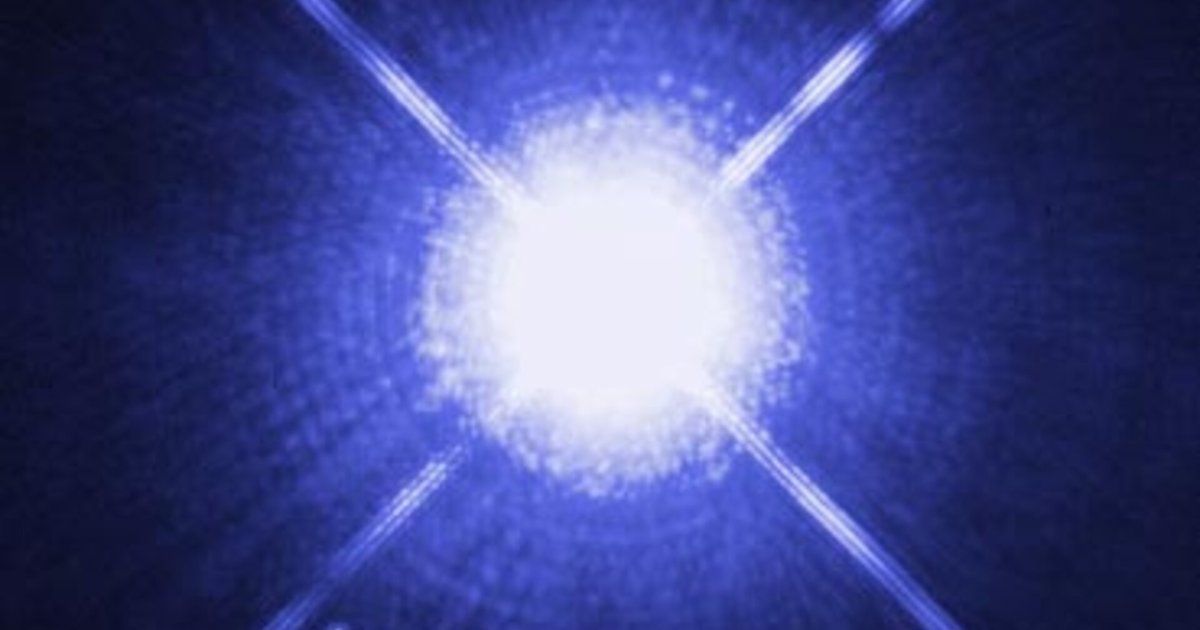
Astronomers refer to elements heavier than helium as metals. Metal-rich naked-eye stars include Mu Leonis, Sirius, and Alpha Centauri. | Published: August 10, 2026 Though measurements fluctuate, making it hard to determine which is absolutely the most metal-rich star in our sky, Sirius is certainly among the contenders. Credit: NASA/ESA/H. Bond (STScI) and M. Barstow (Univ. Leicester) Which naked-eye star is richest in metals and what is the estimated mass of the metal contained therein?ThomasMineral, Virginia In astronomer-speak, metals refer to elements heavier than helium. The first stars that lit up the universe were very metal-poor, since hydrogen and helium were just about the only materials around after the Big Bang. These are known as Population III stars. But, as time went on, those stars created heavier elements in their cores — carbon, nitrogen, oxygen, and so on — and littered galaxies with metal debris after exploding as supernovae. After these massive, short-lived Population III stars had all died, the next generation of stars, Population II, contain slightly higher levels of metals, and are often found today in ancient globular clusters and lingering in the bulge and halo of our galaxy and others. Finally, Population I stars are the youngest and most metal-rich, generally living in the arms of galaxies. Although these stars are more metal-rich than Population II stars, they still display a range in metal content. Our Sun is an intermediate Population I star, with metals comprising 1.34% of its mass. Stars with a significantly higher metallicity than the Sun are considered to be metal-rich. Such stars likely contain at least trace amounts of virtually every stable element, but not all are measurable. So, to estimate how rich in metals a star is, astronomers home in on iron — the heaviest element stars can produce in their cores while still extracting energy from fusion, and one with an especially easy‑to‑spot chemical fingerprint. Metallicity is defined as a value related to the Sun’s iron-to-hydrogen fraction, a logarithmic value called [Fe/H]. A star with 1/1000th the Sun’s metallicity would have [Fe/H] = –3.0, while a star with 10x the Sun’s metallicity would have [Fe/H] = 1.0. There are a few stars with relatively high metallicity that are naked-eye visible, which we will consider to be magnitude 6 or brighter. Among the most metal-rich of those is Mu (μ) Leonis, which has an [Fe/H] of 0.27, or 1.86x the Sun’s metallicity, and has a visual magnitude of 3.88. It’s located about 124 light-years away and is 1.5x the mass of the Sun. With that metallicity and mass, the mass of metals in Mu Leo would be 0.0374 solar mass — or about 40 times the mass of Jupiter. Other metal-rich stars that are perhaps a little more famous than Mu Leo include magnitude –1.44 Sirius, about 8.6 light-years away, and magnitude –0.01 Alpha (α) Centauri, lying a mere 4.3 light-years distant (although it is only visible from the Southern Hemisphere). Sirius has a metallicity of 0.4, or 2.5x that of the Sun, while Alpha Cen is a multiple-star system whose primary star has a metallicity of 0.20, or 1.59x that of the Sun. (Thank you to Miqaela Weller, Ph.D. candidate in astrophysics at Ohio State, for her assistance on this question!) Molly WakelingContributing Editor
Which naked-eye star is richest in metals?
Full Article
Original Source
Read the full article at Astronomy →KhanList aggregates and links to publicly available news content. We do not host full articles from third-party sources. Always verify important information with original sources.