
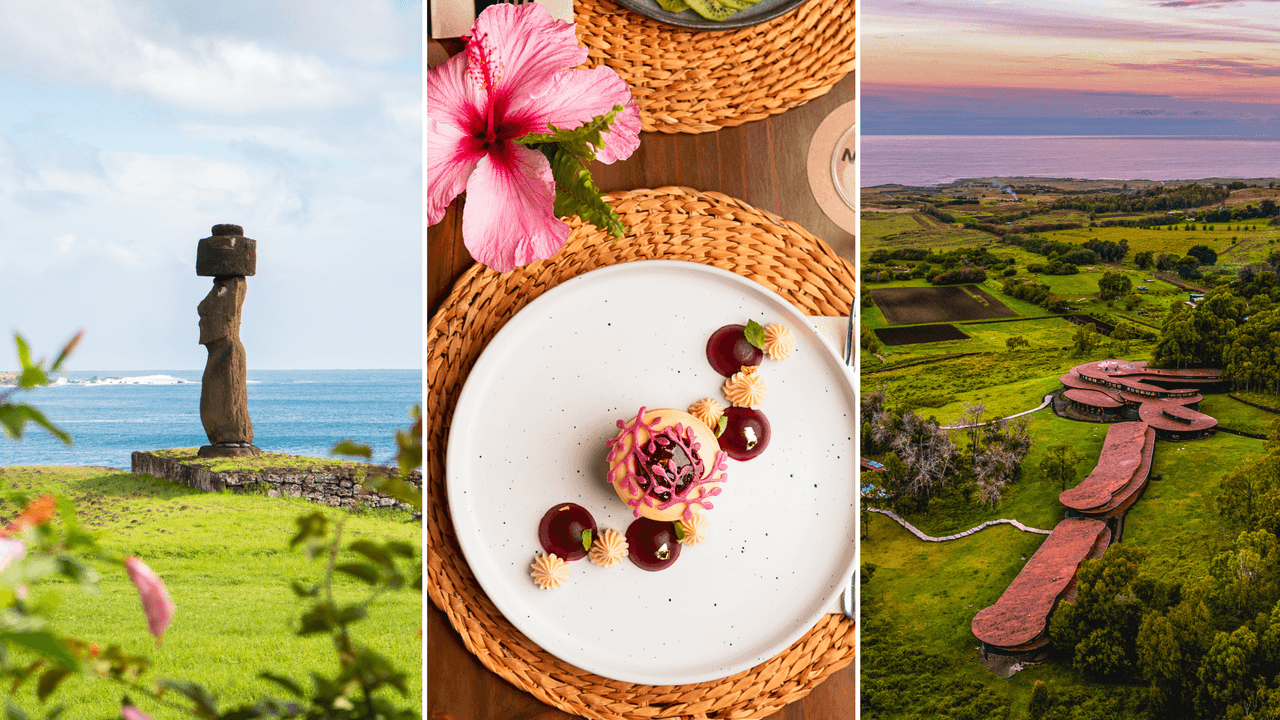
Also known as Easter Island, this Polynesian isle has long been an aspirational destination—here's how to visit.Explora Rapa Nui/Nayara HangaroaAt 1,292 miles from its closest inhabited neighbor, Pitcairn Island, and 2,200 miles from continental Chile, Rapa Nui (Easter Island) takes isolation to the extreme. Here, at the lonely eastern edge of Polynesia, the empty horizon seems to curve with the Earth itself. It’s an extraordinary setting for one of archaeology’s enduring mysteries: Why did a group of Polynesians carve nearly 1,000 monolithic human figures (known as moai), haul them across the island to distant ceremonial platforms over the course of centuries, and then topple them all to the ground? There are plenty of theories, and fewer answers. It adds an element of mystery to an already dramatic landscape, and one that has proven to be timelessly alluring.Today, this Chilean territory is essentially an open-air archaeological museum, with many of its enigmatic moai (representations of Polynesian ancestors) returned to their upright positions following seven decades of restoration. Of course to see Rapa Nui only through its superhuman past is to miss much of the story: The island’s distinct Polynesian culture remains a vital presence, particularly in its sole town, Hanga Roa, where nights come alive with cheerful ukulele music and hip-swirling dances. There’s also a vast, vibrant sea, windswept volcanic plains, and a food culture that draws on the island’s rich heritage and maritime setting.As a repeat visitor to the island, this is my guide to Rapa Nui.There are thousands of stone moai—representations of Polynesian ancestors—on Rapa Nui. GettyGetting to and around Rapa NuiUnless you sail over on one of the dozen or so annual cruise ships that dock here, including National Geographic Resolution and Silversea’s Silver Cloud, you’ll likely arrive via air at the world’s most remote commercial airport, Mataveri International. LATAM is the only carrier serving Rapa Nui with at least one daily flight from Santiago, 5.5 hours (and two time zones) away. Once on island, visitors typically sleep in the town of Hanga Roa and organize day trips to the archeological sites, which are never more than a half-hour drive from each other.The Chilean Government officially transferred administration of Rapa Nui National Park in 2017 to the Ma'u Henua Indigenous Community, an organization run by elected members of the Rapa Nui community. Recently, they’ve increased entrance fees (currently CH$95,000, or about $100 USD) to stave off overtourism, while establishing initiatives encouraging longer stays, deeper cultural connections, and stronger protections for the fragile moai. Chief among the changes is a requirement to visit all archeological sites beyond Hanga Roa with a certified guide. Consequently, it’s become less common these days for visitors to rent a car (or bike) and explore on their own.Head to La Kaleta for lunch along the rugged coastline. La KaletaLa Kaleta's ceviche is served within view of working fisherfolk. La KaletaWhere to eatSeafood is a highlight of the Rapa Nui dining scene where the tuna is so fresh, you’ll invariably want to eat it raw in a ceviche, carpaccio, or tiradito (thinly sliced in a spicy citrus sauce). Te Moai Sunset makes a particularly painterly version of the latter. Paired with a pisco sour and views over the modern Moai de la Paz (“Peace Moai”), it’s the most idyllic place to wind down during—you guessed it—sunset. Similarly, the mahi-mahi is sublime over roasted Rapa Nui sweet potatoes at the tiki-style Te Moana, while the dockside ceviche lunches at La Kaleta let you watch the fisherfolk in action.Kotaro has long been Hanga Roa’s hidden treasure: a small, quirky Japanese restaurant with an impeccable tasting menu and strict dining rules outlined on the website (no kids or chitchatting with the chef, for example). Neptuno Sunset is another off-piste favorite thanks to its seafront location near the end of the airstrip, slightly removed from the action. Bountiful seafood pastas are the specialty, but do save some space here or elsewhere for a dessert of po’e, a sweet, dense sponge cake made from mashed ripe bananas.The wide open spaces are less jungly than most expect from Polynesia, but gorgeous nonetheless. Explora Rapa NuiWhat to doMany assume that Rapa Nui will have the jungle-clad hills of other Polynesian destinations like Hawaii or Tahiti. Instead, it’s covered mostly in grassy plains and looks more like Ireland. While there are two fine beaches on the northern coast at Ovahe and Anakena (which is apt for swimming), this is not your standard resort island, and sunbathing is secondary to the mystique of the moai.Rapa Nui National Park has two chief archeological sites from the moai-building era: Rano Raraku and Ahu Tongariki. The latter is the island’s largest ahu (moai platform) with 15 statues often viewed in silhouette at sunrise. The former is a volcanic crater and quarry site where the ancient Rapa Nui designed some 95% of the island’s sculptures; about 400 remain in situ in various states of construction. There are dozens more ahu sites (many with restored maoi) spread throughout the island. The other major historical attraction is Orongo, a stone village perched on the rim of the Rano Kau volcano, which served as the ceremonial center for religious festivals dedicated to the creator god Makemake.Just offshore from Orongo are Los Motu, small islets that were central to the annual Tangata Manu “Birdman” competition from the 17th to 19th centuries, which involved a death-defying race down Rano Kau, into the Pacific, and up sea cliffs to secure the unbroken egg of a sooty tern. Today, Los Motu is a popular snorkeling site where you can ply the gin-clear waters in search of vibrant corals and 142 marine species found nowhere else on earth, including the rare Easter Island butterflyfish. Mike Rapu Diving Center is one of Rapa Nui’s longest-running and most respected operators for snorkeling and scuba diving. Back on land, there are excellent hikes to be had up Terevaka, the highest point on the island at 1,675 feet, or around the barren Poike Peninsula, which holds several little-explored archeological sites, including petroglyphs and an enormous rock carved in the shape of a human face.Modern Polynesian culture is alive and well on this island of 7,750 people. Though there are many souvenir shops with kitschy moai and colorful shell necklaces, for top local craftsmanship, seek out the paintings, woodcarvings, and jewelry at Mana Gallery, on the north end of Hanga Roa. The music school Toki Rapa Nui, co-founded by classical pianist Mahani Teave, offers occasional concerts and guided visits of its sustainable Earthship building, which is shaped like an eight-petal flower. More popular are the evening Polynesian dance shows from groups like Kari Kari and Te Ra’ai, the latter of which comes with a traditional (if highly theatrical) umu feast cooked in an underground earth oven with hot stones. For something less overtly touristy, check out the contemporary Polynesian music at Iti Lafken.Explora Rapa Nui offers all-inclusive stays with daily adventures led by local guides. Explora Rapa NuiWhere to stayFor an all-inclusive stay with daily adventures led by local guides, book at Explora Rapa Nui, an architecturally striking hotel about 15 minutes outside Hanga Roa. Of all the Explora properties, this one has the finest food and shrewdest guides. Right on the edge of town, the Leading Hotels of the World property Nayara Hangaroa gives you a bit more flexibility to book things à la carte. It boasts an oceanfront pool, three unique dining concepts, and oval-shaped rooms styled after homes in the nearby Orongo ceremonial village.More affordable options include the centrally-located (and playfully designed) Hare Nua Hotel Boutique, or the lush garden rooms of Pikera Uri Eco Lodge, from which you can explore the island on horseback. In general, prices are significantly higher here than in mainland Chile due to the remote location and lack of local resources.Mark Johanson is an American journalist who has lived in Santiago, Chile, for more than a decade. His stories about travel, food, culture, and sustainability have appeared in publications such as Travel + Leisure, AFAR, Food & Wine, The Economist, Men’s Journal, Newsweek, Bloomberg, CNN, and the BBC, among others. ... Read More
Where to Eat, Stay, and Play on Easter Island, the Wild, Remote Island in the Pacific
Full Article
Original Source
Read the full article at Cntraveler →KhanList aggregates and links to publicly available news content. We do not host full articles from third-party sources. Always verify important information with original sources.