
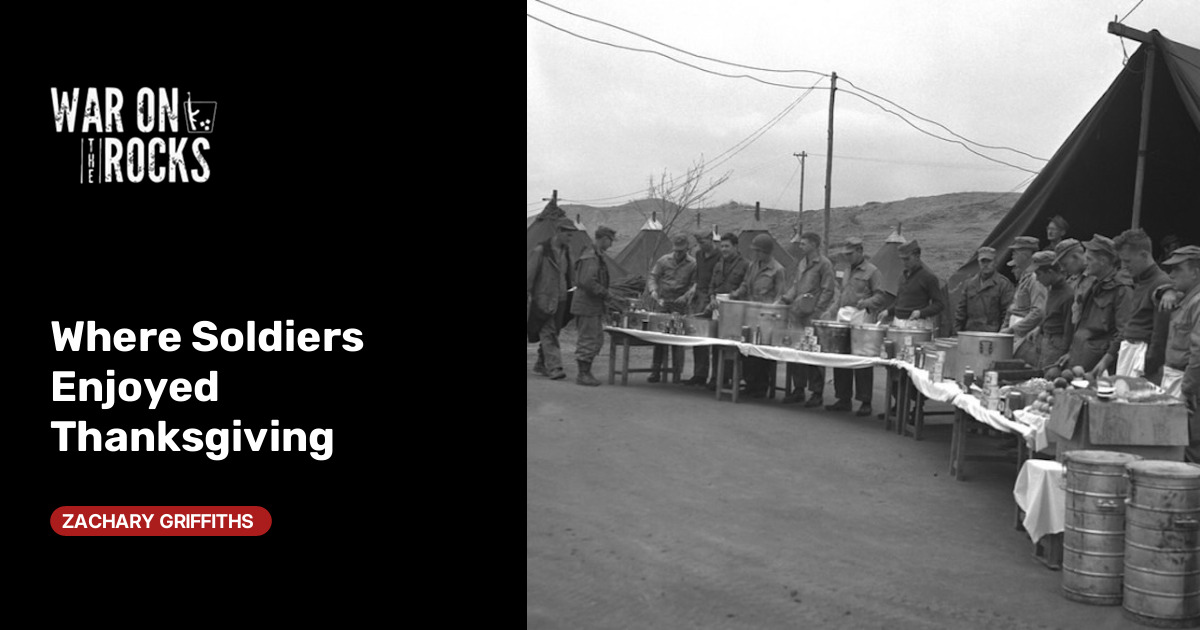
Today, I’m slicing turkey. Grease dots my pinks and greens. Scuffs mar my jump boots. As I serve, soldiers feast: smoked turkey, honey-glazed ham, a steamship round of beef, smoked flank steak, and a whole smoked pig. Alongside those entrees, they’re enjoying collard greens, cornbread twice over, baked mac and cheese, shrimp cocktail, deviled eggs, and three gravies. Families of our young soldiers eat for just $8.75. Others, $11.85. The U.S. Army does Thanksgiving well. While the ideal American Thanksgiving finds everyone back at the family home, I’ve only had four of those in almost 20 years. More often, I’ve dined somewhere else: the only Denny’s in Anchorage in 2008, a plywood shack eight miles from the Pakistani border the next year, in Nangarhar between raids in 2013, and with friends at forts across the United States. Since the Civil War, the Army has served Thanksgiving in a lot of places. This piece is based on 33 menus from 1901 to 1990, largely found in the U.S. Army Heritage and Education Center’s archives. The collection of surviving cards includes 26 menus from garrisons, but only three from troop ships and four from the field. Beyond location, cards always contained the menu, so we know the Army aimed to serve a median of 19 items. The collection’s most decadent Thanksgiving included 29 and the most austere just nine. The earliest menu comes from the 2nd U.S. Cavalry stationed at Hamilton Barracks in Matanzas, Cuba, in 1901. The last served families of the III Corps Artillery at Fort Sill, Oklahoma, in 1990. Sometimes commands included a message, like Gen. William Westmoreland in Vietnam. Other times, units listed who dined together, like the 22d Construction Company in 1918. These menus show the Army’s commitment to Thanksgiving, to soldiers wherever they were, even if the delivered meal sometimes fell short. And as modest mementos of feast and fellowship, nothing beats a printed card. Image Credit: U.S. Army Heritage and Education Center Far from Home 20th-century U.S. Army Thanksgivings built on the Union League Club of New York’s groundwork laid during the Civil War. Their resolution laid out the motivation clearly: “that on the twenty-fourth day of November there shall be no soldier … and no sailor … who does not receive tangible evidence that those for whom he is periling his life, remember him.” They delivered. The Union League supplied 371,586 pounds of poultry with “an enormous quantity of cakes, doughnuts, gingerbread, pickles, preserved fruits, apples, vegetables, and all the other things which go to make up a Northern Thanksgiving Dinner.” Soldiers appreciated the effort. One remarked that it “isn’t the turkey, but the idea that we care for.” Following the Civil War, the Army channeled the Union League’s commitment for soldiers in peace and war, in garrison, in the field, or even afloat. Perhaps unsurprisingly, garrison soldiers ate best. Across the 26 garrison menus, those soldiers enjoyed an average of 20 items. The most fortunate soldiers I’ve found feasted just two weeks before Pearl Harbor. Battery A of the 75th Coast Artillery had 29 dishes: luxurious celery hearts, roast young turkey and Virginia ham, fresh peas and fruit, and six desserts. I’d guess they came up by ship from Seattle to Seward, with the Alaska Railroad carrying their rations the rest of the way to Fort Richardson in Anchorage. While they were in a garrison, that garrison was as far from home as many Thanksgivings in the field. Image Credit: The Author Troops in the field fared less well. The four field menus averaged 17 dishes of mostly preserved foods. During a brutally cold Thanksgiving in North Korea in 1950, X Corps’ soldiers, marines, and South Korean soldiers were promised a hot Thanksgiving dinner with 22 items behind this article’s cover image. The headquarters enjoyed a dinner “complete with cocktails … tablecloths, napkins, Japanese chinaware, regular silverware, [and] place cards.” X Corps’ assigned marines on the line got turkey with “cardboard boxes for plates.” Some Thanksgivings found soldiers both fighting and feasting, like the 344th Field Artillery near Perl, Germany, in 1944. They gave thanks “by sending 633 rounds in the German direction” before having “turkey for our supper.” The final option was Thanksgiving on a troop ship. Those three menus show how experiences on troop ships varied from an austere nine dishes to a luxurious 27. Those on the USS West Point crossing the Arabian Sea in 1942 had just the core Thanksgiving meal with nine shelf-stable dishes. Crossing the Atlantic in 1917, troops on the SS Cedric dined well. In that converted White Star liner, soldiers enjoyed 17 dishes including oysters on the half shell, flounder, lamb cutlets, and roast turkey. No two Army Thanksgivings are the same. Despite general consistency in the menu, conditions differed. Consider Staff Sgt. Frederick Lyons of the 12th Armored Division during World War II. In 1945, he was not sure how he was “going to down a full-course Thanksgiving dinner tomorrow [at three] in the morning, but down it” he would. That postwar Thanksgiving featured 27 dishes, including fresh celery hearts aboard the USS Hermitage as it departed for New York. In the letter accompanying that menu home, he also recalls “standing out in the rain at Raon L’Etape last year … [and] the one in 1943 in the field in Tennessee.” Aboard a troop ship, standing in the rain, or in training, the Army observes Thanksgiving everywhere. War on the Rocks Membership Newsletters. Podcasts. Analysis. Exclusive members-only dispatches, premium shows like The Russia Contingency with Michael Kofman, and expert analysis of the conflicts shaping national security. Military, government, and students 33% off with a .mil or .gov email50% off with a .edu email Choose annual, then sign up with that email address. No code needed. A Full Meal When soldiers cannot get home for Thanksgiving, the Army provides. Dinner often opened with a relish tray and soup. Industrial processes meant preserved pickles appeared on 25 of 33 menus, allowing 8,091 soldiers aboard the USS West Point in the Arabian Sea in 1942 to enjoy sweet gherkins. Lucky soldiers early in the century also enjoyed luxurious celery and imported olives in their first course, though both these items fell off menus once they became commonplace. After relishes, soldiers sipped soups until Carlisle Barracks served the last one in this collection in 1951. Early soups appear to have drawn on local seafood, such as oyster stew in Cuba and clam chowder in the Philippines. Later, economizing cooks stretched their ingredients with soup, serving cream of celery beside fresh celery in 1925 and turkey rice soup in 1949. After enjoying relishes and soup, soldiers dug into turkey. Image Credit: The Author Usually a Bird, Once a Fish The Army takes turkey seriously. In 1908, the Army first authorized “turkey, dressed, on national holidays when practicable.” But company funds had long supplemented the soldier’s holiday diet. An 1892 article describes how companies purchased “turkey on Thanksgiving” from “convenient markets.” Then, the day before Thanksgiving in 1932, President Herbert Hoover directed that every soldier should receive 25 ounces of turkey at Thanksgiving starting in 1933. That was the issue weight, with bones and all, but still seven more ounces of turkey than a soldier’s 18-ounce daily meat ration. Later, in April 1944, the War Food Order 97 “set-aside of 100 per cent of the hen turkeys processed” until the Army purchased “eight million pounds of turkey” which was still “only a part of the need.” Given this emphasis on the traditional bird, turkey is nearly as ubiquitous in U.S. Army messes as it is in American dining rooms. Only two menus missed turkey. Unsurprisingly, these were Thanksgivings catered abroad. In France in 1918, the 94th Aero Squadron ate a French meal for Thanksgiving featuring pork roast. Then, in Delhi, India, in 1944, the 8244-A Engineers enjoyed both barramundi fish and beef tenderloin courses. Stuffing, Oysters, and Later Cornbread The U.S. Army did not skimp on the sides. Core sides included mashed potatoes, stuffing or dressing, dinner rolls, cranberry sauce, and sweet potatoes. One surprise for readers might be the prevalence of oysters. Pilgrims perhaps ate oysters at the first Thanksgiving before they became a staple during the 19th and early 20th centuries. Nine of 15 menus from 1901 to 1941 featured oyster dressing, oyster stew, or both. During and after World War II, oysters largely fell off U.S. Army menus, perhaps reflecting changing tastes or a desire to simplify menus. Another interesting note is the gradual appearance of cornbread on Thanksgiving menus. Cornbread first appeared in these menus in 1965, perhaps reflecting wide adoption of a southern dish as the U.S. Army’s planners shifted menus from serving an almost exclusively northern force at the end of the 19th century to significantly southern by 2000. Finally, cranberry sauce is a stalwart of Army menus. Only six menus missed that tart treat. Plentiful Pies Once the plates were cleared, desserts followed. In 1901, Corporal Maier prepared four cakes and two pies for roughly 100 soldiers in Troop C of the 2nd U.S. Cavalry. They took slices of jelly cake, chocolate cake, pound cake, layer cake, mince pie, and apple pie. After dinner, C Troop enjoyed cigars. By midcentury, the Army’s after-dinner looked different. Tobacco last appeared in these menus during the occupation of Germany in 1947. But overall, pumpkin pie dominated the dessert tray. In fact, pumpkin pie was the only dessert presented to soldiers on the USS West Point after their austere Thanksgiving feast in 1942. After World War II, dessert congealed around pumpkin pie, mince pie, and fruitcake. A Highly Centralized Meal Wherever they ate, soldiers enjoyed a remarkably consistent meal. None of the three menus from Hawaii features poke, kalua pig, or poi. Those in Key West sliced pumpkin pie, not key lime. The only exceptions are early seafood soups and the two meals local caterers cooked in France in 1918 and in Delhi in 1944. Postwar, these menus show standardization across the Army. The 1st Brigade, 1st Infantry Division at Phuoc Vinh, Vietnam, in 1966 and the signal group in Thailand in 1969 printed menus nearly line for line alike. Both enjoyed shrimp cocktail and crackers, roast turkey with bread dressing and giblet gravy, glazed sweet potatoes, a relish tray, then fruitcake, mincemeat pie, and pumpkin pie with whipped cream. The Army did not adapt Thanksgiving to the places it served. It took Thanksgiving to war. Crowded Tables From Cuba to Fort Sill, soldiers ate an American Thanksgiving as those who sat around the table changed. Eight company and battery menu cards even printed every name. The 22d Construction Company at Lee Hall, Virginia, in 1918 included all 23 members from Lt. James L. Hudson to Pvt. Andrew J. Wright. The 22d even included an autograph section to better memorialize the moment. Several units took pains to include their attachments, ensuring that the menu card recognized everyone at the table. In their card below, Battery C of the 31st Coast Artillery welcomed attached privates Stanley Beisner and Leverne Eschenfelder along with others at their Key West celebration in 1943. Cooks often received special recognition. In Cuba in 1901, Troop C of the 2nd Cavalry prominently placed Cpl. Maier, 1st Cook Barten, and 2nd Cook Schrenk’s names just below the unit’s name and above the turkey on the menu. Image Credit: U.S. Army Heritage and Education Center Later, menus moved up the chain and welcomed families. Company and Battery Thanksgivings gave way to battalion, brigade, and division dinners as commanders’ messages replaced the soldiers’ names. In Vietnam in 1966, Gen. Westmoreland encouraged each soldier to “pray for continued blessings and guidance upon our endeavors to assist the Vietnamese people in their struggle to attain an everlasting peace within a free society.” I first found families mentioned in a menu from 1969. At the King’s Hotel in Bangkok, the 29th Signal Group and their families enjoyed a traditional Thanksgiving that was the “next best to being ‘at home.’” Later, during Desert Shield, the III Corps Artillery opened their dining facilities for families while their soldiers were deployed. Tables were full, but the later cards stopped sharing who sat together. The Army Goes Rolling Along Today, I’m slicing turkey. Next year, someone else will. Of my 19 U.S. Army Thanksgivings, many are memorable. That chicken dinner at the Denny’s in Anchorage. The treat of a turkey ice sculpture in a shack near the Pakistani border. Dust swirling as my CH-46 lifted off from a raid. These are clear. But time blurs. I mostly do not remember the names of the soldiers at my table or what we ate. I doubt they remember either. Meanwhile, I know that Cpl. Maier prepared a feast at Hamilton Barracks, Cuba, in 1901. I know that all 23 soldiers in the 22d Construction Company broke bread together from Lt. Hudson to Pvt. Wright. A paper menu would have remembered. The Army should bring back these modest mementos. Whether or not the Army brings back printed menus, all Thanksgivings are a time for thanks. In garrison, in the field, or even at sea, I’m thankful for those who shared a table. I’m also thankful for the cooks. Cpl. Maier in 1901 and our cooks this morning at 0300 putting on the pig. Whether a lone turkey leg before a battle or a feast in garrison, I’m thankful for the U.S. Army’s Thanksgivings. Zachary Griffiths is an officer in the United States Army. Regrettably, the Army’s archive is down, so links reference the documents he saved, where possible. Image: U.S. Army
Where Soldiers Enjoyed Thanksgiving
Full Article
Original Source
Read the full article at Warontherocks →KhanList aggregates and links to publicly available news content. We do not host full articles from third-party sources. Always verify important information with original sources.