
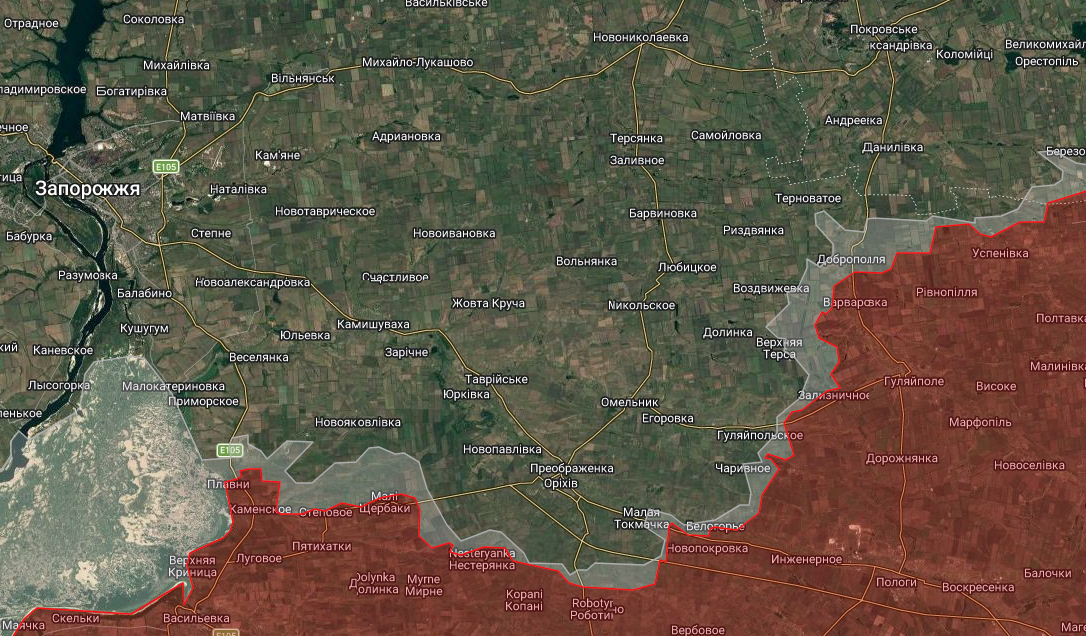
Every day, the Ukraine Battlefield update newsletter offers a clear look at how the war is unfolding on the ground. Subscribe for free here to get the full text delivered to your inbox. The Ukrainian army stays in control of front lines, but safety in cities deteriorates. Kyiv was on fire again as Russian attacks on cities intensify. Rubikon published stats on destroyed Ukrainian drones, decoys being the second most prominent. Russia’s defence ministry will not let go of the Armata: it wants to turn it into an air-defence system, drawing ridicule. Maps of the day: Sloviansk-Kramatorsk direction; Orikhiv direction, Oleksandrivsk direction, Kupiansk direction. Videos of the day: a burning Tu-95MS strategic bomber; a Ukrainian firefighter showed how they extinguished the Academy of Sciences building. The Ukrainian army stays in control of front lines, but safety in cities deteriorates. The war has reached a stage in which two separate conflicts appear to be taking place simultaneously. While Ukraine is currently losing the battle in the air and its cities are continually suffering missile and strikes by jet drones, the situation on battlefields is far better. Last week, Denník N spent time in Ukraine with former chief of the general staff Daniel Zmeko. During the trip, reporters met commanding officers from several brigades and battalions operating from the Izium area to Zaporizhzhia, and all of them said they had the situation under control. The officers spoke about the accuracy of Russian maps, which they said did not correspond to reality. In some places, Russian soldiers are as far as 20 km from the locations where, according to the Kremlin, they are supposed to be. Northern flank of the Sloviansk-Kramatorsk agglomeration: This is a specific section of the front where the Ukrainian army has been reporting its advances only very slowly, while Ukrainian analysts have remained silent so as not to disclose anything sensitive. Russian bloggers, by contrast, are depicting the situation more closely to reality. Yet official Russian maps persist with utterly nonsensical lines. We do not know to what extent this is an effort to deceive domestic and foreign audiences, and to what extent they genuinely believe it in Moscow. It is worth looking at how the regime wants the situation to appear, and what it is really like. The first map in the overview was produced by the Russian state news agency RIA Novosti and depicts the area around Lyman, on the northern flank of the Sloviansk-Kramatorsk direction, as of 29 September. Lyman is shown as occupied in the middle of the map. The map’s author also continues to insist that the Russian army had captured Sviatohirsk — at the tip of the red salient in the centre of the map — and that Russia controls the entire, now non-existent salient with the village of Novoselivka at its centre. Yet Russian outlets Rybar and Two Majors write that fighting is taking place on the Zherebets river around the villages of Terny — on the far right of the map — and Yampil. The following map is much closer to reality. According to it, the front line roughly follows the Zherebets river, which corresponds to Rybar’s claims. In the Lyman direction, in Donetsk region, Ukrainian defenders successfully repelled three attempts by the russian fascist invaders to advance near the settlements of Ridkodub, Novoselivka and Drobysheve.1/2 pic.twitter.com/Zs9VdLLnAr— Michael MacKay (@mhmck) September 28, 2026 Rybar’s map looks like this: Kupiansk direction: The city of Kupiansk is a similar case to Sviatohirsk. Putin declared it captured in August last year. And once the commander-in-chief had declared this, his news agency continued to draw the map as though it were true. Kupiansk is shown as occupied in its centre, but there are further inaccuracies. For example, the Kremlin agency claims that the Ukrainian bridgehead on the eastern bank of the Oskil river south of the city no longer exists. Ukrainians do face major difficulties supplying it, and various analysts have repeatedly warned of an impending disaster, but the Russian map is nevertheless hopelessly inaccurate. Also note the small town of Borova at the bottom centre. RIA Novosti also shows it as occupied, although this is not the case. This time, we will compare the Russian agency’s data with a map by Ukrainian analysts at DeepStateUA, because they updated it on Tuesday to reflect a new advance by Ukrainian units north of Kupiansk — again in the centre of the map — near the village of Dvorichne. In recent weeks, they have succeeded in reducing the Russian bridgehead on the western bank of the Oskil; the change since the end of August is marked in blue. Borova is again at the bottom centre, while below Kupiansk is the Ukrainian bridgehead that Russia claims does not exist. Orikhiv: This is one of the places where Ukrainian officers said during reporters' trip to Ukraine that Russian maps were particularly inaccurate. The Russian map is again from RIA Novosti and again ignores reality along the entire length of this section of the front. Its main target is the city of Zaporizhzhia, with a population of three quarters of a million, in the centre left, while the small town of Orikhiv, at the bottom centre, is a defensive hub. Putin’s news agency places soldiers roughly 12 km from the southern edge of Zaporizhzhia; in reality, they are around 24 km away. It shows Orikhiv as occupied and the Russian army advancing from the east towards the village of Novorozivka, north of Orikhiv. The OSINT project Playfra covers this area in the greatest detail. Its map appears to depict a different war altogether. Everywhere, Russian positions are significantly shifted compared with those shown by RIA Novosti. The differences have a simple explanation. On the western flank near Zaporizhzhia, the Kremlin agency simply ignores the successful counterattacks carried out by Ukrainians there this year. On the eastern flank, it uncritically accepts every claim by the Russian defence ministry and, with equal lack of scrutiny, considers captured every small village where a Russian soldier raised a flag during a suicidal mission, even several months ago. Although those soldiers have since been killed or captured, RIA Novosti acts as though they still control the village. Playfra also offers a more detailed view of the current fighting around Orikhiv, drawing on analyses by Ukrainian analyst Kostyantyn Mashovets. Orikhiv direction.Factually, no changes. Clearings are conducted constantly, but the Russians also continue to infiltrate: the global situation doesn't change.The stalemate situation that I had reported some weeks ago, as well as the gray zone, remains both actual as of the… https://t.co/6rau9f7wcK pic.twitter.com/5uIK3K78Bm— Playfra (@Playfra0) September 28, 2026 Of course, Russians too occasionally notice that they are living in a parallel reality. Most recently, the influential Aleksandr Kharchenko wrote about it: “Comparing our maps with Ukrainian ones can be shocking. The zones of control differ by dozens of kilometres,” he acknowledged, adding that both sides lie, although he focused specifically on false Russian reports. He described Russian soldiers who are the first to break into a village as heroes. But, according to him, wars are not won through heroism, but through a functioning system. “Errors in our maps and information arise because they rely on heroes. Everywhere a Russian soldier is sitting is considered our territory,” Kharchenko argued that this had to change because “our territory is only where a Russian soldier is sitting with food, water and ammunition. This is territory from which we can fight the enemy”. Kyiv was on fire again as relentless Russian attacks on cities intensify. In the capital, Russians particularly targeted energy infrastructure. “Not a single day has passed since the summer without the enemy attacking energy infrastructure. But this is the first such massive and complex attack since the end of the previous heating season,” Ukrainian PM Serhiy Koretskyi told NV. In addition to causing serious damage, the attacks on Kyiv and other cities killed at least five residents and injured another 14. President Volodymyr Zelensky also said that, thanks to the delivery of new surface-to-air missiles, five Russian ballistic missiles had been shot down. Since last night, emergency services and repair crews have been working to address the aftermath of the Russian strike. It was a difficult attack – nearly 190 attack drones, as well as ballistic missiles. And the main target was energy infrastructure in the capital and the Kyiv… pic.twitter.com/wUNWEUdpTL— Volodymyr Zelenskyy / Володимир Зеленський (@ZelenskyyUa) September 30, 2026 Rubikon published stats on destroyed Ukrainian drones, decoys being the second most prominent. Ukraine’s response is continuing in parallel with the Russian offensive against cities. But the stats currently weigh against Ukraine. While the effectiveness of Ukrainian air defence has fallen dramatically since the arrival of Russian jet drones, Russia has successfully shot down Ukrainian ones. For example, the recent large-scale drone raid on Moscow involved several hundred drones — and, according to some sources, more than 1,000 — but only 10 penetrated the airspace above the Russian capital. In this context, the Russian Rubikon unit published interesting statistics. Although it operates at and near the front, its data for September show that, of 827 Ukrainian drones hit, as many as 247 were Maya-type drones — unmanned decoys intended to deceive Russian air defences. They look very similar to FP-1 attack drones but, unlike them, carry no warhead. For context, the top two most frequently intercepted Ukrainian UAVs by Russian forces are both decoy drones — the “Maya.” This suggests that Ukraine’s deception strategy is working, as the Ukrainian Defense Forces have increasingly begun deploying decoy UAVs to mislead Russian… https://t.co/NKPvbzm38U— Oko Gora (@oko_gora_tg) September 29, 2026 Russia’s defence ministry will not let go of the Armata: it wants to turn it into an air-defence system, drawing ridicule. Zvezda News is a media outlet directly controlled by the Russian defence ministry. On Monday evening, it published technical news on the long-forgotten T-14 Armata tank, which Russian propaganda had claimed would revolutionise tank warfare. Today, it is beyond any doubt that the project is dead and new information confirms this, but its authors presumably intended to convey precisely the opposite. “Rostec has upgraded the Russian T-14 Armata tank into a short-range air-defence system,” the report stated, citing military expert Oleg Shaladin. The list of new features appears impressive at first glance. The new version of the Armata has received new electronic equipment; its 125 mm main gun is to be replaced by a 152 mm gun, allowing the tank to fire Kornet anti-tank missiles with a range of 10 km. The new Armata will also be able to use Krasnopol guided artillery shells, which are used by more modern howitzers, while the tank is also to gain the ability to operate as the aforementioned short-range air-defence system. Further changes have already been made to the project, but even the brief list above makes it clear that the Armata is no longer intended to be a tank, but rather some kind of hybrid capable of fighting everything and nothing at the same time. Among others, the Russian Telegram channel Military Informant commented on the report, openly mocking it. It said Rostec had mixed together “all the old tales from 10 years ago” in its list of changes, but that in practice “the tank never got beyond parades and training grounds, because it was created for an entirely different war, which ultimately never happened. It became conceptually obsolete from the outset, without even having had the chance to fight”. Videos of the day Russia has lost another Tu-95MS strategic bomber. This is the 12th confirmed loss of this type — the Oryx website has not yet updated its figures, so it records only 11. According to available information, the aircraft crashed shortly after taking off from a base in Amur region. Six crew members were reportedly killed, while one survived with injuries. Armed with cruise missiles, the aircraft was probably heading for Olenya air base, from which Russia attacks Ukraine. A Russian Tu-95MS Bear heavy bomber crashed on takeoff in Amur this evening during a training flight. The airframe is a total loss, with no survivors reported. pic.twitter.com/tbujV6RVP5— OSINTtechnical (@Osinttechnical) September 29, 2026 Denník N wrote on Tuesday about the attack on the headquarters of the Ukrainian Academy of Sciences. A video has since emerged from the helmet camera of one of the firefighters involved in the rescue operation. Helmet-cam footage of Ukrainian firefighters tackling the blaze at the National Academy of Sciences of Ukraine in Kyiv on Monday after a Russian drone strike. pic.twitter.com/DqEcz3wPlK— OSINTtechnical (@Osinttechnical) September 30, 2026 What are the losses No update on Wednesday. By Tuesday (22 September), Russia had verifiably lost 24,138 pieces of heavy equipment, compared with 24,098 on Monday (14 September). Of these, 19,105 (19,065) were destroyed by Ukrainians, 1,000 (1,000) were damaged, 1,194 (1,194) were abandoned by their crews and 2,839 (2,839) were captured by the Ukrainian army. This includes 4,448 (4,447) tanks, of which 3,353 (3,352) were destroyed in combat. Ukraine lost 12,175 (12,143) pieces of equipment, including 9,579 (9,551) destroyed, 702 (698) damaged, 695 (695) abandoned and 1,199 (1,199) captured. This includes 1,464 (1,462) tanks, of which 1,125 (1,120) were destroyed in combat. Note: Neither side regularly reports its own deaths or equipment losses. Ukraine publishes daily figures for Russian casualties and destroyed equipment, which cannot be independently verified. In this overview, we use data from the Oryx project, which has compiled a list based exclusively on photographically documented equipment losses since the start of the war.
Where Russian maps place the occupiers, and where they really are — an overview of parts of the front (Ukraine Battlefield update, Day 1,679)
Full Article
Original Source
Read the full article at Euobserver →KhanList aggregates and links to publicly available news content. We do not host full articles from third-party sources. Always verify important information with original sources.