
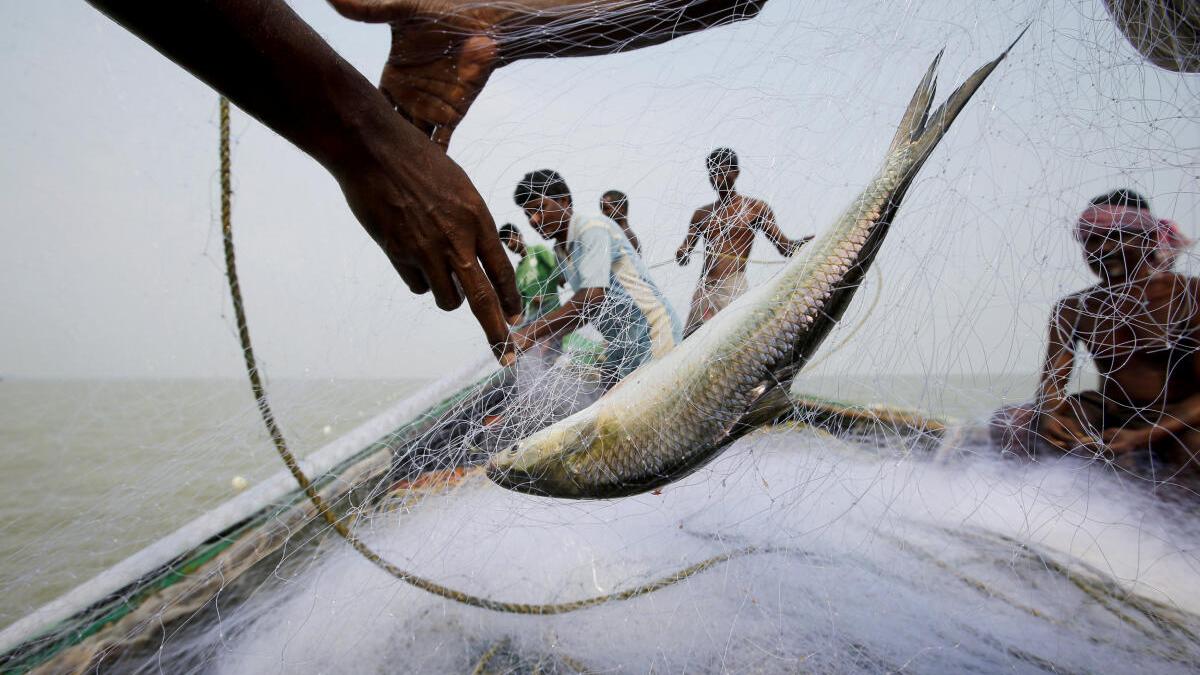
The journey of the hilsa begins far from the Bengali kitchen. Before the mustard paste, before the green chillies split down the middle, before the first hiss of fish meeting hot oil, it is out at sea, moving through deeper, colder water. Then the monsoon gathers, the rivers swell, and something ancient pulls the fish inland.“It is an ocean fish,” says Sujoy Chatterjee co-founder of the lunchroom Amar Khamar who works with a large network of farmers and growers across West Bengal and Sunderbans for his ingredient and rare fish revival work. Sujoy says that the hilsa comes to the rivers for laying eggs. Circa 1997. FIshermen handling large quantities of fish | Photo Credit: The Hindu Archives The journey is the beginning of almost everything Bengalis later attach to hilsa: season, taste, geography, ritual, even longing. Sujoy describes the fish travelling in large shoals, pushing against the current with remarkable speed. Research, he says, has recorded hilsa covering 40 to 60 kilometres in a day, sometimes even more. The fish needs depth to make that journey. It is naturally at home in deeper water, and rivers that have become shallower through siltation can make the passage harder. Sujoy Chatterjee, co-founder Amar Khamar | Photo Credit: Special Arrangement “There is a saying that hilsa dies for its children,” he says. The fish leaves the sea to spawn. The young eventually travel back towards the ocean, grow there and, when their turn comes, begin the journey upriver themselves. This year’s hilsa on display at Gariahat Market | Photo Credit: Shreya Banerjee Once, that journey was considerably longer. Sujoy recalls accounts of hilsa travelling up the Ganga as far as Kanpur before the Farakka Barrage altered the river system. Today, it enters river systems across Bengal and Bangladesh: the Ganga-Bhagirathi-Hooghly, the Rupnarayan, the Padma, Meghna, Jamuna and their tributaries and estuaries. But the romance of hilsa has always depended on more than how far it swims. It depends on where it swims.Differentiating the Ganga and Padma hilsaAsk a Bengali whether Ganga hilsa tastes better than Padma hilsa and a discussion can acquire the solemnity of constitutional debate. Sujoy has his own visual shorthand. Ganga hilsa, he says, is often more elongated, its body whiter, sometimes carrying a silvery-golden line along the belly. Padma hilsa can appear broader, roundish, with a slightly different cast to the flesh.Taste, however, is harder to pin down. For generations, fisherfolk and seasoned eaters have argued that a hilsa changes once it enters a river. But Sujoy reaches for an agricultural analogy. “If you ask me why Gobindobhog grows beautifully in one part of Bardhaman, I will talk about terroir, about microclimate. With hilsa also, the ecology of the place must matter,” he notes Hilsas at Gariahat market | Photo Credit: Shreya Banerjee River depth, current, silt, water composition and the food available to the fish may all play a role. There are old explanations that hilsa loses some of its marine salinity as it travels through fresh water, making its flesh taste sweeter. Sujoy is careful not to present every inherited theory as science, but he is fascinated by the fact that generations of people who catch and eat the fish have consistently linked taste to water.Old Calcutta took this connoisseurship several steps further. Sujoy recalls a time when serious hilsa eaters supposedly claimed they could tell whether a fish had been caught near Babughat, Bagbazar or elsewhere along the river simply by tasting it.“It was almost like a blind tasting of wine,” he says. It is an extraordinary image: a city sitting beside the Hooghly, tasting its own river kilometre by kilometre.That world had advantages that Kolkata no longer does. The population was smaller, river systems were different and fishing pressure was lower. And hilsa was still governed more firmly by season. Circa 1998. Blocks of ice being carried to a fishing trawler moored at Diamond Harbour in West Bengal. | Photo Credit: The Hindu Archives The fish typically enters rivers with the monsoon. By January or February, the return journey towards the sea begins. Older Bengali food customs followed this cycle much more closely, with certain religious and cultural occasions marking when hilsa appeared on the plate and when it disappeared again.Today, appetite has become less patient. Kolkata’s hilsa now arrives through several routes. There is the local catch from Bengal’s coast and estuarine stretches; fish from Gujarat, particularly the Narmada region around Bharuch; and, depending on trade permissions, the fiercely coveted hilsa from Bangladesh.Mention Gujarat hilsa in certain Bengali circles and noses may rise before forks do. But Sujoy refuses to participate. “There is no point in being so snobbish. A good quality hilsa from Gujarat can be a very good fish,” he believes. Bengal’s demand for hilsa is enormous, he points out, and local supply cannot always meet it. What matters, finally, is the quality of the fish and its freshness.At Gariahat Market, one of Kolkata’s largest fish and vegetable markets, Mujibor Molla sits at his 25-year-old fish stall inherited from his grandfather. This year, he says, most of his hilsa comes from Diamond Harbour, Canning, Lakshmikantapur, Sonakhali and Malancha, where arats, or wholesale markets, feed Kolkata’s fish trade. Hilsa is selling for ₹1,800 to ₹2,000 a kilogram, while Bangladeshi fish, he says, has not arrived at all. Much of the catch is kept in cold storage almost immediately: hilsa, Rejaul explains, is a sukhi, or delicate fish, that dies soon after leaving the water. He has noticed another change too. With pollution closer to shore, he says, more hilsa are moving towards the cleaner waters of the high seas, where much of this year’s catch is coming from. Mujibor says, “Hilsa is available in the off-season too, but it does not have the same flavour as the monsoon catch. During the off-season, prices usually range between ₹1,200 and ₹1,400 per kg.”Tridge, a global agri-food market intelligence platform that tracks international trade flows, offers a snapshot of how hilsa is moving in and out of India. In June 2026, its dataset recorded 60 frozen-hilsa transactions from Myanmar to India, involving 316,696.5 kg, while India recorded three frozen-hilsa export transactions, two to Iraq and one to Malaysia. For fresh hilsa that month, 52 of 56 recorded transactions were from Myanmar to India; India, in turn, recorded two exports each to the UK and US. By July 2026, Tridge recorded nine fresh-hilsa import transactions into India, all from Myanmar, amounting to 3,250 kg, while India exported 484 kg of fresh hilsa to the UK across eight transactions.Environmental effectsThe fish’s life depends upon movement between marine and freshwater ecosystems. Rising ocean temperatures can affect plankton, one of its principal food sources. Changes in oxygen levels, river depth and water temperature can influence migration. Pollution alters river ecology. Deep-sea fishing can intercept fish before they reach the rivers to spawn.There is also growing concern, Sujoy says, about hilsa maturing at smaller sizes. The problem, in other words, does not begin with a fisherman’s net. It can begin at the fish counter. When consumers expect hilsa in every month of the year and are prepared to pay for it, supply responds. Sujoy believes one of the simplest acts of conservation available to an eater is to wait.“Why not respect the seasonality? Have hilsa when it is at its best. At other times, celebrate the local fish, the smaller fish,” notes Sujoy. When the season arrives, the aroma of freshly fried hilsa runs amok before it reaches the dining table. Fry a piece and the smell travels through the house, down corridors, into bedrooms and, for anyone who grew up in a Bengali household, straight into memory. Steamed hilsa in a mustard gravy | Photo Credit: Special Arrangement “As children, we would complain. Everything is smelling of hilsa. Even if I want to eat something else, that is also smelling of hilsa. Flavours are memories,” he says. For Sujoy, those memories are populated by people. An aunt who was a wonderful cook. An elderly cook from his childhood who could create extraordinary food with very little. Family members who argued about how the fish ought to be prepared. His own household carried both East Bengali and West Bengali inheritances, which meant there was rarely one uncontested answer. Hilsa possesses an intricate bone structure, and anyone watching an experienced Bengali eat it may wonder whether a small surgical procedure is underway. Tiny bones are located, separated, gathered neatly at one side of the plate. Fried hilsa | Photo Credit: Special Arrangment The hilsa is barely fried. Brinjal goes into a thin jhol. The fish releases its oil into the broth; the brinjal absorbs it. There is no heavy sauce attempting to overpower the principal ingredient. “That ilish-er tel (oil of the hilsa), and the brinjal, and that light broth — I think it is a world-class dish.” If a similarly delicate broth belonged to French or Italian cuisine, he argues, people would discuss its technique with enormous seriousness. Why should this be regarded differently?To him, such dishes represent culinary knowledge accumulated over centuries: how little to do to an ingredient when the ingredient is good; how acidity can soften tiny bones in an ilish-er tok; how kochu (taro) can work with hilsa; how even a shukto (milk based vegetable side) can accommodate the fish.In older households, almost nothing was wasted. Head, tail and other portions entered separate preparations. Hilsa is eaten well beyond Bengal, from Assam to other parts of the subcontinent. It swims through waters that pay little attention to political borders. Frozen, it travels farther still, to Bengali and South Asian communities in the Gulf, Britain, the United States and elsewhere.Yet Bengal has made something unusually elaborate out of its relationship with this fish. It appears in poems and proverbs, in ritual and rain, in East Bengal-West Bengal arguments and inherited kitchen rules. It has inspired people to distinguish rivers by taste and children to complain that the entire house smells of dinner. It can be discussed as marine biology in one breath and as an aunt’s jhol in the next.
Where Kolkata’s hilsa comes from and why its waters may shape its taste
Full Article
Original Source
Read the full article at Thehindu →KhanList aggregates and links to publicly available news content. We do not host full articles from third-party sources. Always verify important information with original sources.