
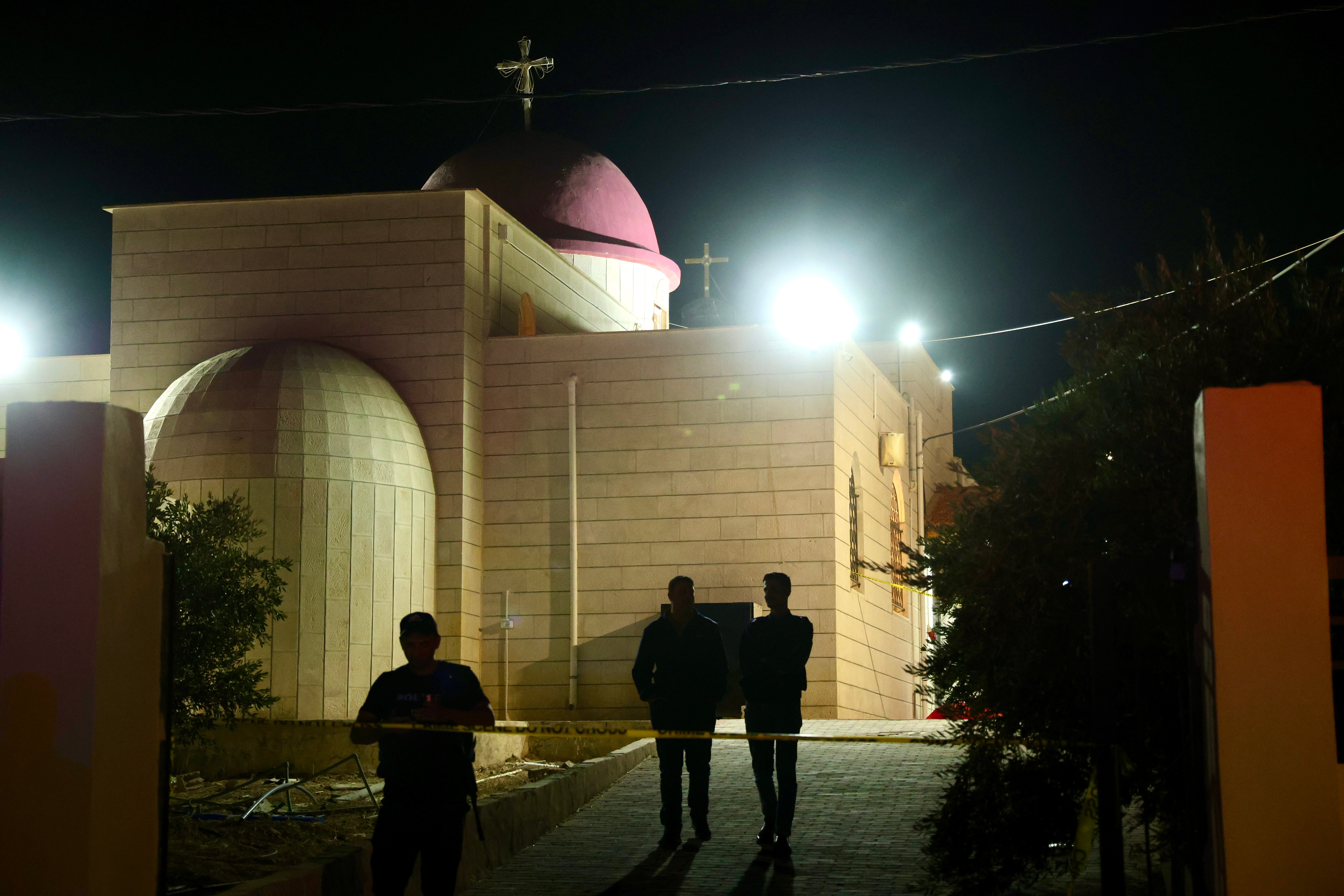
The unprecedented terrorist attack on a church in Jordan last month that killed nine people and injured at least 34 has raised understandable concern about the spread of Salafist violence targeting civilians in the country. It should raise even greater concern about how Jordan’s government has used billions in U.S. security assistance and more than a decade of support for countering violent extremism. The main perpetrator of the attack had only recently left prison following a terrorism conviction, yet the government has offered little explanation of how he went on to carry out the massacre. Instead, it launched kneejerk airstrikes on alleged Islamic State hideouts in Syria, killing seven civilians, three of them children, according to Syrian authorities. Both the failure to prevent the attack and the deadly retaliation expose a broader problem: security agencies empowered to raid, arrest, and punish, with little public accounting of whether their methods actually protect people. The unprecedented terrorist attack on a church in Jordan last month that killed nine people and injured at least 34 has raised understandable concern about the spread of Salafist violence targeting civilians in the country. It should raise even greater concern about how Jordan’s government has used billions in U.S. security assistance and more than a decade of support for countering violent extremism. The main perpetrator of the attack had only recently left prison following a terrorism conviction, yet the government has offered little explanation of how he went on to carry out the massacre. Instead, it launched kneejerk airstrikes on alleged Islamic State hideouts in Syria, killing seven civilians, three of them children, according to Syrian authorities. Both the failure to prevent the attack and the deadly retaliation expose a broader problem: security agencies empowered to raid, arrest, and punish, with little public accounting of whether their methods actually protect people. The sequence of events is revealing. On Oct. 23, three gunmen—brothers Hazza Mohammad and Mishal Mohammad and their brother-in-law Ahmad Sami Hussein—attacked mourners at a funeral. The event was taking place at St. George’s Greek Orthodox Church in Hmoud, a small village in the Karak governorate of southern Jordan; the gunmen lived in a nearby village. Karak itself is home to one of Jordan’s oldest Christian communities, dating back more than 1,500 years, and it has long been a model of Muslim-Christian cohesion. While there have been at least 12 attacks by Jordanian violent extremists in the past decade, all but one have targeted military and police sites. This attack was one of a very few in Jordan’s history to deliberately target Christians, who make up a mere 2.1 percent of the country’s population. Following a three-day search, authorities captured the three alleged perpetrators on Oct. 26, wounding them, one critically, in a shoot-out at an abandoned house in Karak, where they also recovered weapons and substantial ammunition. The government initially claimed that the church attack was random and opportunistic, but it later revised its claim to confirm that this was a planned attack, documenting preparations involving smuggled weapons, vehicles, assigned roles, and escape routes. The most damning facts to emerge, however, concern the authorities’ prior knowledge of Hazza Mohammad, the reported ringleader, and the police presence at the church before the attack. Jordanian authorities had released Hazza from prison less than six months ago, following the completion of a seven-year sentence for planning a terrorist attack and promoting Islamic State ideology. He presumably would have, or should have, remained under close surveillance by Jordanian authorities. On Oct. 26, a local woman reported that a police patrol was stationed at the church during Sunday worship services earlier this month, something that she had never seen before; a Karak churchgoer confirmed this in an Oct. 28 interview with the authors. On the same night as the arrests of the three men, the Jordanian government launched an aerial bombardment on four rural locations near Daraa and Suwayda in Syria. The attack is confirmed to have killed five family members in al-Tuff, three of them children; an 80-year-old man at a farm in al-Shiyah; and a 60-year-old man in Shahib. Local reporting suggested that the Jordanian Armed Forces appear to have been aware that women and children were at al-Tuff but hit it anyway. The government claimed that it had identified Islamic State cell hideouts connected to the attackers but presented no evidence establishing that connection. It said Hazza had called a number in Daraa shortly before the attack but did not establish whom he contacted or how that call connected the Syrian targets to the church shooting. Jordanian Interior Minister Mazen al-Faraya said the attackers shared the same ideology as the Islamic State and al Qaeda but acknowledged that investigators had not established whether they belonged to, or were influenced by, either organization. The Jordanian government acknowledged the civilian deaths that it caused and subsequently offered condolences to the victims, though not compensation. It insisted that it was targeting terrorists and that its strike had killed 20 Islamic State members and destroyed a weapons depot and some vehicles. To date, however, there has been no independent verification of any Islamic State deaths; Syrian rescuers at the site reported only the recovery of seven civilian bodies. The Jordanian government also claimed that it had coordinated the attack with the Syrian government, but Damascus denied this, condemned the breach of Syrian airspace—a clear violation of sovereignty—and summoned Jordan’s ambassador to deliver a formal protest. The two governments subsequently agreed to a joint security committee to establish the facts. Jordan’s security failures, both before and after the attack, come despite years of foreign investment in its security apparatus—and at a moment when Americans are turning away from foreign military aid. U.S. President Donald Trump announced in early November that billions in annual aid to Israel would be terminated; this would directly impact the military aid the United States allocates to Jordan and Egypt as their “peace dividend” for entering into peace agreements with Israel. As part of this understanding, the U.S. government has provided almost $5 billion in military assistance to Jordan since 2015, alongside substantial economic assistance. Public records document hundreds of millions of dollars in surveillance-related programs, including more than $234 million between 2009-2021 for the Jordan Border Security Program and additional assistance for intelligence and surveillance. Separately, public reporting establishes that the CIA funds Jordan’s General Intelligence Directorate, which it helped establish, though it provides no public information about the amount of its support. European governments, the European Union, and Canada also have granted roughly $200 million since 2016 to support Jordan’s policing, intelligence gathering, surveillance, border security, and military. However, the Jordanian government has provided no meaningful accounting about how it has used these generous foreign resources to protect its citizens, particularly from terrorist violence. Its “Countering Violent Extremism” (CVE) unit, funded by the State Department and the European Union, offers almost no information about its activities, its budget, or its staff, despite its 11 years in operation. Established in 2015 under the Ministry of the Interior, the program was bounced to the Ministry of Culture in 2016 and then to the prime minister’s office in 2020. The prime ministry’s website links the unit to a 2018 report, while a recent official news item describes its director attending a conference in Japan. Even the U.S. State Department issued a rare rebuke about Jordan’s unit in a 2023 report, citing the government’s lack of a “sustained level of coordination or responsiveness… for CVE efforts,” and noting the “numerous Jordanian government stakeholders with equities in PVE [preventing violent extremism], making strategic collaboration by the donor community challenging.” What little we do know about Jordan’s CVE effort is that it has relied extensively on a heavy-handed security approach while neglecting the economic, political, and social grievances that researchers consider essential to address in countering radicalization. A comprehensive 2025 study of Jordan’s response to violent extremism found extensive reliance on preventive raids and arrests and abuse of overbroad anti-terrorism laws. It also documented overlapping military, police, and intelligence operations with little transparency as well as broad intelligence agency veto powers over civil society prevention programs. This same security apparatus has instead prioritized shielding the monarchy from political dissent. Over the past five years, the government has carried out mass spying and arrests of teachers, doctors, bus drivers, and supporters of Palestine who have protested lack of democracy and economic injustice in the country, “preemptively” arresting those merely planning to attend protests, shuttering the teacher’s union, prosecuting the leadership of the country’s human rights body, dissolving 19 political parties, and jailing members of the country’s now-banned Muslim Brotherhood organization. Jordan needs to come clean about how a previously convicted extremist carried out an attack just after his release, what rehabilitation he received, and how authorities assessed and monitored his risk after release. It must also produce the evidence that it relied on to justify its bungled strike in Syria and identify the security reforms that it will make to protect Jordanians, in particular its religious minorities. Such accountability will require broader democratic reform to make security agencies answerable to the citizens that they are supposed to protect, rather than the monarchy.
Where Is U.S. Security Assistance to Jordan Going?
Full Article
Original Source
Read the full article at Foreignpolicy →KhanList aggregates and links to publicly available news content. We do not host full articles from third-party sources. Always verify important information with original sources.