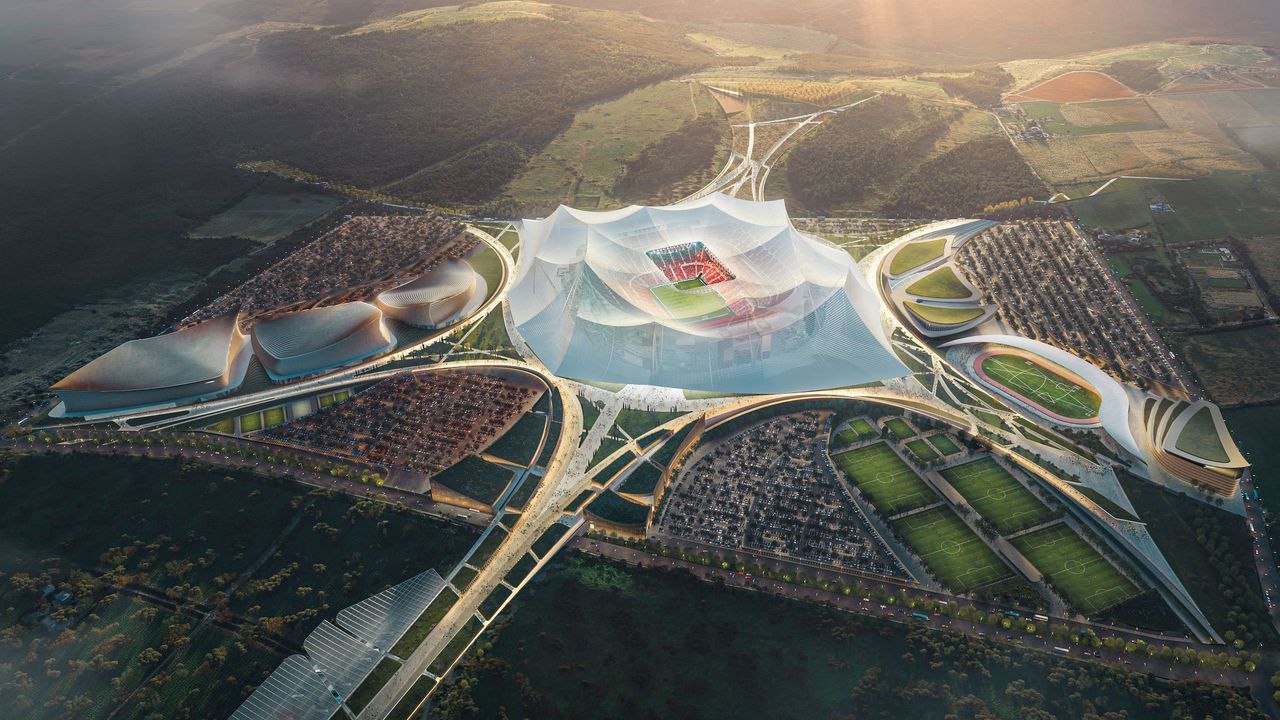
With the 2026 tournament over, everyone is asking: Where is the next World Cup?The 2030 World Cup will be a unique one, set across Spain, Portugal, and Morocco—repeating the three-country format from this year's Cup—but the first few games will begin an ocean away, with a match each in Uruguay, Argentina, and Paraguay. No World Cup has ever spanned six countries and three continents, but this first-ever approach arrives just in time for the 100th anniversary of the tournament, which began in South America in 1930.Uruguay won the first World Cup on home soil that year, at the Estadio Centenario in Montevideo—still the only stadium FIFA has ever named a Historical Monument of World Football, designated in 1983. That final game (a matchup with neighboring Argentina) was nearly derailed by an argument over whose ball to use, settled only when the teams agreed to play with Argentina's in the first half and Uruguay's in the second. Argentina led at the break, but Uruguay came back to win 4-2. A century later, fans will be looking forward to more edge-of-your-seat games.Here's what we know about the 2030 World Cup.Centenario Stadium in Montevideo—where Uruguay won the very first World Cup in 1930 on home soil—will host the first match of the 2030 World Cup. GettyWhen and where is the next World Cup?The tournament is coming home for the centennial: On June 8, 2030, Uruguay will play the opening match at Centenario Stadium in Montevideo, with the next two games unfolding the same weekend in Argentina's Buenos Aires and Paraguay’s capital, Asunción. (As with all six hosts, these three teams have qualified automatically.) After those three games, the squads—and any fans chasing the full schedule—will face traveling some 6,000 miles to reach the group stage games in Europe and North Africa. FIFA says it has built in extra rest days, but no World Cup has ever asked its teams to switch continents mid-tournament, and the players will likely feel it. The date and location of the first match hosted in Europe/North Africa has yet to be confirmed.Which teams are playing in the 2030 World Cup?The 2030 tournament is big: 104 matches over about six weeks, nearly all of them in the three main host countries, ending with the final on July 21, 2030 (and that location to be determined; more on that below).It may get even bigger: South America's soccer body, CONMEBOL, wants to grow the field from the 48 teams in this tournament to a whopping 64, and FIFA's president signaled in mid-July that he'll at least hear the idea out once this summer's World Cup wraps.Estádio da Luz in Lisbon (pictured) will host games along with Porto's Estádio do Dragão. GettyWhich cities will be hosting the 2030 World Cup?Hosting for the first time since 1982, Spain gets the largest slice of the games, with Madrid and Barcelona at the forefront and additional matches spread across the country; the exact list of Spanish cities is still being finalized. Portugal, hosting for the first time ever, will hold games in Lisbon and Porto.Morocco will make history as the first North African host and the second on the African continent (South Africa hosted in 2010), with matches spread across six cities from Tangier to Agadir. Outside Casablanca, in Benslimane, the country is building the 115,000-seat Grand Stade Hassan II, a 115,000-seat arena shaped like a traditional Moroccan tent that will be the largest soccer stadium in the world.And of course, the South American capitals hosting opening matches will go all in on the experience, even if only for one game apiece: Montevideo’s Centenario closes later this year for a 30-month overhaul timed to the anniversary that will add a roof to every stand (except for its tower), and increase capacity from 60,235 to 63,000.Spotify Camp Nou Stadium in Barcelona is competing with its Madrid and Casablanca counterparts to host the final. GettyTangier's Al Boraq trains in Morocco are the first high-speed trains on the continent—and will make travel between games easier. GettyWhere will the final match take place?The fiercest contest right now isn't on the field—it's over who hosts the final. Three stadiums want it: Madrid's Santiago Bernabéu, a rebuilt Camp Nou in Barcelona, and Morocco's new Grand Stade Hassan II. Spain has spent years assuming the final was theirs, but by this summer the Spanish press began admitting, through gritted teeth, that Casablanca was pulling ahead in the competition. FIFA won't officially decide until December 2026. Geography, at least, is on the fans' side, however things shake out: Spain and Morocco nearly touch at the Strait of Gibraltar, close enough that you could catch a match in Seville and another across the water in Tangier the same day—an hour by ferry, or a couple of hours on Al Boraq, the first high-speed train in Africa.Where is the next World Cup in 2034?After 2030, the games head to Saudi Arabia. The 2034 World Cup host was awarded the same day that the 2030 location was ratified. But that is 2034's story. This one starts where the whole thing did.
Where Is the Next World Cup? Plus Everything Else We Know So Far
Full Article
Original Source
Read the full article at Cntraveler →KhanList aggregates and links to publicly available news content. We do not host full articles from third-party sources. Always verify important information with original sources.