
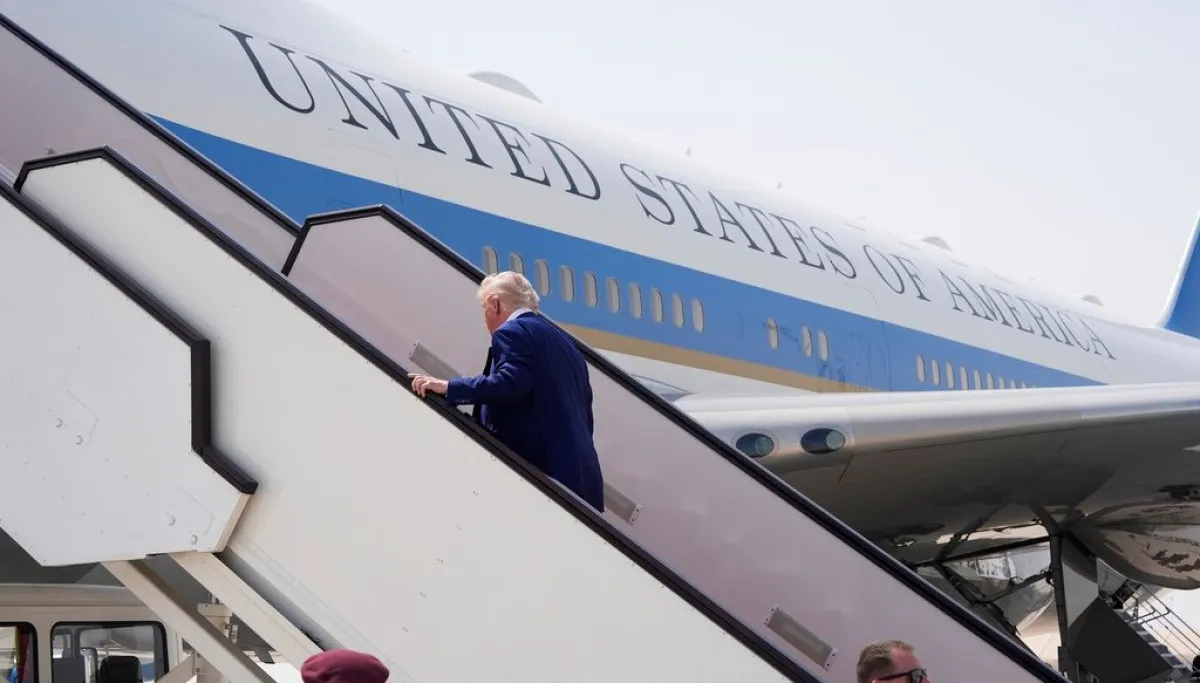
President Donald Trump pledged at the beginning of September to spend the final month before the midterm elections traveling the country to rescue vulnerable Republican candidates, promising to visit 35 races in roughly 30 days.The president has made good on that promise in part by concentrating his appearances in a handful of states, with Texas receiving the most attention, followed by Ohio and Georgia. His itinerary offers a glimpse into where Republicans believe they need the most help, and where they think Trump can provide it.Trump said during remarks at the White House that he planned to visit all 35 targeted races before Election Day, Nov. 3, and supplement his appearances with a series of virtual town halls. “I’m going to go to every one of those 35 places, and we’re going to see if we can get everyone elected,” Trump said. “We’re going to really work hard. So we’re going to take that little, that final 30 days.”As of Oct. 30, Trump had made five campaign stops in Texas, three in Ohio, and two in Georgia. He also visited South Carolina, Florida, Kansas, and Iowa twice each.Christopher Devine, a political science professor who researches elections and campaign strategy, said presidential travel schedules can offer a useful indication of how candidates and their advisers view the political landscape.“Unlike money, time is a finite resource, and everybody gets the same amount of it,” Devine told the Washington Examiner.Where Trump chooses to spend his time, he said, can signal which candidates Republicans believe need assistance and where the president thinks he can be helpful.That doesn’t necessarily mean the states receiving the most attention are the most competitive, however. It may also reflect where Trump believes his popularity gives him an advantage.Texas and Ohio draw the most attention Texas has been Trump’s most frequent destination, with stops in Denton, San Antonio, Lubbock, and Corpus Christi. The state is facing an unexpectedly competitive Senate contest between Republican candidate Ken Paxton and Democrat James Talarico. The race has become one of the country’s most closely watched and expensive contests of the 2026 election cycle. RealClearPolitics‘s polling average through Oct. 28 showed Talarico leading Paxton by roughly one percentage point, 48.8% to 47.0%. Election analysis at the Cook Political Report rates the contest a toss-up. If Talarico were to win the Senate race, he’d be the Lone Star State’s first Democratic Senator after roughly three decades.Ohio, where Trump has held three rallies, is another critical battleground. The state’s special Senate election pits Republican incumbent Sen. Jon Husted (R-OH) against former Democratic Sen. Sherrod Brown, who is seeking to reclaim the seat.Despite Trump’s clear victory in Ohio in 2024, Brown has remained competitive. The RealClearPolitics average showed Husted leading Brown by only one percentage point, while Cook also rates the race a toss-up.Both states offer Republicans a reason to deploy the president. Their Senate contests could help determine which party controls the chamber next year, and both feature Republican candidates facing serious challenges in states Trump carried in 2024.Georgia, meanwhile, has received two visits, in Dalton and Perry, despite a more difficult outlook for Republicans in its Senate contest. Republican Rep. Mike Collins (R-GA) is challenging Democratic Sen. Jon Ossoff (D-GA), whose reelection campaign has maintained a substantial polling advantage. The RealClearPolitics average showed Ossoff ahead by 8.2 points, 51.2% to 43%, and Cook rates the race Likely Democratic.Trump’s decision to campaign there anyway could reflect the importance of maintaining Republican enthusiasm in a state that has become increasingly competitive in recent presidential elections. He carried Georgia by a narrow margin in 2024.Other states receiving multiple visits include Iowa and Kansas, both of which have competitive Senate contests. RealClearPolitics’ averages showed Republican Ashley Hinson leading Democrat Josh Turek by just half a percentage point in Iowa, while Democrat Adam Hamilton held a 0.2-point advantage over Republican Sen. Roger Marshall in Kansas. Both races are rated toss-ups by Cook.South Carolina and Florida, which also received two visits apiece, offer a somewhat different picture. Republican Sen. Darline Graham (R-SC) is facing Democrat Annie Andrews in South Carolina, where recent polling has suggested the race could be neck-and-neck. In Florida, Republican incumbent Sen. Ashley Moody (R-FL) held an 8.4-point advantage over progressive Democrat Angie Nixon. Cook rates South Carolina Lean Republican and Florida Likely Republican.The distribution of Trump’s appearances also raises questions about where Republicans believe the president could be more of a liability than an asset. Notably, Trump has not traveled to Maine, where longtime Republican Sen. Susan Collins (R-ME) is facing a tight race against her progressive challenger Troy Jackson.Maine is an interesting case for a few reasons. Harris won the state by a narrow margin in the 2024 election, while Collins also has built a reputation as a moderate and independently minded Republican. Devine suggested the decision to stay away from certain states could be deliberate, particularly when a Republican candidate might benefit from distancing themselves from the president.His absence could allow voters to evaluate Collins independently of their opinions of Trump, Devine suggested.“He’s going to places more so where he is more popular, so at least a somewhat red state or purple state like Georgia, Ohio, for example,” Devine said. “That would indicate that he believes he’s more of an asset there.”Do the rallies actually work? Even if Trump’s travel schedule reveals where Republicans see vulnerabilities, it doesn’t necessarily mean his appearances will make much difference on Election Day.Devine said there is relatively little evidence that presidential campaign visits consistently change election outcomes. He pointed to the 2018 midterm elections, when Trump also traveled extensively to campaign for Republican candidates but appeared to have little measurable effect on their performance.One explanation is that rallies largely attract voters who have already decided whom they support, leaving little opportunity to persuade undecided voters.“Rallies tend to attract the true believers, and so there’s not much room to persuade them,” Devine said.There can still be a mobilization benefit, he added, as appearances encourage supporters who might otherwise stay home to turn out. News coverage and social media can also expose Trump’s message to voters who did not attend the events themselves.Devine’s own research into the 2024 election found that Trump’s visits could have a greater effect when he campaigned in places where Harris was not making appearances.But he cautioned against interpreting the limited impact of campaign visits as a reason for candidates to stop traveling altogether. Campaign activities, including rallies and advertising, often serve to maintain a candidate’s standing rather than produce dramatic gains.2026 MIDTERM ELECTIONS LIVE UPDATES: LATEST NEWS, RESULTS AND ANALYSIS“The function of these activities is mostly to maintain your current position or at least prevent the other side from getting an advantage,” he said.For Trump, then, the extensive travel may be less about turning voters who oppose him into supporters than ensuring that Republicans who already do are motivated to show up.
Where has Trump traveled the most ahead of the November election?
Full Article
Original Source
Read the full article at Washingtonexaminer →KhanList aggregates and links to publicly available news content. We do not host full articles from third-party sources. Always verify important information with original sources.