
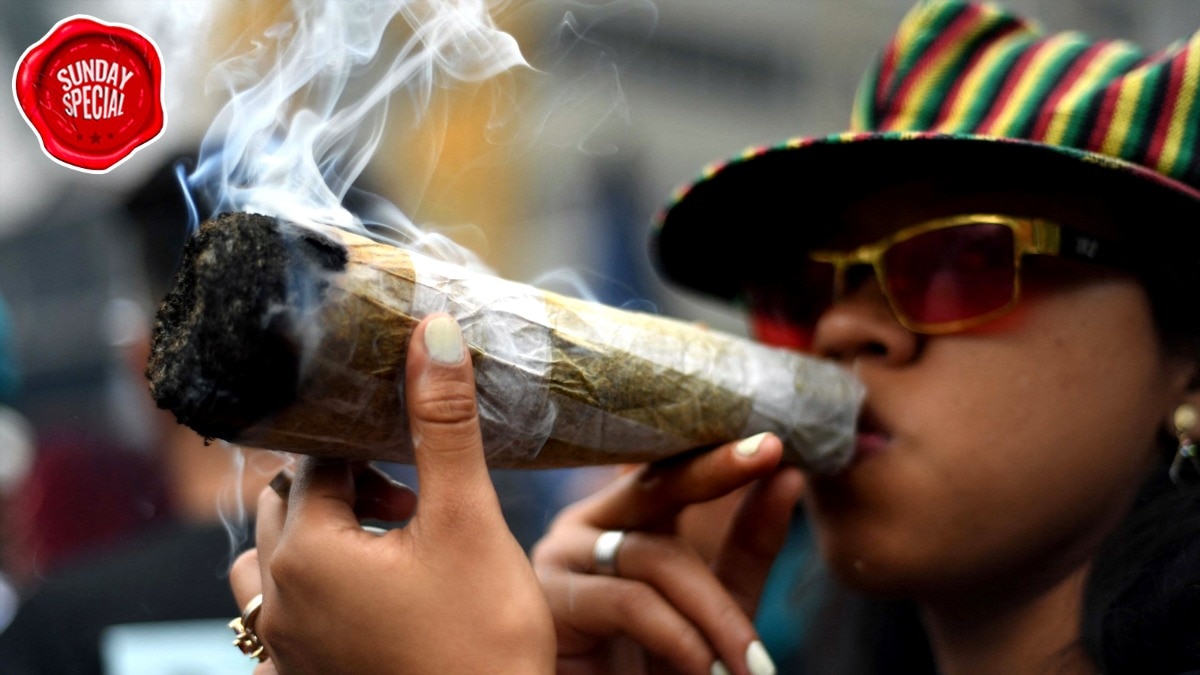
"It's not a shortage, it's a drought!" said a Delhi-based marijuana connoisseur, describing how difficult it has become to score a variety of pot in the national capital for the past couple of months. For Delhi's stoners, the familiar ritual of texting a "contact" to get a stash of OG Kush and hydro ganja, two premium varieties of marijuana, delivered to their doorstep is no longer as easy as it used to be.The expensive, high-potency hydroponic weed that circulates through the capital's underground market is becoming difficult to find. In Mumbai and Bengaluru too, people reported a similar squeeze. A stoner from Kolkata confirmed that the rates have shot up by over 50% due to the scarcity. The cheaper, locally grown varieties of ganja, which are often spiked with other cheap drugs, are still around. But the imported and hydroponic cannabis that many affluent users prefer is running short in cities across India.A health warning upfront. We aren't promoting pot or any other drug, but reporting on the scarcity and probing if it has to do with the government's anti-narcotics drive.The scarcity is such that it has unsettled both sellers and their customers. Delhi's stoners, who often channel Shaggy from Scooby-Doo, have suddenly traded their laid-back vibes for full-blown panic, and the mission is to find weed. Some peddlers India Today Digital spoke to have decided that keeping a low profile is better than risking a police raid. The shortage has reportedly been building for over two months, with some stoners and sellers pointing to intensified checks on roads and at interstate borders. The timing of the disappearance of ganja comes against the backdrop of the government's renewed push against narcotics. Just over a month ago, in the first week of September, Union Home Minister Amit Shah announced the roadmap to make India drug-free by 2029. He said more than 1.19 crore kilograms of drugs, valued at about Rs 1.89 lakh crore, were seized between 2014 and 2024, while over 48.66 lakh kilograms were destroyed.The Drug-Free India campaign was launched in 2021, but it has been given a renewed push and a deadline now. DCP Gaurav Gupta, who heads the Delhi Police's Anti-Narcotics Task Force (ANTF), told India Today Digital that the current shortage of hydro ganja is linked to the national initiative, and the Delhi Police is also maintaining additional vigilance.What is evident from accounts gathered by India Today Digital from Delhi-NCR's underground market is that sourcing the more expensive varieties of ganja has become harder, even as the demand for them persists.While ganja is one of the "drugs" under scanners, its consumption is more common than one might think. Cannabis products such as ganja and charas are banned under India's NDPS Act, 1985, but bhang, made from the plant's leaves, is legal. When we asked a pool of dozens of people if they had ever smoked pot, nearly half said they had either tried it at least once or used it occasionally or regularly. Given the legal implications and the sensitive nature of the subject, we have not named the users in this story. A representative setup showing how hydroponic cannabis is grown indoors. Weed cultivated this way is often sold as a premium product because of its perceived potency, and can be significantly more expensive than regular ganja. (Image: AFP) WHAT'S OG KUSH AND HYDRO GANJA AND WHY ARE THEY OUT OF REACH?To understand the shortage, it is important to know what sets hydroponic cannabis and premium OG Kush apart from the locally grown ganja that circulate in India's underground market.Hydroponic weed, or hydro ganja, is cannabis cultivated without soil, using water containing dissolved nutrients. Growing it indoors requires control over conditions such as lighting, temperature and water supply. The method can allow growers to manage the growing environment closely, and some varieties produced this way are sold at a premium price.OG Kush, meanwhile, is a cannabis strain whose name has acquired an almost mythical status in weed culture. The meaning of "OG" has many versions, with interpretations like "Original Gangster" to "Ocean Grown" and "Original Grower". Associated with California's cannabis scene in the 1990s, OG Kush is known for its distinctive earthy, pine-like aroma and potent effects. Its reputation was reinforced by its association with the US's West Coast hip-hop and popular cannabis culture.While OG Kush is a particular strain, hydroponics is a cultivation method. In the Indian market, however, the terms OG and hydroponic are often used loosely, sometimes interchangeably. The labels don't establish where a particular batch was grown or how potent it is.Both hydroponic and OG ganja are typically sold at considerably higher prices than ordinary desi cannabis. Their appeal is because of their potency, quality, and scarcity, as well as the cultural cachet attached to particular strains. It is worth noting that OG and hydroponic marijuana are costly and have a niche following. A gram typically makes just four to five joints, making it an expensive habit.Who consumes it? Think iPhones, Nike sneakers, Uniqlo fits, Coach wallets and Hugo Boss perfumes — a relatively affluent crowd with expensive tastes. If just 0.1% of India's population can afford this premium weed, that's still lakhs of people, which is why it is a multi-hundred-crore economy, if not thousands of crores.The latest example of how huge the economy is can be estimated by a single raid in October first week, in which about 140 kg of hydroponic cannabis, valued at roughly Rs 140 crore, was seized by the customs authorities in Delhi. Similar news came from Bengaluru in the same week.A pothead, currently based in Delhi and familiar with the market, said, "Before the current shortage, premium cannabis could cost around Rs 1,000-1,300 per gram, depending on its quality, strain and the city. The price almost doubled, before good ganja became difficult to obtain altogether in the last two months."By comparison, the person said, Rs 2,000 can buy around 20 grams of some cheaper, locally grown varieties. These are informal market estimates, not standardised prices, but they show the divide between the premium segment and the rest of the market.A LOCKDOWN OF DRUGS IN DELHI-NCRA pot peddler based in Noida described the situation across Delhi-NCR as a "lockdown of drugs", with movement between Noida-Delhi-Gurgaon becoming more difficult because the checking by authorities has been ramped up. The plug told India Today Digital, "A peddler operating in Noida can no longer travel to Gurugram as easily, and the reverse journey has become equally difficult. Local police are sometimes cooperative, but checks have become more intensive."Hydroponic weed and OG were still available, the supplier said, "but at prices of around Rs 3,000 per gram". That's more than double the earlier price.For now, the supplier said, "Indian-grown weed is the more readily available option for users."Speaking to India Today Digital, DCP Gaurav Gupta of Delhi Police's anti-narcotics task force said, "We have been conducting continuous operations and recovering significant quantities of drugs. This acts as a major deterrent to those bringing them onto the market. Hydroponic cannabis is very expensive, costing almost three times as much as regular ganja. When a consignment is seized, traffickers suffer a huge financial loss. This discourages them from continuing the trade.""The crackdown has been continuing, and these factors have contributed to the disruption in supply," DCP Gupta added.But among peddlers, whose networks might be funding far more serious crimes, and casual smokers who see a little puff-puff-pass as harmless fun, hope remains. They are waiting for the OG drought to end and the good times to roll again. The Noida-based plug told India Today Digtal, "Cops have been checking even tourist vehicles coming down from the hills in Himachal Pradesh, making the journey back with a stash trickier than a mountain road."Ali, a peddler based in east Delhi who sells varieties of ganja such as Idukki, Shillong and Mango, as well as his own homegrown cannabis, said he had been lying low for several weeks. Even his own stock was not something he was eager to sell. "I'll sell it somewhere nearby. Sending it farther away is risky," he said.Ali said supplies coming from Himachal Pradesh, Uttarakhand and Nepal had been affected for more than a month. Checks at interstate borders have made sourcing from the north more difficult, while tighter surveillance along the Nepal border had complicated the other route. "Every other day, you see reports of seizures of charas, ganja, cocaine, MDMA or acid," Ali told India Today Digital.The constant reports of enforcement action had made Ali cautious. "It's better to wait for a while. I've stopped selling for now," he said.His phone, however, has not stopped ringing. Ali said customers continued to call and message the number he had used to stay in touch with them. He was considering switching his phone off altogether, he added. An OG Kush in full flower. (Image: Getty Images) THE LONG ARM OF THE LAW AGAINST GANJAThe "difficulties" described by peddlers come against the backdrop of seizures and enforcement action against hydroponic cannabis by law-enforcement agencies.In July 2025, Maharashtra Chief Minister Devendra Fadnavis told the state Assembly that hydroponic weed had become a serious challenge for law enforcement. He pointed to the easy availability of cannabis in Thailand and parts of the US as factors that had made it easier for traffickers to source and smuggle the product into India.Courier and postal services have been used to move consignments, according to the account presented in the Maharashtra Assembly.On drugs being delivered to doorsteps through Porter and other quick-delivery services, DCP Gaurav Gupta said, "We are very much aware of this modus operandi. We are in touch with the nodal officers of these delivery platforms at the highest level, and we have already held three meetings with them to sensitise them.""Ultimately, these delivery personnel also become our [police's] eyes and ears. There may be a few black sheep in every organisation who operate out of greed, but we have well-defined intelligence inputs and act on them to catch those involved," the senior Delhi Police officer told India Today Digital.On whether it is difficult to trace those using Porter or other apps for drug transportation, the officer said, "It is difficult to trace such deliveries because the delivery person does not have a scanning device. They simply pick up a package from one location and deliver it to another. It also depends on the intelligence of the delivery person."This modus operandi reportedly evolved during the Covid lockdown and its aftermath, as per accounts of anonymous social media accounts on platforms such as Reddit.AUTHORITIES' PR DIMENSION BEHIND GANJA SEIZURES; POTHEADS ANXIOUSA Delhi-based customs official, requesting anonymity, told India Today Digital that there is a public-relations (PR) dimension to the latest announcements of the seizure of drugs like ganja. "Seizures and destruction drives allow authorities to demonstrate that action is being taken against narcotics... The publicity around the latest narcotics seizures is a part of the government's larger anti-drug push," the customs official told India Today Digital.India has long seen reports of seized cannabis allegedly being consumed by rats while in police custody or storage. Against that backdrop, the publicised destruction of expensive hydroponic cannabis stands out as a departure from the norm.Whether these operations will produce a sustained reduction in supply and consumption is another question.A Mumbai-based pothead who prefers OG Kush said the product had not vanished entirely from the city, but there was anxiety among consumers over police checks and rapid drug-screening tests. Such concerns are not confined to Mumbai. Police in other cities have carried out roadside screening operations using portable drug-testing kits.In one reported operation on Gujarat's Sarkhej-Gandhinagar Highway from December 2025, police and forensic personnel checked motorists, collected saliva samples from drivers they considered suspicious and used kits designed to detect substances including cannabis, cocaine, amphetamines and opioids.The Mumbai-based pothead also recounted a similar police test involving his friend in Bengaluru in September, who allegedly paid a bribe of Rs 5 lakh to avoid the consequences after he was tested positive for ganja. The person said, "Such screening was not present earlier. But now, there is a risk of being caught instantly."These accounts point to the anxiety among users.For the premium cannabis market, the combination of scarcity, higher prices and anxiety due to law being enforced, has changed the calculations for both sellers and consumers. Some users whom India Today Digital spoke to have switched to cheaper varieties of marijuana though. Police destroy seized marijuana in a furnace. Images of such destruction drives have become more frequent in recent months amid the government's Drug-Free India campaign. (Image: AFP) GOVT AIMS DRUG-FREE INDIA BY 2029Union Home Minister Amit Shah's Drug-Free India campaign has set an ambitious target. But the current shortage, as described by users and sellers, offers only a limited view of what the campaign or wider enforcement efforts are achieving.There is evidence of seizures, reports of more intensive checks and accounts of disruption in the supply chain.The market's response will matter as much as the immediate disruption. If demand persists, as Delhi-based peddler Ali said, "sellers might seek alternative sources or customers might move to substitutes." None of those outcomes can be assumed in advance, but they are reasons not to confuse a temporary supply crunch with the disappearance of the market.DCP Gupta told India Today Digital, "Delhi is surrounded by three states, and our borders are not completely watertight. There are several porous stretches. Between Mundka and Kanjhawala (in north-west Delhi), there are at least 10 such porous stretches. Things do move through these routes. However, I would not be able to comment on whether there has been a change in the routes being used."For now, the accounts from Delhi-NCR, Mumbai, and Kolkata describe a premium cannabis market under pressure. The cheaper desi stuff is still around, but the supply chain for premium stash, it seems, has gone up in smoke.- Ends(With inputs from Avinash Kateel)
Where has Delhi's hydro ganja gone? There's a weed drought, say stoners
Full Article
Original Source
Read the full article at Indiatoday →KhanList aggregates and links to publicly available news content. We do not host full articles from third-party sources. Always verify important information with original sources.