
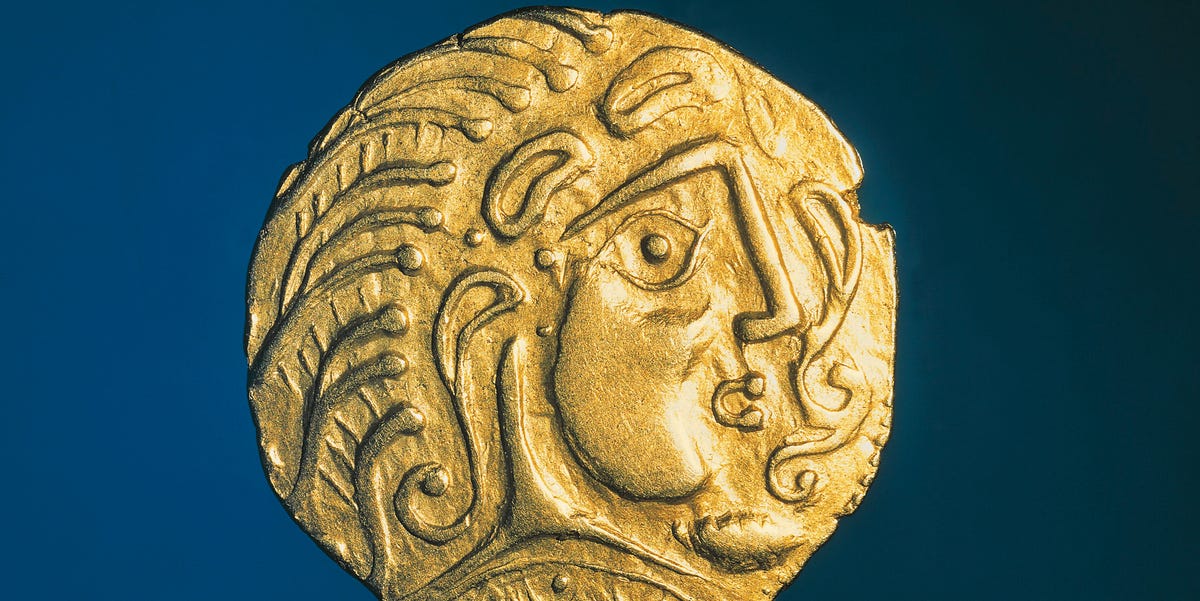
3 min readHere’s what you’ll learn when you read this story:New evidence discovered at the pre-Roman Gallic city of Corent could rewrite the history of ancient coin production.Intriguing clues point to the world’s most impressive coin operation of its age.Metalworkers there crafted massive numbers of gold and silver coins.Tucked alongside an excavated stone wall in France measuring up to two feet thick in places, archaeologists discovered clues they believe hint at the largest coin production site in the world during the first century B.C.E. They even found coin-making debris to back it up.Archaeologists have scoured portions of the 5,000-square-foot site for two decades, but it wasn’t until this past summer that a portion of the pre-Roman history of ancient Gaul, at Corent in central France, grabbed their attention. Experts previously believed modest bronze coin production happened at the site, but now they’re convinced it was Gaul’s most impressive center for gold and silver coin minting.The leader of the excavation, Matthieu Poux, said that he believes this discovery offers “not only [the largest known coin workshop] in Celtic Europe, but in the entire ancient world,” according to Le Monde.Beyond the actual coin production, Poux said finding such an impressive minting site could rewrite the history of Gaul before the Romans conquered it, casting Corent as a Gallic stronghold and the seat of the Celtic Arverni tribe’s economic power.Prior excavations at the site revealed a sanctuary, an assembly building, market areas, craft workshops, and housing. In 2024, archaeologists found coin blanks, a fragment of a coin die, and metal waste, all highlighting bronze coin production there. But in 2026, gold and silver joined the bronze. And there wasn’t much waste to speak of. For a known metalworking site, experts said surprisingly few scraps remained from the height of production before the Gallic Wars started in 58 B.C.E., as workers potentially funneled the spent materials back into the production of additional coin blanks.The most concrete example found in 2026 comes from the discovery of a lead disc. The disc still bears impressions from coin punches that match a known Arvernian “stater”—the gold or silver coin that anchored Celtic trade. Close inspection shows a horse, its rider, a wheel, and a head, images that mimic known Arvernian gold and silver staters during the same period. Experts believe the coin-makers used lead as a sort of proof of design, an inexpensive way to test out a fresh coin look before minting a gold or silver version.The team discovered an impressive amount of flint near the newly discovered workspaces, which included furnaces and access to water. Flint combines with salt to help process raw materials for final use, and it’s evidence that Corent workers may have processed precious metals before punching the actual coins. If researchers led by experts from Lumière University Lyon 2 can garner proof of that theory, it will show that Corent was Gaul’s most impressive seat of economic power and finally reveal the true capital of pre-Roman Gaul.Even after 25 years of investigation, Corent has plenty left to give up—not least whether these latest finds truly mark one of the ancient world’s greatest mints.Tim Newcomb is a journalist based in the Pacific Northwest. He covers stadiums, sneakers, gear, infrastructure, and more for a variety of publications, including Popular Mechanics. His favorite interviews have included sit-downs with Roger Federer in Switzerland, Kobe Bryant in Los Angeles, and Tinker Hatfield in Portland.
Where Did These Ancient Coins Come From? Archaeologists May Have an Astounding Answer.
Full Article
Original Source
Read the full article at Popularmechanics →KhanList aggregates and links to publicly available news content. We do not host full articles from third-party sources. Always verify important information with original sources.